
[Paper Review] INSTRUCTEVAL: Towards Holistic Evaluation of Instruction-Tuned Large Language Models
InstructEval provides a holistic benchmark suite to evaluate instruction-tuned LLMs across problem-solving, writing, and alignment to human values, analyzing the impact of pretraining, instruction data, and training methods.
Instruction-tuned large language models have revolutionized natural language processing and have shown great potential in applications such as conversational agents. These models, such as GPT-4, can not only master language but also solve complex tasks in areas like mathematics, coding, medicine, and law. Despite their impressive capabilities, there is still a lack of comprehensive understanding regarding their full potential, primarily due to the black-box nature of many models and the absence of holistic evaluation studies. To address these challenges, we present INSTRUCTEVAL, a more comprehensive evaluation suite designed specifically for instruction-tuned large language models. Unlike previous works, our evaluation involves a rigorous assessment of models based on problem-solving, writing ability, and alignment to human values. We take a holistic approach to analyze various factors affecting model performance, including the pretraining foundation, instruction-tuning data, and training methods. Our findings reveal that the quality of instruction data is the most crucial factor in scaling model performance. While open-source models demonstrate impressive writing abilities, there is substantial room for improvement in problem-solving and alignment. We are encouraged by the rapid development of models by the open-source community, but we also highlight the need for rigorous evaluation to support claims made about these models. Through INSTRUCTEVAL, we aim to foster a deeper understanding of instruction-tuned models and advancements in their capabilities. INSTRUCTEVAL is publicly available at https://github.com/declare-lab/instruct-eval.
Motivation & Objective
- Assess the holistic capabilities of instruction-tuned LLMs beyond traditional benchmarks.
- Analyze how pretraining foundation, instruction data, and training methods influence performance.
- Identify which factors most effectively scale model capabilities.
- Provide open-source access to a comprehensive evaluation framework and leaderboard.
Proposed method
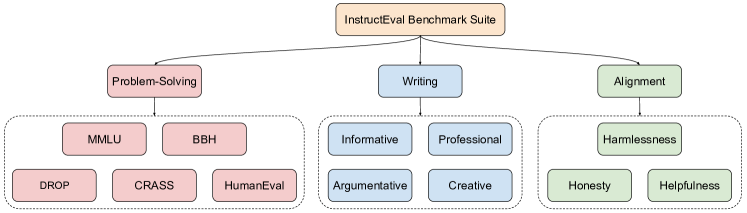
- Define a holistic evaluation suite covering problem-solving, writing, and alignment to human values.
- Use multiple objective and subjective evaluation methods including automatic and human-in-the-loop assessments.
- Compare over 60 open-source instructed LLMs using standardized benchmarks (MMLU, BBH, DROP, CRASS, HumanEval, HHH, and an impact writing dataset).
- Analyze effects of foundation model size, instruction data quality, and training method (supervised vs RLHF, parameter-efficient fine-tuning).
- Investigate few-shot versus zero-shot performance and in-context learning effects across tasks.
Experimental results
Research questions
- RQ1How do instruction-tuning factors (foundational model, data quality, and training method) affect problem-solving, writing, and alignment performance?
- RQ2What is the relative importance of instruction data versus pretraining foundation in scaling performance?
- RQ3Can open-source instructed LLMs match or approach closed-source models in writing and alignment, and where do they lag in problem-solving?
- RQ4Do few-shot demonstrations consistently improve performance across tasks and models?
Key findings
- Instruction data quality is the most crucial factor for scaling performance.
- Open-source instructed LLMs excel in writing but show substantial gaps in problem-solving and alignment.
- Mimicking closed-source models via synthetic instructions yields limited benefits and can propagate biases/noise.
- Training method (e.g., RLHF) helps but generally has smaller impact than instruction data; parameter-efficient tuning scales well with model size.
- There is not a uniform benefit of few-shot demonstrations across tasks; benefits are task-dependent and sometimes negative.

Read this paper
Open the full text in the Nubint reader and ask about any passage as you read.
Read this paper on NubintThis review was generated by AI from the original paper. Please check the paper before citing it.