
[Paper Review] Instruction-Following Evaluation for Large Language Models
IFEval is an automatic benchmark to evaluate LLMs on verifiable instructions, reducing reliance on human or model-based judgments.
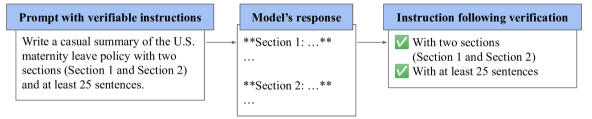
One core capability of Large Language Models (LLMs) is to follow natural language instructions. However, the evaluation of such abilities is not standardized: Human evaluations are expensive, slow, and not objectively reproducible, while LLM-based auto-evaluation is potentially biased or limited by the ability of the evaluator LLM. To overcome these issues, we introduce Instruction-Following Eval (IFEval) for large language models. IFEval is a straightforward and easy-to-reproduce evaluation benchmark. It focuses on a set of "verifiable instructions" such as "write in more than 400 words" and "mention the keyword of AI at least 3 times". We identified 25 types of those verifiable instructions and constructed around 500 prompts, with each prompt containing one or more verifiable instructions. We show evaluation results of two widely available LLMs on the market. Our code and data can be found at https://github.com/google-research/google-research/tree/master/instruction_following_eval
Motivation & Objective
- Motivate the need for standardized evaluation of instruction following in LLMs for safety and reliability.
- Introduce verifiable instructions to enable objective, automatic assessment.
- Construct a dataset of prompts with verifiable instructions and provide baseline results on popular models.
Proposed method
- Define verifiable instructions that can be objectively verified in responses.
- Create around 500 prompts each containing one or more verifiable instructions with 25 instruction types.
- Propose strict and loose instruction-following accuracy metrics to account for verification edge cases.
- Use prompt-level and instruction-level evaluations on two models (GPT-4 and PaLM 2 S).
- Describe prompt synthesis procedures including base prompts, few-shot filtering, and rephrasing steps.
Experimental results
Research questions
- RQ1Can instruction-following accuracy be measured objectively using verifiable instructions?
- RQ2How do different instruction categories affect model adherence to directives?
- RQ3What are the baseline instruction-following performances of widely available LLMs on verifiable instructions?
- RQ4How do strict and loose verification criteria compare in practice?
Key findings
- IFEval enables automatic verification of instruction-following for a broad set of verifiable prompts.
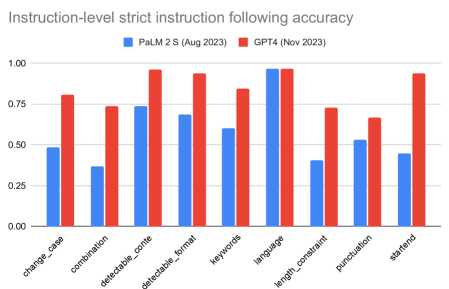
- GPT-4 achieves higher accuracy than PaLM 2 S on both strict and loose metrics in the reported baselines.
- Strict accuracy is lower than loose accuracy due to edge cases and verification challenges.
- There is variability in instruction adherence across instruction categories, as shown in the detailed category analysis.
- The evaluation framework is reproducible and the authors provide code and prompts publicly.
- The two evaluation metrics (strict and loose) help balance false positives and false negatives in verification.
Read this paper
Open the full text in the Nubint reader and ask about any passage as you read.
Read this paper on NubintThis review was generated by AI from the original paper. Please check the paper before citing it.