
[Paper Review] InstructP2P: Learning to Edit 3D Point Clouds with Text Instructions
InstructP2P is an end-to-end framework that enables text-guided 3D point cloud editing by fine-tuning a text-conditioned diffusion model (Point-E) using a newly constructed dataset of shape editing examples and LLM-generated instructions. It achieves joint geometry and color editing in a single forward pass, demonstrating strong generalization to unseen shapes and instructions despite limited training data.
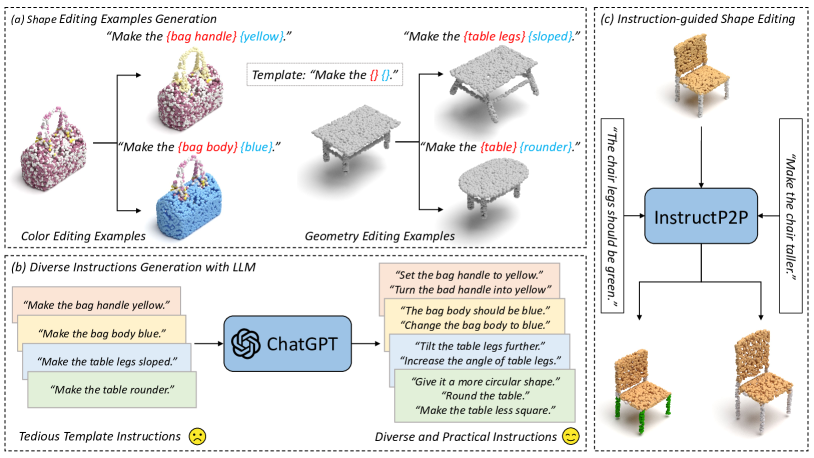
Enhancing AI systems to perform tasks following human instructions can significantly boost productivity. In this paper, we present InstructP2P, an end-to-end framework for 3D shape editing on point clouds, guided by high-level textual instructions. InstructP2P extends the capabilities of existing methods by synergizing the strengths of a text-conditioned point cloud diffusion model, Point-E, and powerful language models, enabling color and geometry editing using language instructions. To train InstructP2P, we introduce a new shape editing dataset, constructed by integrating a shape segmentation dataset, off-the-shelf shape programs, and diverse edit instructions generated by a large language model, ChatGPT. Our proposed method allows for editing both color and geometry of specific regions in a single forward pass, while leaving other regions unaffected. In our experiments, InstructP2P shows generalization capabilities, adapting to novel shape categories and instructions, despite being trained on a limited amount of data.
Motivation & Objective
- To enable intuitive, high-level text instruction-based editing of 3D point clouds, overcoming limitations of traditional geometry-only or non-intuitive learning-based methods.
- To address the lack of end-to-end frameworks that simultaneously edit both geometry and color using natural language.
- To improve generalization to unseen shape categories and diverse edit instructions through a data-augmented training approach.
- To bridge the gap between language understanding and 3D shape manipulation by leveraging vision-language models and diffusion priors.
Proposed method
- Fine-tune the 40M-textvec variant of Point-E, a text-conditioned point cloud diffusion model, to become an instruction-conditioned shape editor.
- Construct a new shape editing dataset by combining PartNet segmentation data, off-the-shelf shape programs, and diverse edit instructions generated via ChatGPT.
- Use CLIP text embeddings of instructions as conditional inputs during fine-tuning, aligning language semantics with 3D shape edits.
- Train the model jointly on geometry and color editing tasks to enable simultaneous manipulation in a single forward pass.
- Apply a point cloud matching procedure before evaluation to ensure accurate Chamfer-L1 and RGB error computation.
- Leverage the strong 3D generation priors of Point-E to enable zero-shot generalization to unseen shapes and instructions.

Experimental results
Research questions
- RQ1Can a text-conditioned point cloud diffusion model be effectively fine-tuned to perform joint geometry and color editing based on natural language instructions?
- RQ2How effective is the use of LLM-generated instructions in improving model generalization across diverse edit types and unseen shape categories?
- RQ3What is the impact of joint training on geometry and color editing compared to separate training on each modality?
- RQ4How does the choice of conditional input (text vs. image embeddings) affect generalization and performance?
Key findings
- InstructP2P achieves significantly lower Chamfer-L1 distance and RGB error than the DDIM inversion baseline, demonstrating superior performance in both geometry and color editing.
- The model trained with LLM-generated instructions generalizes better to free-form, diverse instructions than a model trained only on template-based instructions.
- Joint training on geometry and color editing enables a single model to perform both tasks effectively, while separate training leads to failure in one modality.
- Fine-tuning from the text-conditional Point-E variant (40M-textvec) yields better generalization than other Point-E variants using image embeddings as conditions.
- Despite limited training data, InstructP2P generalizes to unseen shape categories and instructions, indicating strong zero-shot capability.
Read this paper
Open the full text in the Nubint reader and ask about any passage as you read.
Read this paper on NubintThis review was generated by AI from the original paper. Please check the paper before citing it.