
[Paper Review] InstructRetro: Instruction Tuning post Retrieval-Augmented Pretraining
This paper introduces InstructRetro, a 48B-parameter instruction-tuned language model trained via continued retrieval-augmented pretraining on 1.2 trillion tokens. By fine-tuning a 43B GPT backbone with retrieval over 1.2T external tokens, InstructRetro achieves 7% higher zero-shot accuracy than its GPT counterpart on short-form QA, 10% on long-form QA, and 16% on summarization tasks, demonstrating that retrieval-augmented pretraining significantly boosts instruction tuning performance even at scale.
Pretraining auto-regressive large language models~(LLMs) with retrieval demonstrates better perplexity and factual accuracy by leveraging external databases. However, the size of existing pretrained retrieval-augmented LLM is still limited (e.g., Retro has 7.5B parameters), which limits the effectiveness of instruction tuning and zero-shot generalization. In this work, we introduce Retro 48B, the largest LLM pretrained with retrieval. Specifically, we continue to pretrain a 43B GPT model on additional 100 billion tokens using the Retro augmentation method by retrieving from 1.2 trillion tokens. Notably, the obtained foundation model, Retro 48B, largely outperforms the counterpart GPT 43B trained on 1.2T tokens in terms of perplexity with only 2.58% additional GPU hours, demonstrating the significant scaling potential of the method. After instruction tuning on Retro, InstructRetro demonstrates significant improvement over the instruction tuned GPT on a wide range of zero-shot tasks. Specifically, the average improvement of InstructRetro is 7% over its GPT counterpart across 8 short-form QA and reading comprehension tasks, 10% over GPT across 4 challenging long-form QA tasks, and 16% over GPT across 3 summarization tasks. Surprisingly, we find that one can ablate the encoder from InstructRetro architecture and directly use its decoder backbone, while achieving comparable results. Our results highlight the promising direction to obtain a better GPT decoder through continued pretraining with retrieval before instruction tuning. Our code and checkpoints are publicly available at: https://huggingface.co/nvidia/retro-48b-instruct-4k.
Motivation & Objective
- To scale retrieval-augmented language models beyond the current 10B-parameter limit, enabling better zero-shot generalization and instruction following.
- To investigate whether continued pretraining with retrieval improves the quality of large language model foundations before instruction tuning.
- To evaluate whether the encoder component in retrieval-augmented models is essential for downstream performance after instruction tuning.
- To demonstrate that instruction tuning post retrieval-augmented pretraining yields superior factual accuracy and contextual understanding compared to standard RAG or non-retrieval fine-tuned models.
Proposed method
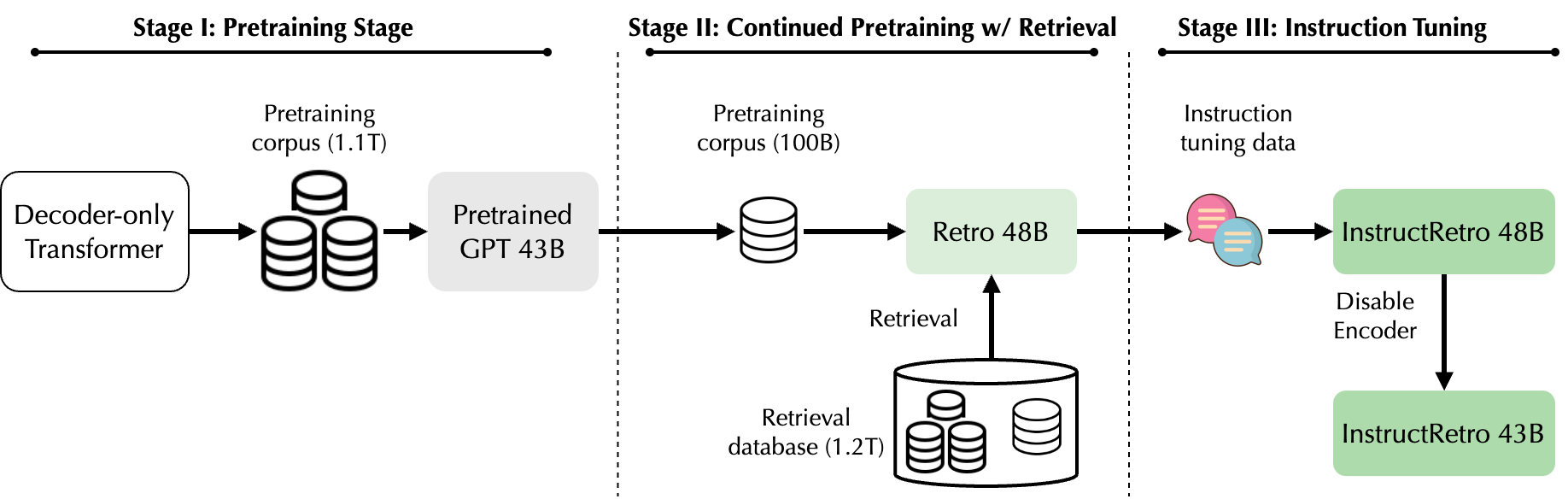
- Continued pretraining of a 43B-parameter GPT model on 100 billion additional tokens using retrieval-augmented generation (Retro), retrieving from a 1.2 trillion token database.
- Unfroze the decoder weights during continued pretraining, enabling joint optimization of all parameters instead of freezing them as in prior Retro methods.
- Applied instruction tuning to the resulting retrieval-augmented foundation model (Retro 48B) to produce InstructRetro 48B, enhancing instruction-following capabilities.
- Conducted ablation studies by removing the encoder from InstructRetro 48B, resulting in a decoder-only InstructRetro 43B model to test architectural necessity.
- Evaluated performance on zero-shot QA, summarization, and reading comprehension tasks using standard metrics like EM and ROUGE.
- Used a two-stage training pipeline: first retrieval-augmented pretraining, then instruction tuning with curated instruction data.
Experimental results
Research questions
- RQ1Can retrieval-augmented pretraining at scale (1.2T tokens) significantly improve the performance of large language models before instruction tuning?
- RQ2Does continued pretraining with retrieval, especially when unfreezing the decoder, lead to better perplexity and downstream zero-shot generalization than standard pretraining?
- RQ3To what extent does instruction tuning amplify the benefits of retrieval-augmented pretraining in terms of factual accuracy and reasoning?
- RQ4Is the encoder component in retrieval-augmented models like InstructRetro necessary for high performance after instruction tuning?
- RQ5Can a decoder-only model derived from InstructRetro achieve comparable performance to the full model, suggesting a path to more efficient instruction-tuned LLMs?
Key findings
- InstructRetro 48B achieves 7% higher average zero-shot EM accuracy than its GPT 43B counterpart across 8 short-form QA and reading comprehension tasks.
- On 4 challenging long-form QA tasks, InstructRetro 48B shows a 10% improvement over the GPT 43B baseline in zero-shot evaluation.
- For 3 summarization tasks, InstructRetro 48B improves ROUGE scores by 4.87 points on GovReport and consistently outperforms Instruct GPT-RAG 70B.
- InstructRetro 43B, a decoder-only variant with the encoder ablated, achieves comparable performance to InstructRetro 48B, indicating the encoder is not essential post-instruction tuning.
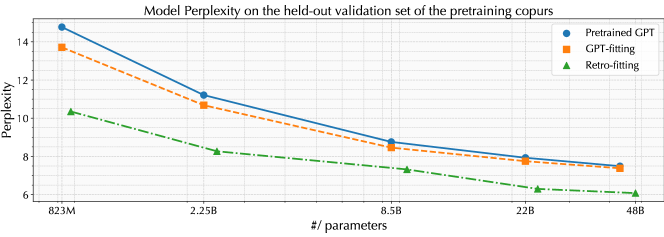
- Retro 48B achieves lower perplexity than its GPT 43B counterpart with only 2.58% additional GPU hours, demonstrating the scalability and efficiency of retrieval-augmented pretraining.
- Instruction tuning significantly mitigates the instruction-following bottleneck in both GPT and Retro models, with the benefits of retrieval becoming more pronounced only after tuning.
Read this paper
Open the full text in the Nubint reader and ask about any passage as you read.
Read this paper on NubintThis review was generated by AI from the original paper. Please check the paper before citing it.