
[Paper Review] InstructTTS: Modelling Expressive TTS in Discrete Latent Space with Natural Language Style Prompt
InstructTTS proposes a novel expressive text-to-speech system that uses natural language style prompts to control speech prosody and emotion. It models acoustic features in a discrete latent space via a vector-quantized VQ-VAE and employs a discrete diffusion model to generate speech tokens, achieving high-fidelity, diverse, and controllable speech synthesis with improved style disentanglement through mutual information minimization.
Expressive text-to-speech (TTS) aims to synthesize different speaking style speech according to human's demands. Nowadays, there are two common ways to control speaking styles: (1) Pre-defining a group of speaking style and using categorical index to denote different speaking style. However, there are limitations in the diversity of expressiveness, as these models can only generate the pre-defined styles. (2) Using reference speech as style input, which results in a problem that the extracted style information is not intuitive or interpretable. In this study, we attempt to use natural language as style prompt to control the styles in the synthetic speech, e.g., "Sigh tone in full of sad mood with some helpless feeling". Considering that there is no existing TTS corpus which is proper to benchmark this novel task, we first construct a speech corpus, whose speech samples are annotated with not only content transcriptions but also style descriptions in natural language. Then we propose an expressive TTS model, named as InstructTTS, which is novel in the sense of following aspects: (1) We fully take the advantage of self-supervised learning and cross-modal metric learning, and propose a novel three-stage training procedure to obtain a robust sentence embedding model, which can effectively capture semantic information from the style prompts and control the speaking style in the generated speech. (2) We propose to model acoustic features in discrete latent space and train a novel discrete diffusion probabilistic model to generate vector-quantized (VQ) acoustic tokens rather than the commonly-used mel spectrogram. (3) We jointly apply mutual information (MI) estimation and minimization during acoustic model training to minimize style-speaker and style-content MI, avoiding possible content and speaker information leakage from the style prompt.
Motivation & Objective
- To enable user-controllable expressive TTS using long-form natural language style prompts instead of categorical labels or reference utterances.
- To address the challenge of learning semantic style representations from unstructured natural language prompts.
- To model expressive TTS in a discrete latent space using vector-quantized acoustic features, enabling sequence-to-sequence language modeling.
- To minimize information leakage between style, content, and speaker by jointly estimating and minimizing mutual information during training.
- To develop a non-autoregressive, one-stage training framework for waveform-based VQ features, differing from concurrent models like VALL-E.
Proposed method
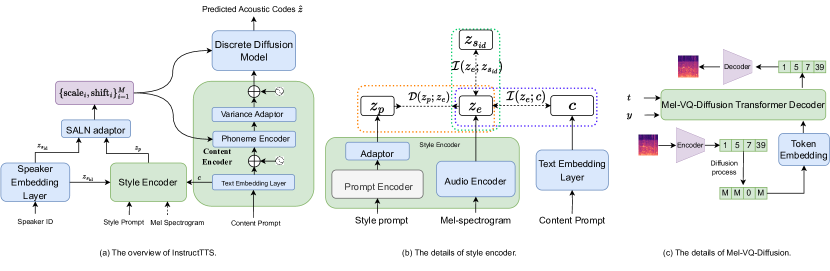
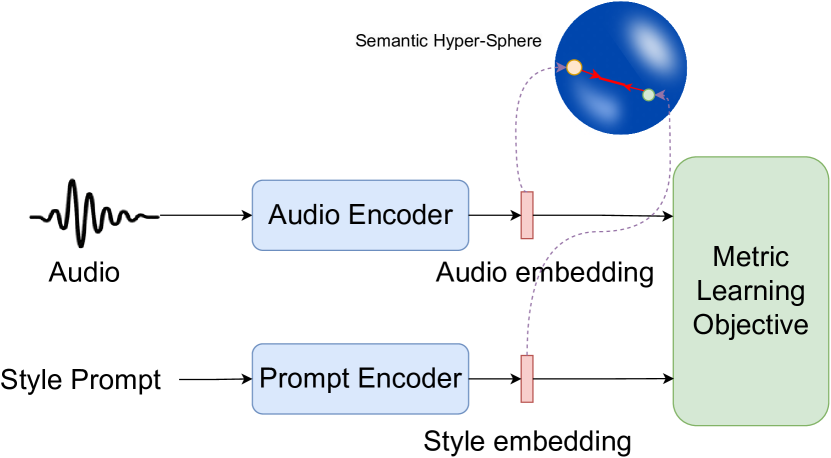
- A three-stage training procedure is proposed to train a robust sentence embedding model that captures semantic meaning from natural language style prompts.
- Acoustic features are modeled in a discrete latent space using a pre-trained VQ-VAE, with two variants: Mel-VQ (based on mel-spectrograms) and Wave-VQ (based on raw waveforms).
- A novel discrete diffusion probabilistic model is trained to generate VQ tokens sequentially, treating speech synthesis as a language modeling task in the discrete codebook space.
- A U-transformer architecture is used as the diffusion decoder, enabling effective modeling of long-sequence dependencies in the latent space.
- Mutual information (MI) estimation and minimization are jointly applied during acoustic model training to reduce leakage of content and speaker information from the style prompt.
- An improved mask-and-replace (I-MAR) strategy is introduced for the diffusion training, enhancing generation quality and diversity.
Experimental results
Research questions
- RQ1Can natural language prompts effectively control expressive speaking styles in TTS without requiring reference utterances or predefined categorical labels?
- RQ2How can a robust sentence embedding model be trained to capture semantic and prosodic information from long-form natural language style descriptions?
- RQ3Can expressive TTS be effectively modeled in a discrete latent space using a diffusion-based generative process on VQ-acoustic tokens?
- RQ4What is the impact of different VQ-based acoustic representations (mel-spectrogram vs. waveform) on speech synthesis quality and training efficiency?
- RQ5To what extent does mutual information minimization between style, content, and speaker improve disentanglement and generalization in prompt-based TTS?
Key findings
- The proposed I-MAR diffusion strategy outperforms standard MAR, reducing MCD by 0.03 (5.68 vs. 5.71) and increasing SSIM by 0.02 (0.384 vs. 0.364).
- Wave-VQ-Diffusion-based InstructTTS achieves a STOI of 0.615 and FFE of 0.23, demonstrating high intelligibility and naturalness in synthesized speech.
- GRVQ-based audio codecs achieve the best reconstruction performance with PESQ 3.63 and STOI 0.95, outperforming RVQ and Encodec.
- The use of 8 codebooks in RVQ improves PESQ from 3.54 to 3.54, but performance gains do not scale linearly with codebook count, suggesting model capacity constraints.
- Inference with 10 random runs using the same input produces diverse F0 contours, confirming that InstructTTS generates varied, non-deterministic speech with natural prosodic variation.
- The model demonstrates strong zero-shot generalization to unseen styles, as evidenced by high subjective scores on natural language prompt control.
Read this paper
Open the full text in the Nubint reader and ask about any passage as you read.
Read this paper on NubintThis review was generated by AI from the original paper. Please check the paper before citing it.