
[Paper Review] Integrated Sensing, Communication, and Powering (ISCAP): Towards Multi-functional 6G Wireless Networks
This paper proposes Integrated Sensing, Communication, and Powering (ISCAP), a multi-functional 6G wireless network that unifies sensing, communication, and wireless power transfer using the same radio signals. By enabling simultaneous transmission, sensing-assisted power transfer, and energy harvesting for sustainable ISAC, ISCAP enhances spectral and energy efficiency, reduces costs, and unlocks new capabilities like near-field beamforming and intelligent reflecting surfaces.
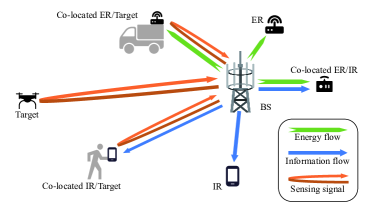
This article presents a novel multi-functional system for a sixth-generation (6G) wireless network with integrated sensing, communication, and powering (ISCAP), which unifies integrated sensing and communication (ISAC) and wireless information and power transfer (WIPT) techniques. The multi-functional ISCAP network promises to enhance resource utilization efficiency, reduce network costs, and improve overall performance through versatile operational modes. Specifically, a multi-functional base station (BS) can enable multi-functional transmission, by exploiting the same radio signals to perform target/environment sensing, wireless communication, and wireless power transfer (WPT), simultaneously. Besides, the three functions can be intelligently coordinated to pursue mutual benefits,i.e., wireless sensing can be leveraged to enable light-training or even training-free WIPT by providing side-channel information, and the BS can utilize WPT to wirelessly charge low-power devices for ensuring sustainable ISAC. Furthermore, multiple multi-functional BSs can cooperate in both transmission and reception phases for efficient interference management, multi-static sensing, and distributed energy beamforming. For these operational modes, we discuss the technical challenges and potential solutions, particularly focusing on the fundamental performance tradeoff limits, transmission protocol design, as well as waveform and beamforming optimization. Finally, interesting research directions are identified.
Motivation & Objective
- Address the growing need for sustainable, high-capacity 6G networks supporting massive IoT devices with long battery life.
- Overcome the limitations of conventional single-function wireless networks by unifying sensing, communication, and power transfer.
- Improve spectral and energy efficiency while reducing infrastructure and operational costs through multi-functional base stations.
- Enable mutual benefits among sensing, communication, and powering functions via intelligent coordination and resource sharing.
- Develop novel transmission protocols, beamforming, and waveform designs to support simultaneous multi-functional operations in 6G.
Proposed method
- Proposes a simultaneous multi-functional transmission mode where a single radio signal performs sensing, communication, and wireless power transfer concurrently.
- Introduces sensing-assisted WIPT, using channel state information (CSI) and scatterer locations from sensing to enable low-training or training-free wireless power transfer.
- Employs wireless-powered ISAC, where energy harvested from WPT powers low-energy IoT devices to sustain their ISAC operations.
- Envisions networked multi-functional transmission with cooperative multi-base station operations for distributed beamforming, interference management, and multi-static sensing.
- Introduces near-field channel models based on spherical wavefronts for extremely large-scale antenna arrays to enable 3D localization and focused energy beams.
- Explores hybrid digital-analog beamforming in mmWave/THz bands to reduce hardware costs while maintaining performance in multi-functional systems.
Experimental results
Research questions
- RQ1How can sensing, communication, and power transfer be jointly optimized in a single radio signal to maximize system efficiency?
- RQ2What are the fundamental performance tradeoffs between sensing accuracy, communication rate, and energy transfer efficiency in ISCAP systems?
- RQ3How can sensing information be leveraged to reduce CSI training overhead in wireless power transfer?
- RQ4What beamforming and waveform designs are optimal for near-field multi-functional transmission with extremely large-scale arrays?
- RQ5How can intelligent reflecting surfaces (IRS) be jointly optimized with base station beamforming to enhance C-R-E (communication, sensing, energy) performance?
Key findings
- Simultaneous multi-functional transmission enables triple use of spectrum, hardware, and signals, significantly improving resource utilization and reducing network costs.
- Sensing-assisted WIPT reduces training overhead by using environmental scatterer information to estimate CSI, enabling low-training or training-free power transfer.
- Wireless-powered ISAC allows low-power IoT devices to sustain long-term sensing and communication operations by harvesting energy from the same signal.
- Near-field multi-functional transmission with extremely large-scale antennas enables high-precision 3D localization and focused energy beams, enhancing SNR and energy efficiency.
- Hybrid beamforming architectures in mmWave/THz bands support high data rates and accurate sensing while reducing hardware complexity.
- Intelligent reflecting surfaces (IRS) enhance signal strength and enable virtual LoS links, improving performance in ISAC and WIPT, especially when combined with sensing for CSI acquisition.
![Figure 2: The Pareto boundary of a C-R-E region example [ 8 ] .](https://ar5iv.labs.arxiv.org/html/2401.03516/assets/x2.png)
Better researchstarts right now
From reading papers to final review, dramatically reduce your research time.
No credit card · Free plan available
This review was created by AI and reviewed by human editors.