
[Paper Review] Integrating Large Language Models in Causal Discovery: A Statistical Causal Approach
The paper proposes a framework that combines statistical causal discovery with knowledge-based causal inference from GPT-4 via statistical causal prompting to improve causal graphs, even on biased or unseen datasets.
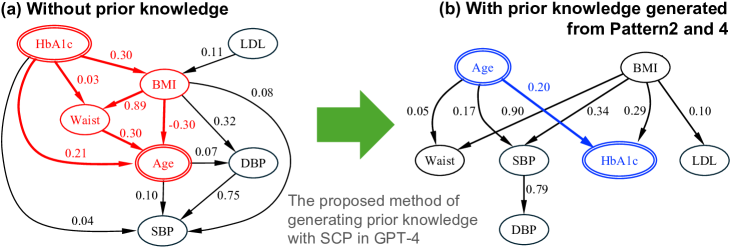
In practical statistical causal discovery (SCD), embedding domain expert knowledge as constraints into the algorithm is important for reasonable causal models reflecting the broad knowledge of domain experts, despite the challenges in the systematic acquisition of background knowledge. To overcome these challenges, this paper proposes a novel method for causal inference, in which SCD and knowledge-based causal inference (KBCI) with a large language model (LLM) are synthesized through ``statistical causal prompting (SCP)'' for LLMs and prior knowledge augmentation for SCD. The experiments in this work have revealed that the results of LLM-KBCI and SCD augmented with LLM-KBCI approach the ground truths, more than the SCD result without prior knowledge. These experiments have also revealed that the SCD result can be further improved if the LLM undergoes SCP. Furthermore, with an unpublished real-world dataset, we have demonstrated that the background knowledge provided by the LLM can improve the SCD on this dataset, even if this dataset has never been included in the training data of the LLM. For future practical application of this proposed method across important domains such as healthcare, we also thoroughly discuss the limitations, risks of critical errors, expected improvement of techniques around LLMs, and realistic integration of expert checks of the results into this automatic process, with SCP simulations under various conditions both in successful and failure scenarios. The careful and appropriate application of the proposed approach in this work, with improvement and customization for each domain, can thus address challenges such as dataset biases and limitations, illustrating the potential of LLMs to improve data-driven causal inference across diverse scientific domains. The code used in this work is publicly available at: www.github.com/mas-takayama/LLM-and-SCD
Motivation & Objective
- Motivate the integration of domain knowledge into statistical causal discovery (SCD) to obtain more meaningful causal models.
- Propose a methodology (statistical causal prompting) to generate and integrate LLM-based background knowledge into SCD.
- Demonstrate that LLM-guided background knowledge can improve SCD performance and robustness to dataset biases.
- Show that SCP can enhance both LLM-KBCI outputs and SCD results across multiple algorithms and datasets.
Proposed method
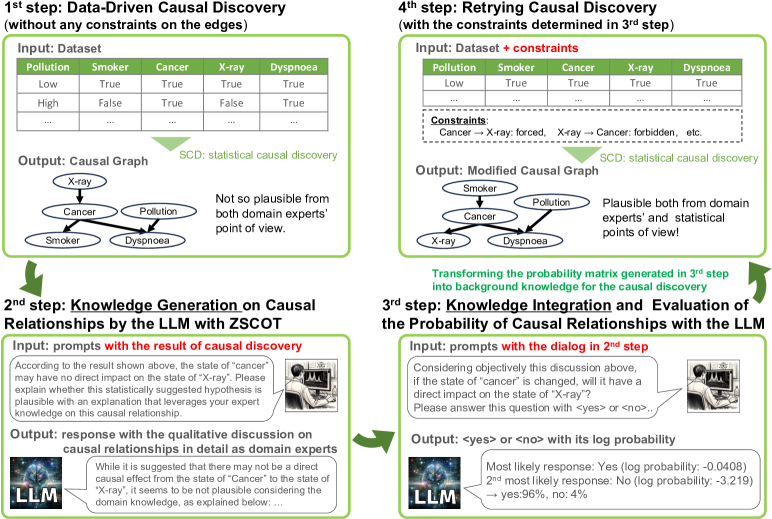
- Run an initial SCD on data X without prior knowledge using PC, Exact Search, or DirectLiNGAM (S).
- Generate detailed causal knowledge between all variable pairs from an LLM (GPT-4) using zero-shot chain-of-thought prompts, informed by initial SCD results (GKP).
- Evaluate LLM responses with multiple attempts to estimate the probability of causal links (statistical causal prompting, SCP).
- Transform the LLM-derived probability matrix into a prior knowledge (PK) matrix via a transformation rule, then re-run SCD with PK to obtain a refined graph.
- Utilize bootstrap resampling to quantify edge probabilities and integrate them into the prior knowledge through rule-based constraints (forbidden/forced edges).
- Test across multiple datasets (DWD climate data, health screening subset) and SCD algorithms to assess robustness and generality.
Experimental results
Research questions
- RQ1Can GPT-4-derived background knowledge, when prompted with SCP, improve the accuracy of causal graphs learned by SCD?
- RQ2Does SCP enable mutual improvements, where enhanced SCD results further improve LLM-KBCI outputs?
- RQ3Is the proposed LLM-assisted SCD effective on datasets not contained in the LLM’s pre-training data and with biases?
- RQ4How do different SCP patterns (amount and type of information provided to the LLM) affect performance?
- RQ5Can the approach maintain statistical validity (e.g., CFI, RMSEA, BIC) while leveraging LLM-derived prior knowledge?
Key findings
- LLM-guided background knowledge augmented by SCP brings SCD results closer to ground truth compared to SCD without PK.
- Augmenting SCD with PK often improves precision and F1, and reduces BIC, indicating better model fit with domain knowledge.
- SCP enhances both the LLM-KBCI output and the downstream SCD results, demonstrating mutual performance gains.
- The method remains beneficial even when the dataset (health screening subset) is not included in GPT-4’s pre-training data and may contain biases.
- DirectLiNGAM particularly benefits from SCP under certain prompting patterns, showing pattern-dependent improvements.
Read this paper
Open the full text in the Nubint reader and ask about any passage as you read.
Read this paper on NubintThis review was generated by AI from the original paper. Please check the paper before citing it.