
[Paper Review] Integration of Large Language Models and Federated Learning
This position paper defines Federated LLM (FL for LLMs) and outlines a three-part framework—federated LLM pre-training, fine-tuning, and prompt engineering—along with key security, privacy, efficiency, and Non-IID challenges and potential defenses.
As the parameter size of Large Language Models (LLMs) continues to expand, there is an urgent need to address the scarcity of high-quality data. In response, existing research has attempted to make a breakthrough by incorporating Federated Learning (FL) into LLMs. Conversely, considering the outstanding performance of LLMs in task generalization, researchers have also tried applying LLMs within FL to tackle challenges in relevant domains. The complementarity between LLMs and FL has already ignited widespread research interest. In this paper, we aim to deeply explore the integration of LLMs and FL. We propose a research framework, dividing the fusion of LLMs and FL into three parts: the combination of LLM sub-technologies with FL, the integration of FL sub-technologies with LLMs, and the overall merger of LLMs and FL. We first provide a comprehensive review of the current state of research in the domain of LLMs combined with FL, including their typical applications, integration advantages, challenges faced, and future directions for resolution. Subsequently, we discuss the practical applications of the combination of LLMs and FL in critical scenarios such as healthcare, finance, and education, and provide new perspectives and insights into future research directions for LLMs and FL.
Motivation & Objective
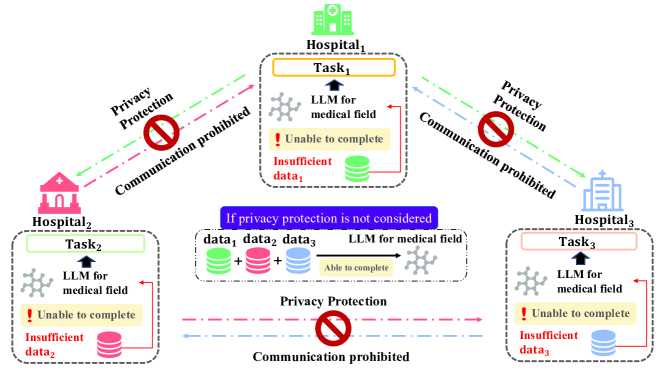
- Address data privacy and data scarcity in large language model (LLM) development by leveraging decentralized data sources.
- Propose a Federated LLM framework to integrate FL into LLM training and utilization.
- Analyze challenges introduced by combining FL and LLM (security, privacy, efficiency, Non-IID) and outline potential strategies.
Proposed method
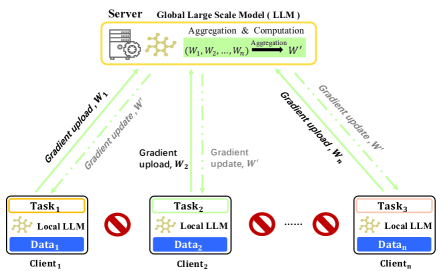
- Define Federated LLM and decompose into three components: federated LLM pre-training, federated LLM fine-tuning, and federated LLM prompt engineering.
- Propose architectural designs and training workflows for each component under FL constraints.
- Compare traditional LLM training with FL-based LLM approaches to highlight privacy and efficiency trade-offs.
- Discuss data privacy, security threats, and efficiency considerations with proposed defense and mitigation strategies.
- Outline potential parameter-efficient fine-tuning methods (e.g., adapters, LoRA, prefix/prompt tuning) within FL.
Experimental results
Research questions
- RQ1How can federated learning be effectively integrated into pre-training, fine-tuning, and prompt engineering of LLMs?
- RQ2What are the primary security, privacy, efficiency, and data-heterogeneity (Non-IID) challenges when building Federated LLMs, and how can they be mitigated?
- RQ3What architectural and training strategy choices (e.g., full-model vs. parameter-efficient fine-tuning) balance performance with privacy and compute costs in FL-LLMs?
- RQ4How can prompt engineering be adapted to federated settings to personalize and improve LLM performance without exposing sensitive data.
Key findings
- A foundational Federated LLM framework is proposed, consisting of pre-training, fine-tuning, and prompt engineering components.
- The paper analyzes four core challenges—security threats and defenses, privacy threats and enhancements, efficiency, and Non-IID data—and discusses potential mitigation directions.
- It suggests adapting parameter-efficient fine-tuning methods (e.g., adapters, LoRA, prefix/prompt tuning) within FL to reduce computation and communication costs.
- The Federated LLM prompt engineering approach enables privacy-preserving, personalized prompts via local prompt learner updates without sending raw data.
- It highlights that robust aggregation, privacy-preserving techniques (e.g., differential privacy, secure aggregation), and adversarial training pose practical trade-offs in FL-LLMs.
Read this paper
Open the full text in the Nubint reader and ask about any passage as you read.
Read this paper on NubintThis review was generated by AI from the original paper. Please check the paper before citing it.