
[Paper Review] Intelligent Agricultural Greenhouse Control System Based on Internet of Things and Machine Learning
The paper designs and implements an IoT-driven greenhouse control system using machine learning to monitor environmental parameters and adaptively regulate temperature, humidity, light, irrigation, and other factors to improve crop growth and resource efficiency.
This study endeavors to conceptualize and execute a sophisticated agricultural greenhouse control system grounded in the amalgamation of the Internet of Things (IoT) and machine learning. Through meticulous monitoring of intrinsic environmental parameters within the greenhouse and the integration of machine learning algorithms, the conditions within the greenhouse are aptly modulated. The envisaged outcome is an enhancement in crop growth efficiency and yield, accompanied by a reduction in resource wastage. In the backdrop of escalating global population figures and the escalating exigencies of climate change, agriculture confronts unprecedented challenges. Conventional agricultural paradigms have proven inadequate in addressing the imperatives of food safety and production efficiency. Against this backdrop, greenhouse agriculture emerges as a viable solution, proffering a controlled milieu for crop cultivation to augment yields, refine quality, and diminish reliance on natural resources [b1]. Nevertheless, greenhouse agriculture contends with a gamut of challenges. Traditional greenhouse management strategies, often grounded in experiential knowledge and predefined rules, lack targeted personalized regulation, thereby resulting in resource inefficiencies. The exigencies of real-time monitoring and precise control of the greenhouse's internal environment gain paramount importance with the burgeoning scale of agriculture. To redress this challenge, the study introduces IoT technology and machine learning algorithms into greenhouse agriculture, aspiring to institute an intelligent agricultural greenhouse control system conducive to augmenting the efficiency and sustainability of agricultural production.
Motivation & Objective
- Motivate the need for intelligent, sustainable greenhouse management amid rising food demand and climate challenges.
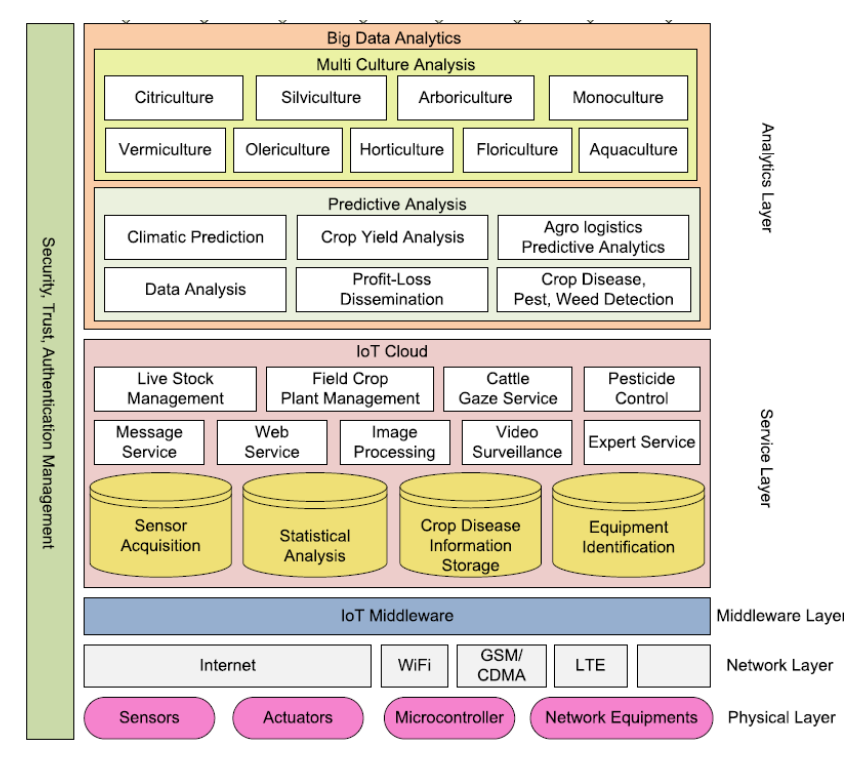
- Propose an IoT-based architecture integrated with machine learning to monitor and control greenhouse internal conditions.
- Demonstrate real-time data collection, processing, and model-driven regulation to improve crop growth efficiency and reduce resource waste.
- Address privacy, security, modularity, and socio-economic considerations for deploying smart greenhouse systems.
Proposed method
- Deploy sensors (temperature, humidity, light) arranged for comprehensive greenhouse monitoring.
- Use IoT to transmit sensor data to the cloud for processing and storage.
- Apply data preprocessing (outlier repair, normalization) and train RNN-based models on historical time-series data.
- Implement a hybrid control strategy combining PID, MPC, and fuzzy control for real-time regulation.
- Use machine learning outputs to adjust environmental parameters via feedback control.
- Develop energy, irrigation, and fertilization models to optimize resource use.
Experimental results
Research questions
- RQ1How can IoT-enabled sensing and cloud processing support accurate modeling of greenhouse environmental dynamics?
- RQ2Can a combined PID, MPC, and fuzzy control framework, guided by ML predictions, achieve precise real-time greenhouse regulation?
- RQ3What are the potential energy, water, and fertilizer savings achievable with ML-driven greenhouse control across crops?
- RQ4What challenges exist in data privacy, system maintenance, and technology adoption for smart greenhouse deployments?
Key findings
- A cloud-based data pipeline supports cleaning, normalization, and anomaly repair for greenhouse sensor data.
- An RNN-based model is used to predict future greenhouse conditions from historical time-series data.
- A multi-algorithm control strategy (PID, MPC, fuzzy) improves regulation flexibility and responsiveness to changing conditions.
- The system enables crop-specific environmental tuning and optimization of energy and water resources.
- Real-world case studies suggest improvements in crop growth efficiency and reductions in resource waste.
- Future work includes integrating advanced sensors, deep learning, and broader ecosystem interoperability.
Read this paper
Open the full text in the Nubint reader and ask about any passage as you read.
Read this paper on NubintThis review was generated by AI from the original paper. Please check the paper before citing it.