
[Paper Review] Interlayer Coupling Driven High-Temperature Superconductivity in La$_3$Ni$_2$O$_7$ Under Pressure
The paper derives a bilayer t-J model for La3Ni2O7 under pressure, showing that interlayer coupling J_perp drives a transition from d-wave to interlayer s-wave pairing and can dramatically raise Tc, with a possible s+id TRSB state.
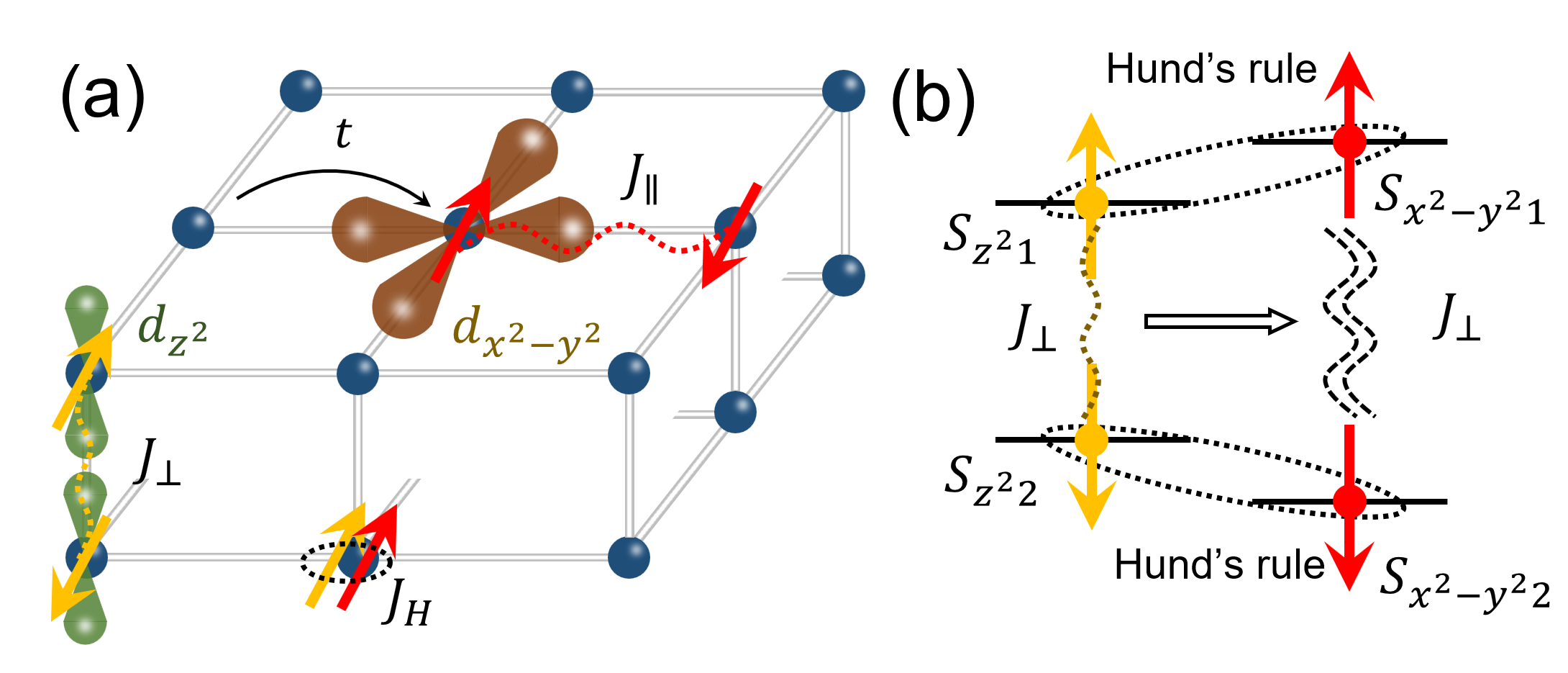
The newly discovered high-temperature superconductivity in La$_3$Ni$_2$O$_7$ under pressure has attracted a great deal of attentions. The essential ingredient characterizing the electronic properties is the bilayer NiO$_2$ planes coupled by the interlayer bonding of $3d_{z^2}$ orbitals through the intermediate oxygen-atoms. In the strong coupling limit, the low energy physics is described by an intralayer antiferromagnetic spin-exchange interaction $J_{\parallel}$ between $3d_{x^2-y^2}$ orbitals and an interlayer one $J_{\perp}$ between $3d_{z^2}$ orbitals. Taking into account Hund's rule on each site and integrating out the $3d_{z^2}$ spin degree of freedom, the system reduces to a single-orbital bilayer $t$-$J$ model based on the $3d_{x^2-y^2}$ orbital. By employing the slave-boson approach, the self-consistent equations for the bonding and pairing order parameters are solved. Near the physically relevant $\frac{1}{4}$-filling regime (doping $δ=0.3\sim 0.5$), the interlayer coupling $J_{\perp}$ tunes the conventional single-layer $d$-wave superconducting state to the $s$-wave one. A strong $J_{\perp}$ could enhance the inter-layer superconducting order, leading to a dramatically increased $T_c$. Interestingly, there could exist a finite regime in which an $s+id$ state emerges.
Motivation & Objective
- Motivate understanding of high-Tc superconductivity in La3Ni2O7 under pressure and identify the role of interlayer coupling.
- Develop a strongly correlated bilayer model incorporating Hund’s rule coupling between Ni 3d orbitals.
- Show that interlayer coupling can change pairing symmetry from d-wave to interlayer s-wave and enhance Tc.
- Predict possible TRSB s+id phase in an intermediate parameter regime.
- Relate theoretical parameters to experimental context under pressure and electron/hole doping possibilities.
Proposed method
- Construct a two-orbital bilayer t-J-J_H model for Ni-based units with H = H_parallel + H_perp.
- Integrate out the 3d_z^2 spin degree of freedom to obtain an effective interlayer S=1/2 exchange J_perp between 3d_x2-y2 spins.
- Apply slave-boson mean-field theory to decouple spinon and holon, with holon condensation giving Tc from RVB pairing.
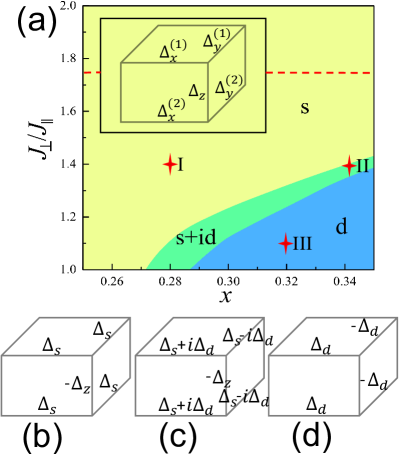
- Introduce and self-consistently solve for intra- and inter-layer bond and pairing order parameters (chi and Delta) including Delta_z and Delta_x/y.
- Analyze ground-state pairing as a function of filling x and ratio J_perp/J_parallel to map out s-wave, d-wave, and s+id regions.
- Connect realistic LNO parameters (J_perp/J_parallel ~ 1.75) to the emergence of interlayer s-wave pairing and Tc enhancement.
Experimental results
Research questions
- RQ1Does interlayer coupling J_perp enhance superconductivity in La3Ni2O7 under pressure?
- RQ2How does J_perp/J_parallel influence pairing symmetry in the bilayer t-J model?
- RQ3Can Hund’s rule coupling transduce interlayer interactions into an effective interlayer pairing channel?
- RQ4Is there a parameter regime where TRSB s+id pairing appears?
- RQ5What do realistic LNO parameters imply for Tc and pairing symmetry under pressure?
Key findings
- Interlayer coupling J_perp converts the single-layer d-wave pairing into interlayer s-wave pairing in the relevant doping regime.
- Tc increases dramatically with increasing J_perp/J_parallel when J_perp > J_parallel, consistent with high-Tc under pressure.
- For realistic LNO parameters (J_perp/J_parallel ≈ 1.75), the pairing is interlayer s-wave with Delta_z dominating Delta_x/y.
- A narrow region in parameter space hosts a TRSB s+id pairing state between s-wave and d-wave regions.
- Electron doping is predicted to further enhance Tc, while apical-oxygen vacancies (reducing J_perp) suppress superconductivity.
Read this paper
Open the full text in the Nubint reader and ask about any passage as you read.
Read this paper on NubintThis review was generated by AI from the original paper. Please check the paper before citing it.