
[Paper Review] Interlayer link prediction in multiplex social networks: an iterative degree penalty algorithm
This paper proposes an iterative degree penalty (IDP) algorithm for interlayer link prediction in multiplex social networks, leveraging network structure and a degree penalty principle to improve matching accuracy. By iteratively refining predictions using adjacency matrix multiplication and prioritizing common neighbors with fewer connections, IDP significantly outperforms existing methods, especially in low-average-degree and low-overlapping-node regimes, with up to 36.6% improvement in recall and 25.0% in F1 score.
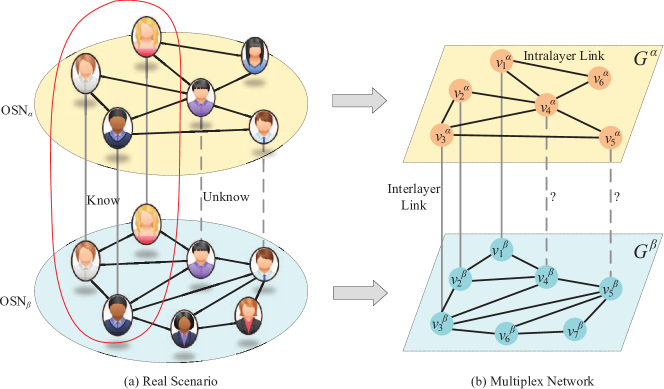
Online social network (OSN) applications provide different experiences; for example, posting a short text on Twitter and sharing photographs on Instagram. Multiple OSNs constitute a multiplex network. For privacy protection and usage purposes, accounts belonging to the same user in different OSNs may have different usernames, photographs, and introductions. Interlayer link prediction in multiplex network aims at identifying whether the accounts in different OSNs belong to the same person, which can aid in tasks including cybercriminal behavior modeling and customer interest analysis. Many real-world OSNs exhibit a scale-free degree distribution; thus, neighbors with different degrees may exert different influences on the node matching degrees across different OSNs. We developed an iterative degree penalty (IDP) algorithm for interlayer link prediction in the multiplex network. First, we proposed a degree penalty principle that assigns a greater weight to a common matched neighbor with fewer connections. Second, we applied node adjacency matrix multiplication for efficiently obtaining the matching degree of all unmatched node pairs. Thereafter, we used the approved maximum value method to obtain the interlayer link prediction results from the matching degree matrix. Finally, the prediction results were inserted into the priori interlayer node pair set and the above processes were performed iteratively until all unmatched nodes in one layer were matched or all matching degrees of the unmatched node pairs were equal to 0. Experiments demonstrated that our advanced IDP algorithm significantly outperforms current network structure-based methods when the multiplex network average degree and node overlapping rate are low.
Motivation & Objective
- To address the challenge of identifying whether user accounts across different online social networks (OSNs) belong to the same individual, especially when usernames and attributes differ due to privacy or anonymity.
- To improve interlayer link prediction accuracy in multiplex networks where network structure is the primary source of information, particularly under low average degree and low node overlap conditions.
- To develop an efficient, scalable method that leverages structural similarity and degree-aware weighting to enhance matching of cross-layer nodes.
- To iteratively discover hidden interlayer links by refining predictions through successive rounds of matching degree computation and maximum value selection.
Proposed method
- Proposes a degree penalty principle that assigns higher weights to common matched neighbors with fewer connections, reflecting their stronger predictive power in scale-free networks.
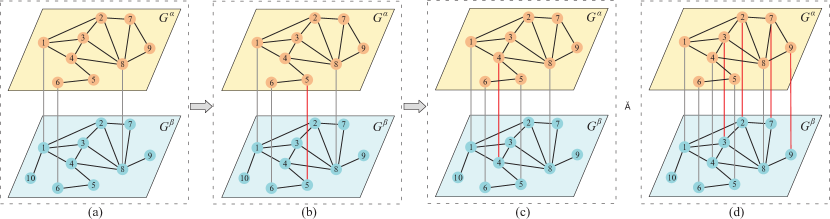
- Uses node adjacency matrix multiplication to efficiently compute the matching degree between all unmatched node pairs across layers in a single operation.
- Applies an approved maximum value method to extract the highest-scoring interlayer link predictions from the matching degree matrix.
- Employs an iterative process that inserts predicted links into the priori set and re-runs the matching degree computation until all unmatched nodes are matched or all degrees become zero.
- Integrates the degree penalty into the matching degree calculation to reflect the influence of both the number of common matched neighbors and their connectivity levels.
- Uses a self-matching multiplex network construction strategy with real-world networks to evaluate performance under controlled conditions.
Experimental results
Research questions
- RQ1How can interlayer link prediction be improved in multiplex social networks when the average degree and node overlapping rate are low?
- RQ2What is the impact of neighbor degree distribution on the reliability of common matched neighbors for interlayer node matching?
- RQ3Can an iterative refinement process enhance prediction accuracy by progressively incorporating high-confidence predictions into the matching process?
- RQ4How does degree-aware weighting of common neighbors compare to uniform weighting in predicting interlayer links?
- RQ5To what extent can adjacency matrix multiplication be used to efficiently compute matching degrees across all unmatched node pairs in a scalable manner?
Key findings
- The IDP algorithm outperforms the FRUI baseline across all real-world networks tested, with a maximum recall improvement of 36.6% and an average recall gain of 7.0%.
- Precision improved by up to 19.0% and on average by 3.8%, indicating stronger confidence in predicted links.
- F1 score increased by a maximum of 25.0% and an average of 5.0%, demonstrating consistent overall performance gains.
- The performance gains of IDP are most significant in networks with low average degree and low node overlap, where traditional methods struggle.
- The improvement percentages for recall, precision, and F1 first increase and then decrease with rising $ p $, indicating a non-monotonic relationship with noise levels.
- The algorithm effectively handles scale-free network structures, where high-degree nodes are less reliable as match indicators, by penalizing them in the matching score.
Better researchstarts right now
From reading papers to final review, dramatically reduce your research time.
No credit card · Free plan available
This review was created by AI and reviewed by human editors.