
[Paper Review] Interpretable and Explainable Logical Policies via Neurally Guided Symbolic Abstraction
NUDGE learns interpretable and explainable logical policies by guiding differentiable forward reasoning with pretrained neural policies, achieving competitive performance and robust adaptation across relational RL tasks.
The limited priors required by neural networks make them the dominating choice to encode and learn policies using reinforcement learning (RL). However, they are also black-boxes, making it hard to understand the agent's behaviour, especially when working on the image level. Therefore, neuro-symbolic RL aims at creating policies that are interpretable in the first place. Unfortunately, interpretability is not explainability. To achieve both, we introduce Neurally gUided Differentiable loGic policiEs (NUDGE). NUDGE exploits trained neural network-based agents to guide the search of candidate-weighted logic rules, then uses differentiable logic to train the logic agents. Our experimental evaluation demonstrates that NUDGE agents can induce interpretable and explainable policies while outperforming purely neural ones and showing good flexibility to environments of different initial states and problem sizes.
Motivation & Objective
- Motivate the need for policies that are both interpretable and explainable in reinforcement learning.
- Propose a neurally guided differentiable logic framework (NUDGE) to learn logic-based policies.
- Enable efficient rule discovery by guiding symbolic abstraction with pretrained neural policies.
- Demonstrate that NUDGE can compete with neural baselines and adapt to environmental changes.
- Showcase interpretability through readable rule sets and gradient-based explanations.
Proposed method
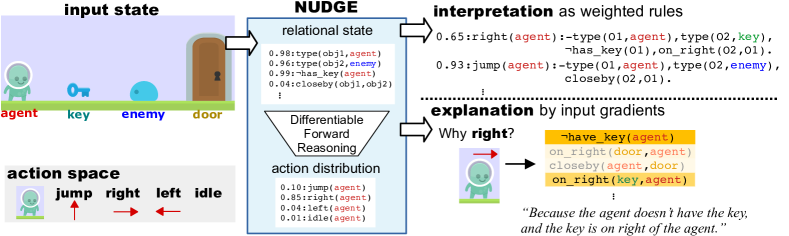
- Define a first-order logic action-state language separating action predicates and state predicates.
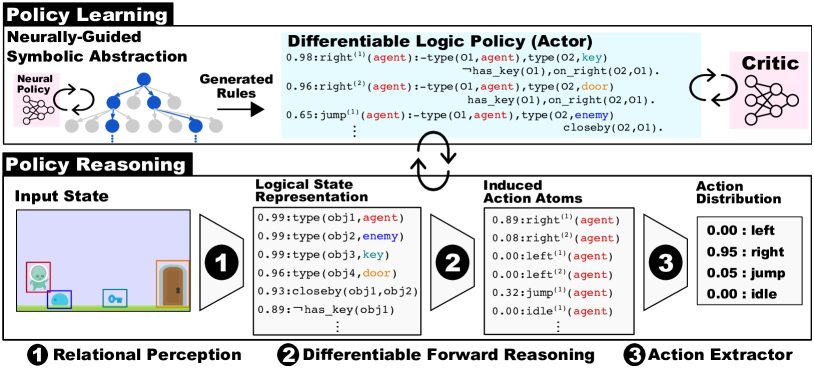
- Use differentiable forward reasoning to compute action distributions from probabilistic facts.
- Implement neurally guided symbolic abstraction to select a compact set of candidate rules based on a neural policy.
- Train rule weights via PPO actor-critic updates with a neural critic to maximize return.
- Provide gradient-based explanations by computing input-attribution scores on the probabilistic logic representation.
Experimental results
Research questions
- RQ1Q1: How does NUDGE compare to neural and purely logic baselines on standard and logic-oriented tasks?
- RQ2Q2: Can NUDGE adapt to environmental changes without retraining?
- RQ3Q3: Are NUDGE policies interpretable and can they provide explanations for decisions?
Key findings
- NUDGE outperforms neural baselines on several logic environments and matches or surpasses neural performance on others.
- NUDGE demonstrates robustness to environmental changes without retraining.
- NUDGE produces interpretable policies as weighted rule sets and enables gradient-based explanations for action choices.
- NUDGE with neurally guided abstraction yields compact rule sets and efficient learning.
- NUDGE significantly surpasses non-differentiable symbolic baselines that rely on fixed templates.
- Experiments include OCAtari benchmarks and three object-centric logic environments showing relational reasoning capabilities.
Read this paper
Open the full text in the Nubint reader and ask about any passage as you read.
Read this paper on NubintThis review was generated by AI from the original paper. Please check the paper before citing it.