
[Paper Review] Interpretable Image Classification with Adaptive Prototype-based Vision Transformers
ProtoViT combines a Vision Transformer backbone with adaptive, deformable prototypes to enable interpretable image classification via case-based reasoning, achieving state-of-the-art accuracy among prototype-based models while ensuring coherent, faithful explanations.
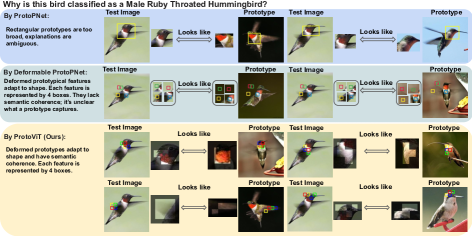
We present ProtoViT, a method for interpretable image classification combining deep learning and case-based reasoning. This method classifies an image by comparing it to a set of learned prototypes, providing explanations of the form ``this looks like that.'' In our model, a prototype consists of extit{parts}, which can deform over irregular geometries to create a better comparison between images. Unlike existing models that rely on Convolutional Neural Network (CNN) backbones and spatially rigid prototypes, our model integrates Vision Transformer (ViT) backbones into prototype based models, while offering spatially deformed prototypes that not only accommodate geometric variations of objects but also provide coherent and clear prototypical feature representations with an adaptive number of prototypical parts. Our experiments show that our model can generally achieve higher performance than the existing prototype based models. Our comprehensive analyses ensure that the prototypes are consistent and the interpretations are faithful.
Motivation & Objective
- Motivate the need for interpretable image classifiers in high-stakes domains.
- Develop a prototype-based framework that uses Vision Transformer backbones.
- Enable adaptive, geometrically flexible prototypes with coherent, faithful explanations.
- Present a training procedure that preserves interpretability while maximizing accuracy.
Proposed method
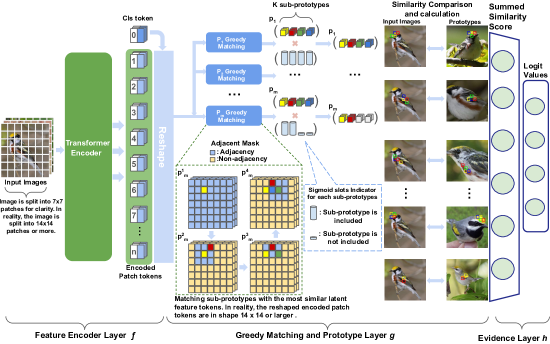
- Use a ViT backbone as feature encoder f to produce latent tokens from image patches.
- Define prototypes as sets of sub-prototypes and apply a greedy matching layer g to pair sub-prototypes with latent tokens.
- Incorporate an adjacency mask to ensure geometric contiguity among sub-prototypes.
- Introduce an adaptive slots mechanism to allow a dynamic number of sub-prototypes per prototype.
- Project prototypes to closest latent patches for visual explanations and optimize an evidence layer h for final classification.
- Train with staged losses including cluster, separation, coherence, and orthogonality terms, followed by prototype pruning and projection steps.
Experimental results
Research questions
- RQ1Can ProtoViT achieve higher accuracy than existing prototype-based models while maintaining interpretability?
- RQ2Do adaptive, deformable prototypes produce coherent and faithful prototypical explanations across diverse datasets?
- RQ3How does ProtoViT handle geometric variation and location misalignment in visual reasoning?
- RQ4What is the impact of prototype projection on model performance and interpretability?
Key findings
- ProtoViT with ViT backbones achieves higher accuracy than several prototype-based methods on bird and car datasets.
- ProtoViT with K=4 sub-prototypes and r=1 adjacency achieves 82.92% CUB accuracy and 89.02% Car accuracy (DeiT backbones).
- ProtoViT with CaiT-XXS backbones achieves 85.82% CUB accuracy and 92.40% Car accuracy.
- ProtoViT demonstrates superior accuracy compared to other prototype-based models using the same backbones, and provides visually coherent prototypes mapped to actual image patches.
- Global/local analyses indicate that prototypes consistently correspond to meaningful semantic features.
- Location misalignment benchmarks show ProtoViT performs on par with or better than CNN-based prototype models in terms of PLC, PAC, and PRC while maintaining competitive accuracy.
Read this paper
Open the full text in the Nubint reader and ask about any passage as you read.
Read this paper on NubintThis review was generated by AI from the original paper. Please check the paper before citing it.