
[Paper Review] Interpretable Multimodal Emotion Recognition using Facial Features and Physiological Signals
This paper proposes an interpretable multimodal emotion recognition framework that fuses rPPG signals and facial features from video inputs using early and late fusion strategies. By applying permutation feature importance (PFI), it quantifies modality contributions, achieving 54.61% accuracy on the IEMOCAP dataset, with visual features contributing 62.33% and rPPG 37.67% to classification performance.
This paper aims to demonstrate the importance and feasibility of fusing multimodal information for emotion recognition. It introduces a multimodal framework for emotion understanding by fusing the information from visual facial features and rPPG signals extracted from the input videos. An interpretability technique based on permutation feature importance analysis has also been implemented to compute the contributions of rPPG and visual modalities toward classifying a given input video into a particular emotion class. The experiments on IEMOCAP dataset demonstrate that the emotion classification performance improves by combining the complementary information from multiple modalities.
Motivation & Objective
- To develop a multimodal emotion recognition system that integrates non-invasive physiological (rPPG) and visual (facial) signals for improved emotion classification.
- To address the lack of interpretability in multimodal AI models by introducing a PFI-based method to quantify the contribution of each modality.
- To evaluate the effectiveness of early and late fusion strategies in combining dynamic rPPG and static facial features for emotion recognition.
- To demonstrate that multimodal fusion enhances performance over unimodal approaches, particularly in capturing nuanced emotional states.
- To provide transparent, interpretable AI outputs for real-world deployment in affective computing applications.
Proposed method
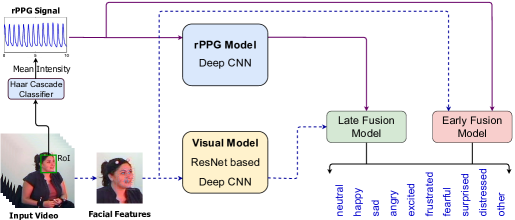
- rPPG signals are extracted from video frames using Haar cascades for face detection and computing mean RGB intensity over the facial ROI, as defined in Equation (1).
- Facial features are extracted using Dlib’s 68-point landmark detector trained on the Face Scrub dataset to capture spatial facial configurations.
- Two separate deep learning models are trained: one for rPPG signals using a CNN with ReLU activations, and another for facial features using a ResNet-34-based architecture.
- Early fusion combines raw rPPG and facial feature embeddings before classification, while late fusion processes each modality independently before merging predictions.
- Permutation Feature Importance (PFI) is applied to estimate modality contributions by measuring the drop in model performance when feature values are randomly shuffled.
- The PFI score for each modality is computed as the difference in expected model score between original and permuted feature sets, as formalized in Equation (5).
Experimental results
Research questions
- RQ1How does early fusion of rPPG and facial features compare to late fusion in terms of emotion recognition accuracy?
- RQ2What is the relative contribution of rPPG signals versus facial features to the final emotion classification decision?
- RQ3Can permutation feature importance effectively quantify the interpretability of multimodal inputs in emotion recognition?
- RQ4Does multimodal fusion significantly improve performance over unimodal models on the IEMOCAP dataset?
- RQ5How robust is the proposed framework when applied to real-world, diverse emotional expressions in video data?
Key findings
- The early fusion model achieved the highest emotion classification accuracy of 54.61% on the IEMOCAP dataset, outperforming individual modality models.
- The rPPG modality contributed 37.67% to the final classification performance, while facial features contributed 62.33%, as measured by permutation feature importance.
- The individual rPPG model achieved 37.45% accuracy, while the facial features model reached 46.42%, demonstrating the stronger discriminative power of visual cues.
- Late fusion yielded lower performance (41.17% accuracy) than early fusion, indicating that early integration enables better cross-modal representation learning.
- The F1 score for the early fusion model was 0.57, reflecting a balanced trade-off between precision and recall across emotion classes.
- The results confirm that combining complementary modalities enhances robustness and accuracy in multimodal emotion recognition systems.
Read this paper
Open the full text in the Nubint reader and ask about any passage as you read.
Read this paper on NubintThis review was generated by AI from the original paper. Please check the paper before citing it.