
[Paper Review] Interpretable Neural-Symbolic Concept Reasoning
This paper introduces the Deep Concept Reasoner (DCR), the first interpretable concept-based model that constructs symbolic logic rules from neural concept embeddings, enabling differentiable, semantically meaningful reasoning. DCR achieves state-of-the-art accuracy—up to +25% over prior models—while discovering human-interpretable rules and enabling counterfactual generation without concept supervision.
Deep learning methods are highly accurate, yet their opaque decision process prevents them from earning full human trust. Concept-based models aim to address this issue by learning tasks based on a set of human-understandable concepts. However, state-of-the-art concept-based models rely on high-dimensional concept embedding representations which lack a clear semantic meaning, thus questioning the interpretability of their decision process. To overcome this limitation, we propose the Deep Concept Reasoner (DCR), the first interpretable concept-based model that builds upon concept embeddings. In DCR, neural networks do not make task predictions directly, but they build syntactic rule structures using concept embeddings. DCR then executes these rules on meaningful concept truth degrees to provide a final interpretable and semantically-consistent prediction in a differentiable manner. Our experiments show that DCR: (i) improves up to +25% w.r.t. state-of-the-art interpretable concept-based models on challenging benchmarks (ii) discovers meaningful logic rules matching known ground truths even in the absence of concept supervision during training, and (iii), facilitates the generation of counterfactual examples providing the learnt rules as guidance.
Motivation & Objective
- Address the interpretability-accuracy trade-off in concept-based deep learning by preserving semantic meaning in concept representations.
- Overcome the limitation of high-dimensional concept embeddings, which lack interpretable semantics despite improving model performance.
- Develop a unified, end-to-end differentiable framework that combines neural learning with symbolic reasoning on concept embeddings.
- Enable model transparency by generating human-readable logic rules that explain predictions without relying on black-box neural components.
- Facilitate counterfactual example generation by leveraging the explicit, interpretable logic rules learned during training.
Proposed method
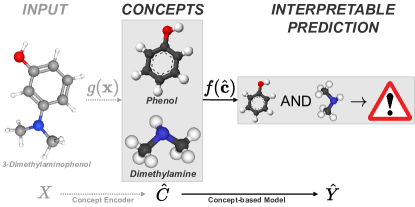
- Use neural networks to learn and compose concept embeddings into syntactic rule structures, rather than using them directly for prediction.
- Transform concept embeddings into truth degrees using differentiable activation functions to enable fuzzy logic reasoning.
- Construct weighted logic rules (e.g., using t-norms and t-conorms) that combine multiple concepts via differentiable operators.
- Execute these rules on truth degrees to produce final, interpretable predictions in a differentiable manner.
- Train the entire system end-to-end using a loss function that optimizes both task accuracy and rule consistency with ground-truth concepts.
- Integrate concept encoders to map raw inputs (images, tabular, graphs) to concept space when input features are not semantically meaningful.
Experimental results
Research questions
- RQ1Can a concept-based model maintain high accuracy while ensuring that its decision process is fully interpretable through symbolic logic rules?
- RQ2Can meaningful, semantically consistent logic rules be discovered from concept embeddings even without explicit concept supervision during training?
- RQ3To what extent can the learned symbolic rules support counterfactual example generation in a human-understandable way?
- RQ4How does the performance of a model that reasons via interpretable logic rules compare to state-of-the-art interpretable and black-box models?
- RQ5Can differentiable symbolic reasoning on concept embeddings outperform models that rely solely on embedding-based representations for interpretability?
Key findings
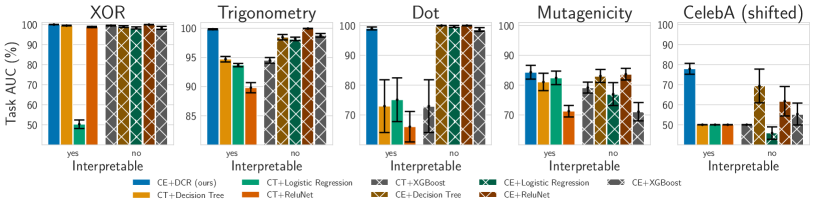
- DCR improves task accuracy by up to +25% compared to state-of-the-art interpretable concept-based models on challenging benchmarks.
- The model discovers logic rules that align with known ground-truth relationships even when no concept supervision is provided during training.
- DCR enables effective counterfactual example generation by using the learned symbolic rules as interpretable guidance.
- The aggregated behavior of DCR’s Boolean rules approximates the global model behavior and matches known factual relationships.
- DCR maintains interpretability by encoding the decision process explicitly in symbolic rules, unlike black-box neural models or neural-symbolic systems with implicit reasoning.
- The model demonstrates strong generalization across diverse data types, including tabular, image, and graph data, while preserving semantic interpretability.
Read this paper
Open the full text in the Nubint reader and ask about any passage as you read.
Read this paper on NubintThis review was generated by AI from the original paper. Please check the paper before citing it.