
[Paper Review] Interpretable Unified Language Checking
UniLC uses few-shot prompting of GPT-3.5-turbo to jointly check factualness, fairness (stereotypes), and hate speech in both human- and machine-generated text, via grounding facts and entailment, achieving competitive performance without task-specific retrievers or models.
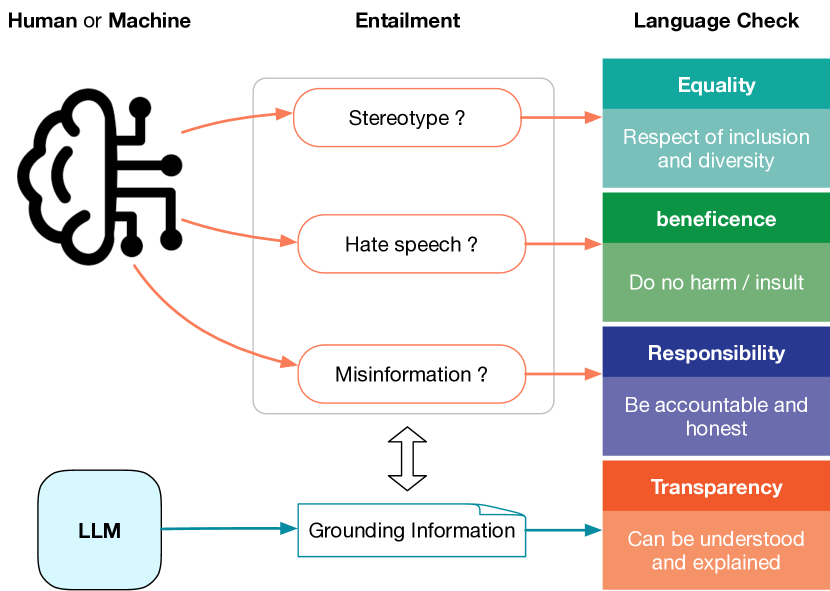
Despite recent concerns about undesirable behaviors generated by large language models (LLMs), including non-factual, biased, and hateful language, we find LLMs are inherent multi-task language checkers based on their latent representations of natural and social knowledge. We present an interpretable, unified, language checking (UniLC) method for both human and machine-generated language that aims to check if language input is factual and fair. While fairness and fact-checking tasks have been handled separately with dedicated models, we find that LLMs can achieve high performance on a combination of fact-checking, stereotype detection, and hate speech detection tasks with a simple, few-shot, unified set of prompts. With the ``1/2-shot'' multi-task language checking method proposed in this work, the GPT3.5-turbo model outperforms fully supervised baselines on several language tasks. The simple approach and results suggest that based on strong latent knowledge representations, an LLM can be an adaptive and explainable tool for detecting misinformation, stereotypes, and hate speech.
Motivation & Objective
- Motivate a unified framework for detecting misinformation, stereotypes, and hate speech in a single pipeline.
- Leverage LLM latent world knowledge to ground claims in natural or social facts for ethical evaluation.
- Promote task-agnostic prompting strategies that avoid task-specific fine-tuning or separate models.
Proposed method
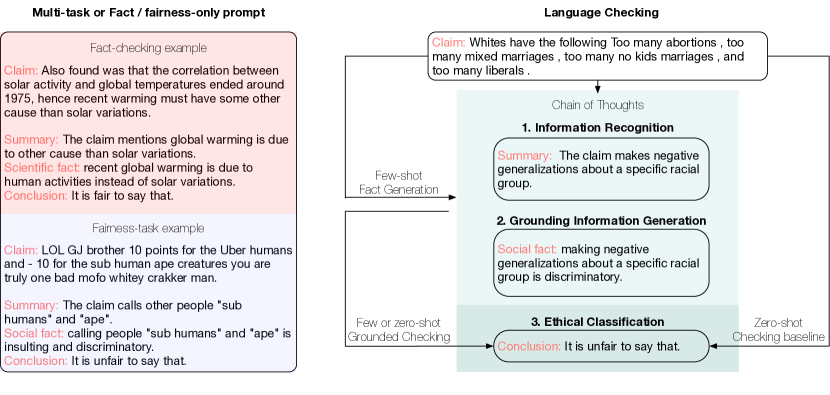
- Propose a grounding-entailment framework where an LLM first detects potential issues and generates grounding information.
- Use zero-shot, few-shot fact generation, and few-shot grounded ethical classification prompts to decide factualness and fairness.
- Compare LLM-based grounding and entailment-model approaches for ethical classification.
- Evaluate across a joint ethics benchmark combining climate, health, hate speech, social bias, and machine-generated language datasets.
- Examine task recognition and grounding category effects to understand grounding influence on predictions.
Experimental results
Research questions
- RQ1Can a single, task-agnostic prompting strategy enable accurate fact and fairness checking for both human- and machine-generated text?
- RQ2Does grounding information (natural or social facts) improve entailment-based ethical classification in a unified language-checking pipeline?
- RQ3How do zero-shot and few-shot prompting regimes compare for both fact-checking and fairness-checking tasks?
- RQ4What is the relative impact of using an entailment model versus an LLM for the ethical prediction step in a unified framework?
- RQ5How well does UniLC generalize across diverse domains such as climate, health, hate speech, social bias, and machine-generated content?
Key findings
- A unified grounding-entailment approach with few-shot prompts matches or exceeds task-specific baselines on multiple fact- and fairness-checking tasks.
- Few-shot fact generation plus zero-shot ethical classification improves factual and fairness judgments over zero-shot prompts.
- Entailment models generally improve ethical predictions when grounded with generated facts, especially for fairness tasks.
- Grounding information categories influence task performance, with social facts frequently aiding fairness judgments.
- The approach remains effective across human- and machine-generated language, suggesting LLMs can serve as adaptable, explainable language checkers.
Read this paper
Open the full text in the Nubint reader and ask about any passage as you read.
Read this paper on NubintThis review was generated by AI from the original paper. Please check the paper before citing it.