
[Paper Review] Interpreting CLIP with Sparse Linear Concept Embeddings (SpLiCE)
This paper proposes SpLiCE, a post-hoc method that decomposes CLIP's dense, uninterpretable image embeddings into sparse, nonnegative linear combinations of human-interpretable concepts without requiring concept labels or retraining. The approach achieves high interpretability with minimal performance drop on downstream tasks, enabling applications like bias detection, model editing, and distribution shift monitoring while maintaining state-of-the-art performance.
CLIP embeddings have demonstrated remarkable performance across a wide range of multimodal applications. However, these high-dimensional, dense vector representations are not easily interpretable, limiting our understanding of the rich structure of CLIP and its use in downstream applications that require transparency. In this work, we show that the semantic structure of CLIP's latent space can be leveraged to provide interpretability, allowing for the decomposition of representations into semantic concepts. We formulate this problem as one of sparse recovery and propose a novel method, Sparse Linear Concept Embeddings, for transforming CLIP representations into sparse linear combinations of human-interpretable concepts. Distinct from previous work, SpLiCE is task-agnostic and can be used, without training, to explain and even replace traditional dense CLIP representations, maintaining high downstream performance while significantly improving their interpretability. We also demonstrate significant use cases of SpLiCE representations including detecting spurious correlations and model editing.
Motivation & Objective
- To address the lack of interpretability in dense CLIP embeddings, which limits transparency in real-world applications.
- To enable post-hoc interpretation of CLIP representations without requiring concept annotations, retraining, or qualitative visualization.
- To develop a method that decomposes CLIP embeddings into sparse, human-interpretable semantic components while preserving downstream performance.
- To demonstrate practical applications of the interpretable representations, including detecting spurious correlations, model editing, and monitoring dataset distribution shifts.
Proposed method
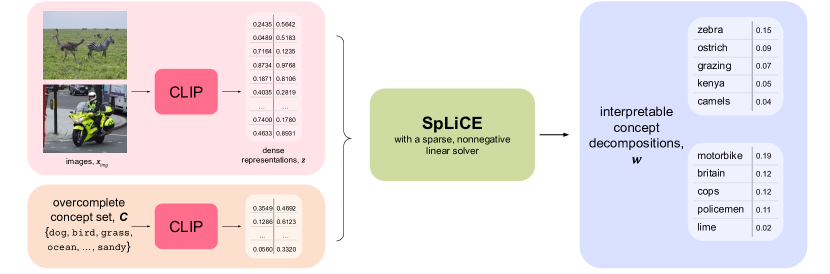
- SpLiCE formulates the interpretation task as a sparse nonnegative dictionary learning problem, solving for a sparse linear combination of pre-defined, human-interpretable concepts.
- It uses an overcomplete concept set covering common visual attributes (e.g., 'bicycle', 'yellow', 'glasses') to represent the semantic space.
- The method applies an ℓ₁ regularization (Lasso) to enforce sparsity in the concept weights, approximating ℓ₀ regularization for interpretability.
- It solves the optimization problem using convex relaxation, enabling efficient and stable decomposition of CLIP features into concept activations.
- The approach operates post-hoc, meaning it can be applied to any pre-trained CLIP model without modifying the original architecture or retraining.
- Concept weights are learned via optimization that minimizes reconstruction error between the original CLIP embedding and the sparse linear combination of concepts.
Experimental results
Research questions
- RQ1Can CLIP’s dense, high-dimensional representations be meaningfully decomposed into sparse, human-interpretable semantic components?
- RQ2Does the resulting sparse decomposition preserve downstream performance compared to the original CLIP features?
- RQ3Can SpLiCE be used to detect spurious correlations in datasets without access to ground-truth concept labels?
- RQ4Can SpLiCE enable effective model editing by modifying concept weights in the representation space?
- RQ5Can SpLiCE effectively monitor and quantify semantic distribution shifts in datasets over time?
Key findings
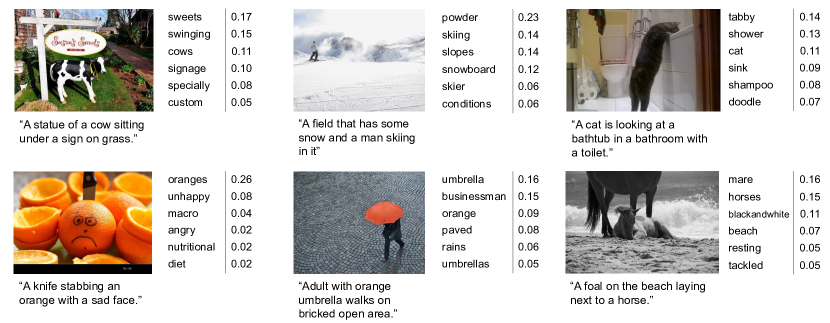
- SpLiCE achieves high sparsity (10–30 concepts per image on average) with minimal performance drop on downstream tasks, maintaining near-identical zero-shot and linear probe accuracy compared to original CLIP.
- In the gender classification task, intervention on the 'glasses' concept via SpLiCE reduced the gender classification accuracy from 0.96 to 0.69, demonstrating its ability to uncover and manipulate model biases.
- SpLiCE successfully detected the spurious correlation of women in bikinis in CIFAR100, revealing a problematic dataset bias not evident from model accuracy alone.
- In the Stanford Cars dataset, SpLiCE concept weights for 'convertible' and 'yellow' closely tracked the actual ground-truth concept prevalence over time, enabling accurate distribution shift monitoring.
- SpLiCE representations enabled effective model editing: modifying concept weights led to measurable changes in model behavior, such as reducing gender bias in facial recognition.
- The method demonstrated robustness across multiple datasets and tasks, showing that interpretable, sparse concept decompositions can serve as a reliable proxy for dense CLIP features.
Read this paper
Open the full text in the Nubint reader and ask about any passage as you read.
Read this paper on NubintThis review was generated by AI from the original paper. Please check the paper before citing it.