
[Paper Review] Interpreting DESI's evidence for evolving dark energy
The paper analyzes DESI BAO data with CMB and SNe to show hints of evolving dark energy in w0-waCDM, but argues that the result is highly sensitive to prior choices and introduces the PhantomX coincidence where w crosses -1 within the observational window.
The latest results on baryon acoustic oscillations from DESI (Dark Energy Spectroscopic Instrument), when combined with cosmic microwave background and supernova data, show indications of a deviation from a cosmological constant in favour of evolving dark energy. Use of a pivot scale for the equation of state $w$ shows that this evidence is concentrated in the derivative of $w$ rather than its mean offset from $-1$, indicating a new cosmic coincidence where the mean equation of state matches that of the $Λ$CDM model precisely in the region probed by the observations. An equivalent way to express this is to say that the dark energy hits the maximum value that it will ever achieve within the observed window. We argue that conclusions on dark energy evolution are strongly driven by the assumed parameter priors and that this coincidence, which we are naming the PhantomX coincidence (where X stands for crossing), may be a signature of this.
Motivation & Objective
- Assess robustness of DESI-based evidence for dark energy evolution under the w0-waCDM model.
- Examine how pivot scale choice affects correlations between w_p and w_a and the interpretation of results.
- Critically evaluate the role of priors in shaping inferred deviations from LambdaCDM.
- Discuss the conceptual implications of phantom crossing and the phantom coincidence for cosmology.
Proposed method
- Use the w0waCDM parametrization w(a)=w0+w_a(1-a) with flat prior ranges w0 in [-3,1], w_a in [-3,2], and constraint w0+w_a<0.
- Apply pivot scale reparameterization w_p=w0+w_a(1-a_p) to decorrelate w_p and w_a and compare effects across different pivot redshifts.
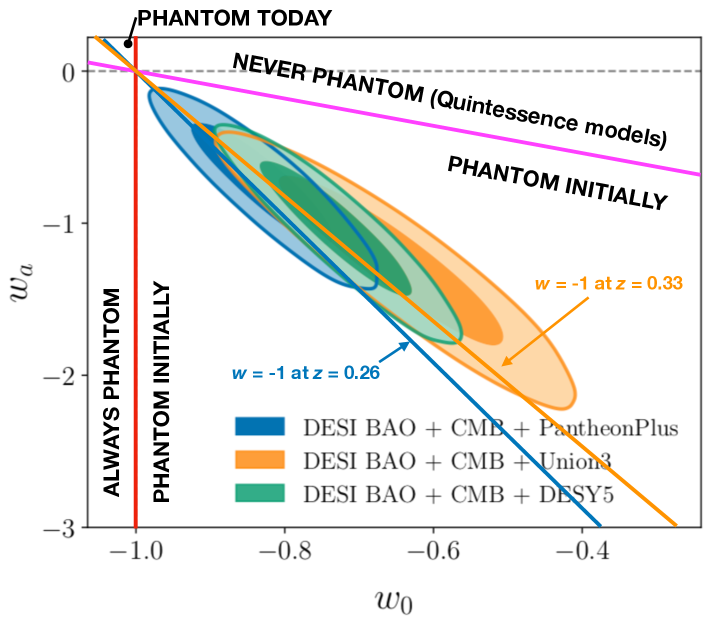
- Overlay observational contours from DESI BAO, CMB (Planck and ACT lensing), and SN datasets (PantheonPlus, Union3, DESY5) in the w0–w_a plane as in DESI’s Fig. 6.
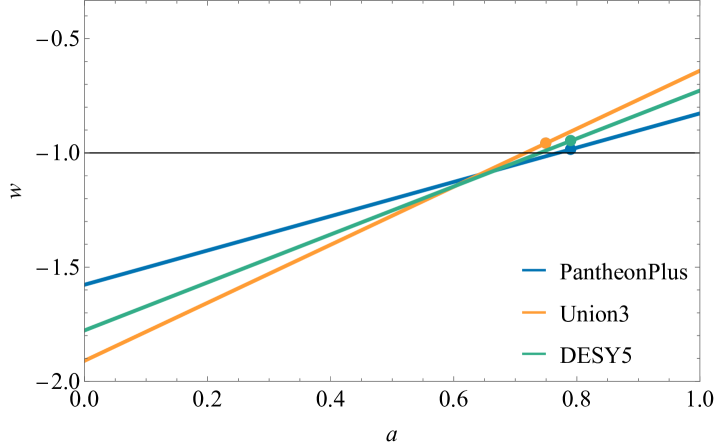
- Interpret the resulting best-fit w(a) evolutions and their proximity to w=-1 at the pivot scale, highlighting the PhantomX coincidence.
- Discuss the dependence of inferred significance on dataset choices and prior ranges, and the implications for robustness of dark energy evolution claims.
Experimental results
Research questions
- RQ1Does DESI BAO combined with CMB and SN data provide statistically significant evidence for evolving dark energy under the w0waCDM model?
- RQ2How does the pivot scale choice affect the correlation between w_p and w_a and the apparent proximity of w_p to -1?
- RQ3To what extent do prior choices influence the inferred deviation from LambdaCDM in the w0waCDM parameter space?
- RQ4What is the PhantomX coincidence and what does it imply about interpreting dark energy evolution within the observed window?
- RQ5Are the observed constraints consistent across different SN catalogs (PantheonPlus, Union3, DESY5) and across curvature assumptions?
Key findings
- DESI BAO plus CMB and SN data show constraints that align w_p with -1 along the pivot line, suggesting a near-LambdaCDM value at the pivot scale.
- Best-fit w(a) cultures start in the phantom regime, reach w≈-1 near constrained redshifts, and rise again outside the observational window, indicating evolution shapes within the observed window.
- The interpretation shows that the apparent deviation from LambdaCDM is highly sensitive to the chosen priors for w0 and w_a.
- The PhantomX coincidence is defined as the crossing of the phantom divide near the center of the observational window, implying a potential bias from prior choices rather than strong evidence for new physics.
- Shifting pivot scales decorrelates w_p and w_a and preserves contour areas, highlighting the non-robustness of the conclusion to pivot choice.
- There is an important noted tension between DESI and SDSS at similar redshifts that necessitates further data to clarify discrepancies.
Read this paper
Open the full text in the Nubint reader and ask about any passage as you read.
Read this paper on NubintThis review was generated by AI from the original paper. Please check the paper before citing it.