
[Paper Review] Interpreting Event-Studies from Recent Difference-in-Differences Methods
The paper shows that event-study plots from recent DiD methods (dCDH, CS, BJS) differ structurally from traditional TWFE plots, due to asymmetric pre/post-treatment construction, and offers practical plotting recommendations.
This note discusses the interpretation of event-study plots produced by recent difference-in-differences methods. I show that even when specialized to the case of non-staggered treatment timing, the default plots produced by software for several of the most popular recent methods do not match those of traditional two-way fixed effects (TWFE) event-studies. The plots produced by the new methods may show a kink or jump at the time of treatment even when the TWFE event-study shows a straight line. This difference stems from the fact that the new methods construct the pre-treatment coefficients asymmetrically from the post-treatment coefficients. As a result, visual heuristics for evaluating violations of parallel trends using TWFE event-study plots should not be immediately applied to those from these methods. I conclude with practical recommendations for constructing and interpreting event-study plots when using these methods.
Motivation & Objective
- Motivate how modern DiD methods produce event-study plots that differ from traditional TWFE plots.
- Explain why pre-treatment and post-treatment coefficients are constructed asymmetrically in CS/dCDH and BJS.
- Demonstrate, via simulation, how these differences affect visual interpretation of event-study plots.
- Provide practical recommendations for constructing and interpreting event-study plots with CS/dCDH and BJS.
Proposed method
- Simulates a simple non-staggered DiD setting to compare TWFE, CS, dCDH, and BJS event-studies.
- Mathematically derives the pre/post-treatment coefficient constructions for TWFE, CS/dCDH, and BJS.
- Shows that CS/dCDH use short-differences before treatment and long-differences after treatment, creating a potential kink.
- Demonstrates that BJS uses asymmetric imputation and pre-treatment averaging, leading to differences from TWFE plots.
- Offers practical remedies such as using universal base period or long-differences to align plots with conventional interpretations.
Experimental results
Research questions
- RQ1Do event-study plots from dCDH, CS, and BJS align with traditional TWFE plots in non-staggered settings?
- RQ2Why do modern DiD event-studies exhibit kinks or jumps near treatment dates despite parallel trends?
- RQ3How does the construction of pre-treatment vs post-treatment coefficients differ across methods?
- RQ4What practical steps can researchers take to render these plots more comparable and interpretable?
Key findings
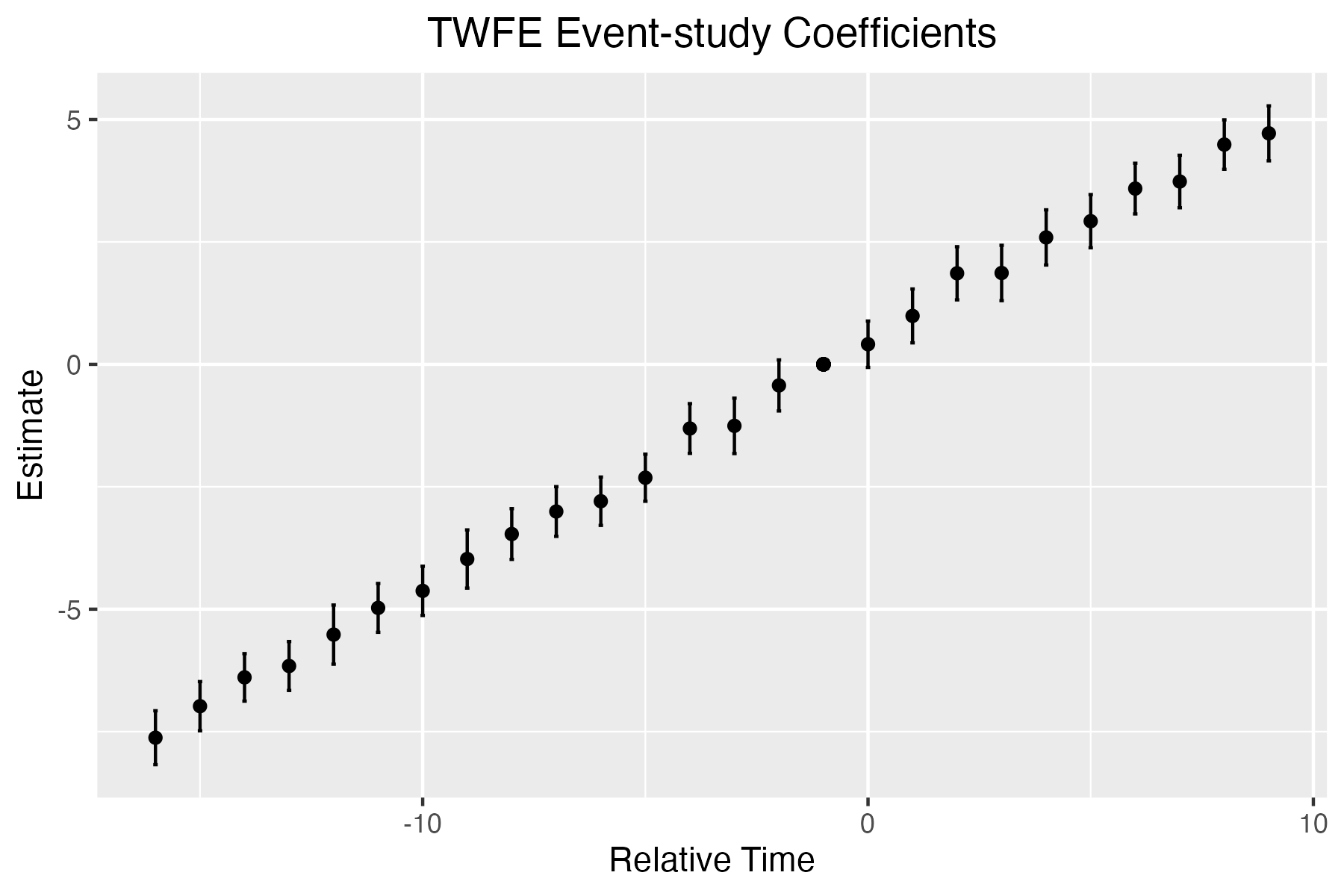
- TWFE event-studies in the non-staggered setting produce a linear pre-treatment trend that continues post-treatment.
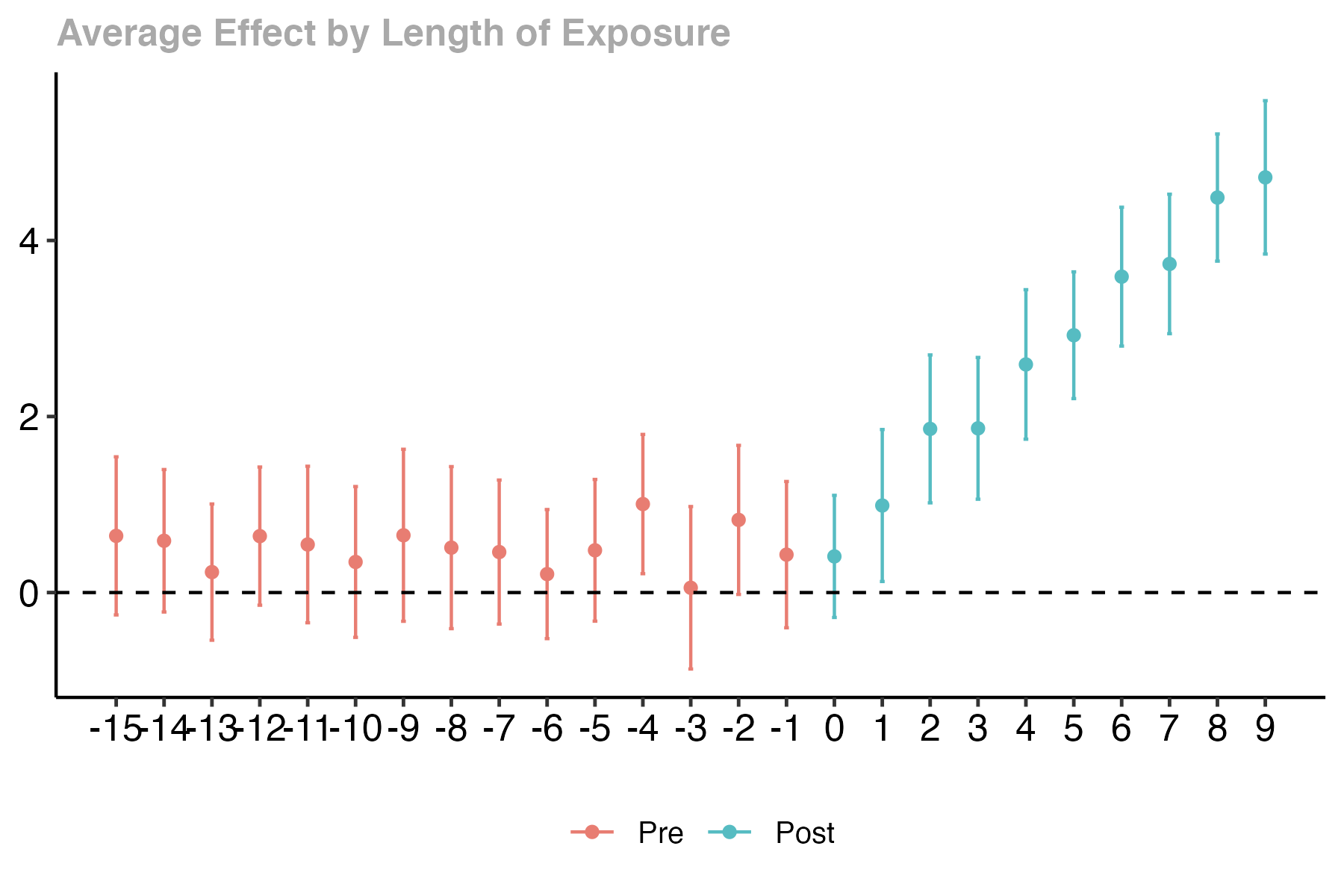
- CS and dCDH produce a kink at the treatment date due to asymmetric pre-treatment (short-differences) and post-treatment (long-differences) construction.
- BJS can show an upward pre-trend with a sharp downward jump at treatment, reflecting its imputation-based and asymmetric design.
- The asymmetry in pre/post-treatment construction explains why visual heuristics from TWFE plots mislead when applied to CS/dCDH and BJS plots.
- Using long-differences for pre-treatment coefficients (universal base period) can make CS/dCDH plots more comparable to TWFE plots.
- Pre-treatment tests of parallel trends and post-treatment effect estimates remain valid under their respective assumptions, but visualization should be interpreted cautiously.
Better researchstarts right now
From reading papers to final review, dramatically reduce your research time.
No credit card · Free plan available
This review was created by AI and reviewed by human editors.