
[Paper Review] Interstellar Objects and Exocomets
This paper reviews the formation, detection, and evolution of exocomets and interstellar objects (ISOs), synthesizing recent theoretical and observational advances. It highlights the discovery of 1I/‘Oumuamua and 2I/Borisov, revealing a diverse ISO population with varying activity levels, and projects future missions and survey capabilities that could enable in-situ exploration of these interstellar bodies.
In this chapter we review our knowledge of our galaxy's cometary population outside our Oort Cloud - exocomets and Interstellar Objects (ISOs). We start with a brief overview of planetary system formation, viewed as a general process around stars. We then take a more detailed look at the creation and structure of exocometary belts, as revealed by the unprecedented combination of theoretical and observational advances in recent years. The existence and characteristics of individual exocomets orbiting other stars is summarized, before looking at the mechanisms by which they may be ejected into interstellar space. The discovery of the first two ISOs is then described, along with the surprising differences in their observed characteristics. We end by looking ahead to what advances may take place in the next decade.
Motivation & Objective
- To synthesize current knowledge on exocomets and interstellar objects (ISOs) in the context of planetary system formation and evolution.
- To examine the mechanisms by which exocomets are ejected into interstellar space, becoming ISOs, and how their physical properties are altered during ejection and interstellar travel.
- To analyze the contrasting characteristics of the first two observed ISOs—1I/‘Oumuamua and 2I/Borisov—and assess their implications for ISO population diversity.
- To evaluate future observational and mission strategies for detecting and visiting ISOs, including launch-on-detection and standby mission concepts.
- To project how upcoming surveys (e.g., LSST) and technological advances will improve ISO detection and characterization in the next decade.
Proposed method
- Combines theoretical models of planetary system formation and cometary belt dynamics with observational data from resolved disk imaging, spectroscopy, and white dwarf atmospheric composition analysis.
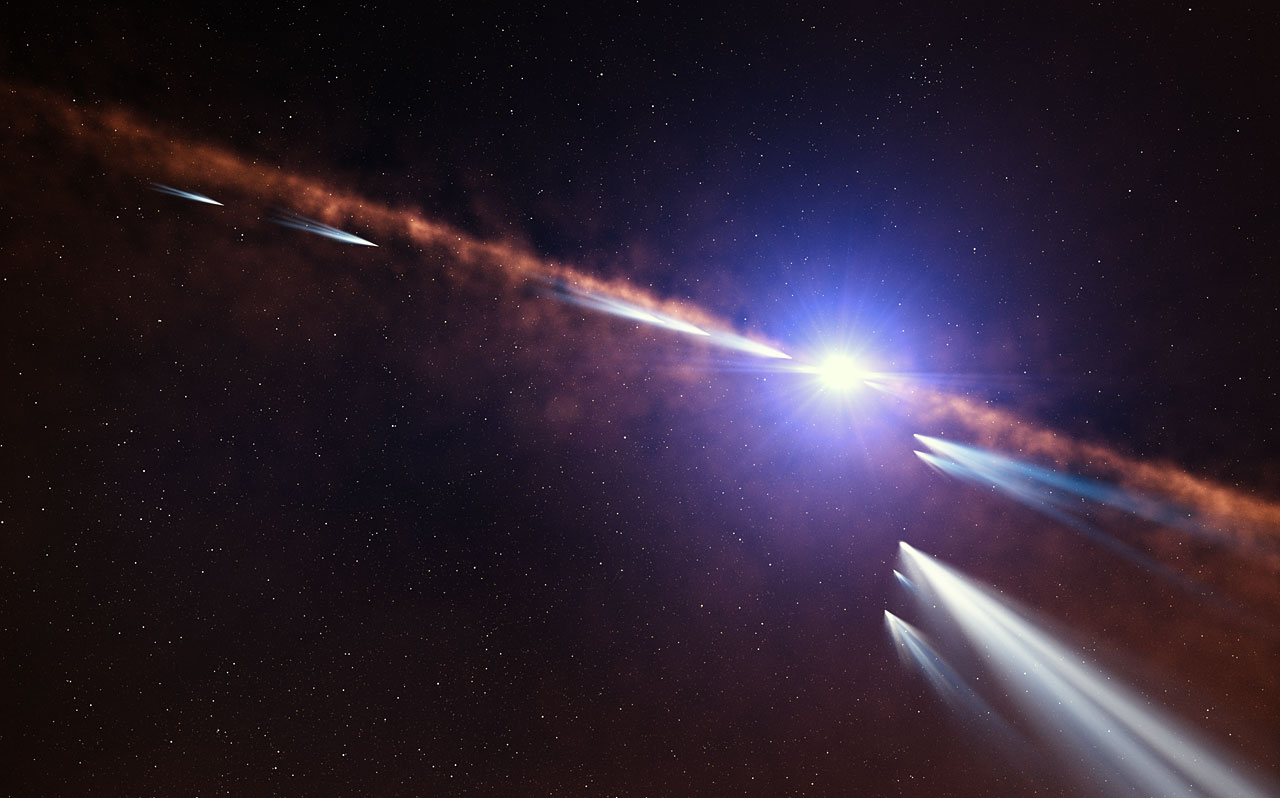
- Uses data from resolved circumstellar disks, including the β Pictoris system, to infer the presence and structure of exocometary belts.
- Analyzes the physical and dynamical processes leading to ejection of planetesimals into interstellar space, including gravitational scattering in binary systems.
- Reviews observational evidence for exocomet activity via gas detections in extrasolar Kuiper belts and dust transits, using IR and sub-mm wavelength observations.
- Evaluates mission design options for flyby and rendezvous with ISOs, including trajectory modeling for 1I/‘Oumuamua and 2I/Borisov using solar sails and high-Δv maneuvers.
- Assesses the impact of future surveys (e.g., LSST) on ISO discovery rates, using sensitivity limits and detection probabilities based on albedo and perihelion distance.
Experimental results
Research questions
- RQ1What mechanisms lead to the ejection of exocomets from planetary systems, and how do these processes affect their physical properties before becoming ISOs?
- RQ2Why do the two known ISOs—1I/‘Oumuamua and 2I/Borisov—exhibit such different activity levels despite both originating from exo-cometary populations?
- RQ3To what extent do the observed properties of ISOs reflect their origin, age, or perihelion passage history?
- RQ4How will upcoming wide-field surveys like LSST improve the detection of ISOs, and what implications does this have for mission planning?
- RQ5What mission architectures (e.g., launch-on-detection, standby orbits, solar sails) are most viable for achieving close flybys or rendezvous with ISOs?
Key findings
- Exocomets are common in nearby stellar systems, with growing observational evidence from resolved disks, gas detections in extrasolar Kuiper belts, and white dwarf atmospheric compositions.
- The discovery of 1I/‘Oumuamua and 2I/Borisov confirms that ISOs are a real and diverse population, with 1I/‘Oumuamua showing no detectable activity despite being observed at 1.2–2.8 au from the Sun.
- 2I/Borisov was clearly active from first detection, confirming that many ISOs are likely cometary in nature, while 1I/‘Oumuamua’s lack of activity suggests it may be a dormant or volatile-poor object.
- Theoretical models suggest that a significant fraction of ISOs may be asteroidal (C- or S-type) rather than cometary, indicating a continuum of physical properties rather than a sharp distinction.
- Current mission concepts for ISO encounters are limited to fast flybys due to high required velocities (often >10 km/s), with rendezvous missions requiring advanced propulsion like solar sails.
- The LSST survey is expected to increase ISO discovery rates by detecting fainter, more distant objects, including inactive ISOs with 1 km nuclei at up to 5.5 au, enabling earlier detection and mission planning.
Read this paper
Open the full text in the Nubint reader and ask about any passage as you read.
Read this paper on NubintThis review was generated by AI from the original paper. Please check the paper before citing it.