
[Paper Review] Intriguing Properties of Quantization at Scale
This paper demonstrates that quantization-induced performance degradation in large language models is not an inevitable emergent property of scale, but rather a consequence of specific optimization choices during pre-training. By carefully tuning hyperparameters like weight decay, gradient clipping, and precision, the authors train models from 410M to 52B parameters that achieve near-zero performance drop (0.26% average degradation) under simple INT8 post-training quantization, proving that quantization-friendly models can be systematically designed through optimization.
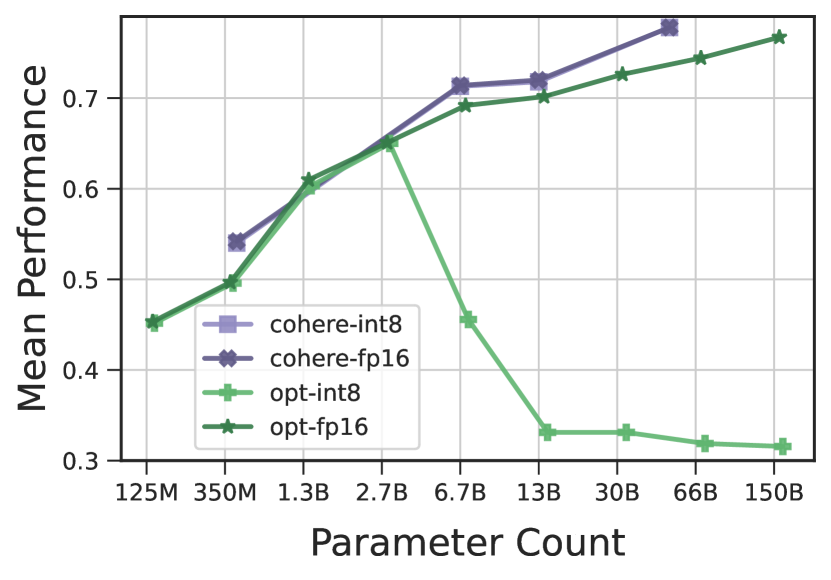
Emergent properties have been widely adopted as a term to describe behavior not present in smaller models but observed in larger models. Recent work suggests that the trade-off incurred by quantization is also an emergent property, with sharp drops in performance in models over 6B parameters. In this work, we ask "are quantization cliffs in performance solely a factor of scale?" Against a backdrop of increased research focus on why certain emergent properties surface at scale, this work provides a useful counter-example. We posit that it is possible to optimize for a quantization friendly training recipe that suppresses large activation magnitude outliers. Here, we find that outlier dimensions are not an inherent product of scale, but rather sensitive to the optimization conditions present during pre-training. This both opens up directions for more efficient quantization, and poses the question of whether other emergent properties are inherent or can be altered and conditioned by optimization and architecture design choices. We successfully quantize models ranging in size from 410M to 52B with minimal degradation in performance.
Motivation & Objective
- To investigate whether quantization performance cliffs in large language models are inherent to model scale or influenced by optimization choices.
- To determine if large models can be trained to be inherently more amenable to simple post-training quantization (PTQ) without mixed-precision or fine-tuning.
- To identify specific pre-training hyperparameters that suppress activation outliers and improve quantization robustness.
- To demonstrate that quantization-friendly models can be trained from random initialization across a wide range of model sizes, from 410M to 52B parameters.
Proposed method
- A controlled large-scale study was conducted, training identical architectures with varying optimization hyperparameters including weight decay, gradient clipping, dropout, and mixed-precision training.
- The authors systematically varied key training hyperparameters—such as weight decay, gradient clipping, and precision—while keeping architecture and data constant across models from 410M to 52B parameters.
- Post-training quantization (PTQ) was applied using standard INT8 quantization for both weights and activations, with no fine-tuning or calibration on downstream data.
- The authors analyzed activation and weight distributions across models to identify outlier dimensions and correlate them with optimization choices.
- They evaluated performance across 8 zero-shot NLP benchmarks (HellaSwag, PIQA, LAMBADA, WinoGrad, etc.) to measure quantization impact.
- A fine-grained analysis of activation magnitudes and weight distributions was performed to link optimization choices to quantization robustness.
Experimental results
Research questions
- RQ1Is the performance degradation observed in large models under quantization an emergent property of scale, or can it be mitigated by optimization choices during pre-training?
- RQ2Which specific training hyperparameters—such as weight decay, gradient clipping, or precision—most significantly influence the presence of activation outliers?
- RQ3Can models as large as 52B parameters be quantized with minimal performance loss using only standard post-training quantization (PTQ) without mixed-precision decomposition?
- RQ4To what extent can the distribution of activations and weights be shaped during pre-training to improve compatibility with low-precision inference?
- RQ5Are the differences in quantization sensitivity between models like OPT and BLOOM due to architectural differences or optimization strategies?
Key findings
- The authors successfully quantized models ranging from 410M to 52B parameters using only standard INT8 post-training quantization, with only 0.26% average performance degradation across 8 zero-shot tasks.
- The 52B parameter model showed negligible degradation—0.26% average drop—under simple INT8 PTQ, demonstrating that large-scale models can be quantized without complex mixed-precision techniques.
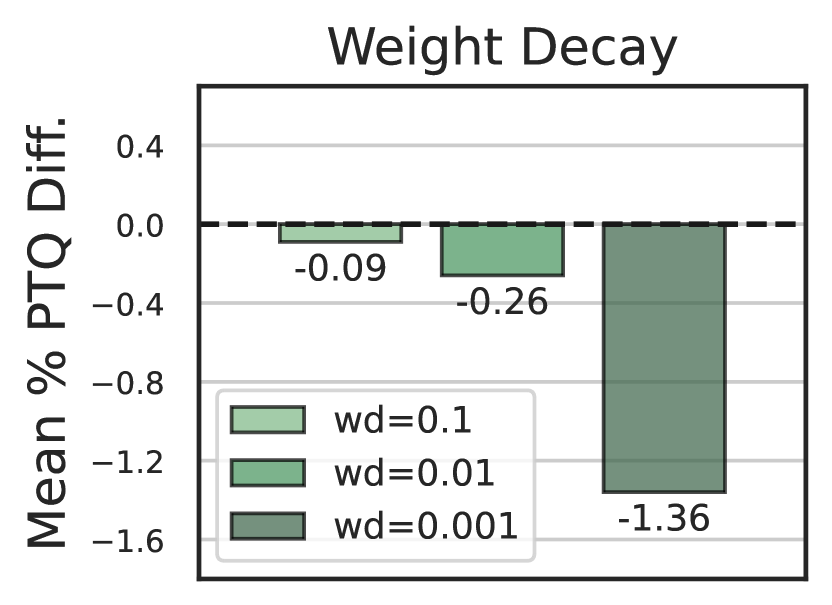
- Activation outliers, previously thought to be an emergent property of scale, were shown to be sensitive to optimization hyperparameters such as weight decay and gradient clipping.
- Models trained with higher weight decay and lower gradient clipping exhibited significantly reduced activation outlier magnitudes, leading to better quantization robustness.
- The study found that the difference in quantization sensitivity between models like OPT and BLOOM is not due to architecture or scale per se, but rather to pre-training optimization choices.
- A controlled ablation study confirmed that specific hyperparameter combinations suppress outlier dimensions, enabling effective quantization without specialized quantization methods.
Read this paper
Open the full text in the Nubint reader and ask about any passage as you read.
Read this paper on NubintThis review was generated by AI from the original paper. Please check the paper before citing it.