
[Paper Review] Introducing the ISE Methodology: A Powerful New Tool for Topological Redescription
The paper introduces the ISE Methodology (Internalize, Search, Externalize) for topological redescription, and demonstrates its use by redescribing a Fourier-transformed spacetime theory and a lattice theory on continuous spacetime.
This paper introduces a powerful new tool for topological redescription, the ISE Methodology. These tools allow us to remove and replace a theory's topological underpinnings just as easily as we can switch between different coordinate systems. Aspirationally, these novel topological redescription techniques can be used to provide new support for a roughly Kantian view of space and time; Rather than corresponding to any fundamental substances or relations, we can see the spacetime manifolds which appear in our theories as merely being an aspect of how we represent the world. This view of spacetime topology parallels the dynamic-first view of geometry as well as a Humean view of laws; The spacetime manifolds which feature in our best theories reflect nothing metaphysically substantial in the world beyond them it being one particularly nice way (among others) of codifying the dynamical behavior of matter. A parallel publication (namely, Grimmer (2023)) will explicitly characterize the power and scope of the topological redescription techniques offered to us by the ISE Methodology. The modest goal of this paper is simply to introduce the ISE Methodology by applying it to two example theories. Firstly, to familiarize ourselves with these techniques, I will show how they can be used to redescribe a spacetime theory via a Fourier transform. Secondly, I will show how the exact same techniques can be used to redescribe a lattice theory (i.e., a theory set on a discrete spacetime, M=RxZ) as existing on a continuous spacetime manifold,M=RxR.
Motivation & Objective
- Motivate a Kantian-like spacetime codification view by showing spacetime manifolds are representations rather than fundamental substances or relations.
- Introduce the ISE Methodology (Internalize, Search, Externalize) as a tool to maneuver between topological descriptions of theories.
- Demonstrate the methodology with concrete examples: a Fourier-transform redescription of a spacetime theory and a lattice-to-continuum redescription.
- Clarify how PSTOs (pre-spacetime translation operations) generate new candidate spacetime settings from a theory’s state space.
- Outline the potential philosophical and methodological consequences of having multiple spacetime descriptions via topological redescription.
Proposed method
- Define the three-step ISE workflow: Internalize to detach dynamics from old topological structure, Search to identify pre-spacetime translation operations (PSTOs), Externalize to treat PSTOs as spacetime translations in a new setting.
- Use PSTOs as smooth transformations on theory states that mimic spacetime translations, including translations in Fourier space and continuous translations on lattices.
- Externalize by building a new spacetime setting where chosen PSTOs become genuine spacetime translations, often related by a transformation such as a Fourier transform.
- Apply the methodology to concrete theories: redescribing a simple Fourier-type shift and redescribing a lattice theory on a continuous manifold.
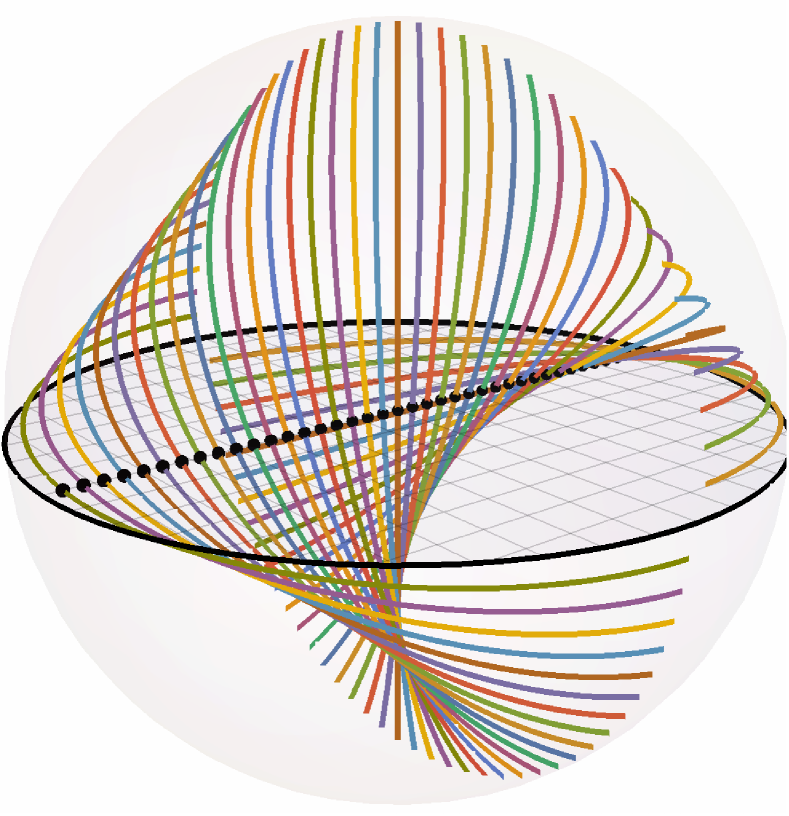
- Show that internalization can preserve key dynamical and algebraic structures while revealing topological information about the old spacetime via surviving diffeomorphisms and homogeneous-manifold structure.
Experimental results
Research questions
- RQ1Can the ISE Methodology generate valid topological redescriptions of physical theories without relying on traditional spacetime manifolds?
- RQ2To what extent can PSTOs be identified and externalized to yield new spacetime settings that preserve or reinterpret dynamics?
- RQ3How does the Fourier-space and lattice-to-continuum redescription illuminate the relation between representation and spacetime topology?
- RQ4What philosophical stance on spacetime (spacetime codificationism) does the ISE Methodology empirically and conceptually support?
- RQ5What are the limits and scope of internalization in removing topological background while preserving dynamical content?
Key findings
- The ISE Methodology provides a systematic route to remove and replace a theory’s topological background much like switching coordinate systems.
- PSTOs are concrete smooth transformations on a theory’s states that act like spacetime translations and can be externalized to create a new spacetime setting.
- A Fourier-shift example shows that a theory’s spacetime description can be redescribed via a Fourier transform, yielding a new spacetime where Fourier-space translations are actual spacetime translations.
- A lattice theory on discrete spacetime can be redescribed on a continuous spacetime by using continuous PSTOs that interpolate between discrete translations, revealing a hidden dynamical symmetry.
- Internalization can preserve the old spacetime’s topological information through surviving diffeomorphisms and can reconstruct the old spacetime from surviving Lie-group structures in the neutral theory.
Read this paper
Open the full text in the Nubint reader and ask about any passage as you read.
Read this paper on NubintThis review was generated by AI from the original paper. Please check the paper before citing it.