
[Paper Review] Invariant Learning via Probability of Sufficient and Necessary Causes
This paper proposes a novel invariant learning framework that leverages the probability of sufficiency and necessity (PNS) to identify causal representations that are both necessary and sufficient for out-of-distribution (OOD) generalization. By introducing a PNS risk objective and theoretically bounding its generalization gap, the method learns robust, disentangled representations that improve OOD performance across synthetic and real-world benchmarks, outperforming state-of-the-art methods.
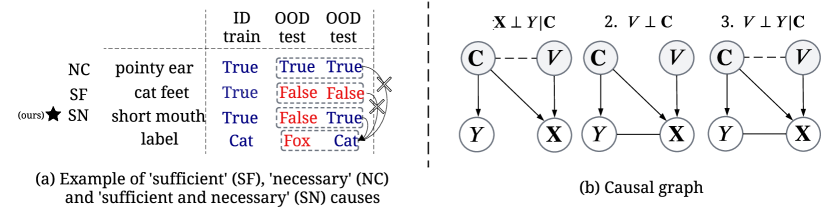
Out-of-distribution (OOD) generalization is indispensable for learning models in the wild, where testing distribution typically unknown and different from the training. Recent methods derived from causality have shown great potential in achieving OOD generalization. However, existing methods mainly focus on the invariance property of causes, while largely overlooking the property of extit{sufficiency} and extit{necessity} conditions. Namely, a necessary but insufficient cause (feature) is invariant to distribution shift, yet it may not have required accuracy. By contrast, a sufficient yet unnecessary cause (feature) tends to fit specific data well but may have a risk of adapting to a new domain. To capture the information of sufficient and necessary causes, we employ a classical concept, the probability of sufficiency and necessary causes (PNS), which indicates the probability of whether one is the necessary and sufficient cause. To associate PNS with OOD generalization, we propose PNS risk and formulate an algorithm to learn representation with a high PNS value. We theoretically analyze and prove the generalizability of the PNS risk. Experiments on both synthetic and real-world benchmarks demonstrate the effectiveness of the proposed method. The details of the implementation can be found at the GitHub repository: https://github.com/ymy4323460/CaSN.
Motivation & Objective
- To address the limitation of existing invariant learning methods that focus only on invariant causes while neglecting sufficiency and necessity conditions.
- To improve out-of-distribution (OOD) generalization by identifying representations that are both necessary and sufficient for accurate prediction.
- To formalize a new risk objective—PNS risk—that quantifies the probability of a feature being a necessary and sufficient cause.
- To theoretically bound the generalization gap between source and test domain PNS risk under OOD settings.
- To develop an algorithm that learns representations with low PNS risk, ensuring stability and robustness in unseen distributions.
Proposed method
- Proposes a new risk objective, PNS risk, defined as the probability that a feature is both necessary and sufficient for predicting the label.
- Uses counterfactual reasoning to estimate PNS values from observational data under known causal graphs.
- Derives theoretical bounds on the generalization gap between PNS risk on source domains and test domains using PAC learning frameworks.
- Designs an optimization algorithm that minimizes PNS risk during representation learning, promoting robustness to distribution shift.
- Implements the method in a semantic separable representation space, enforcing monotonicity and exogeneity conditions.
- Employs a contrastive-like objective but grounds it in counterfactual PNS reasoning rather than instance-level contrastivity.
Experimental results
Research questions
- RQ1Can PNS risk serve as a reliable proxy for identifying causal features that are both necessary and sufficient for prediction?
- RQ2How does the PNS risk on source domains relate to its value on unseen test domains under distribution shift?
- RQ3Can minimizing PNS risk lead to better OOD generalization compared to existing invariant risk minimization methods?
- RQ4What theoretical guarantees can be provided for the generalization performance of models trained with PNS risk?
- RQ5How does the proposed method compare empirically to state-of-the-art OOD generalization baselines on synthetic and real-world data?
Key findings
- The proposed method achieves state-of-the-art performance on both synthetic and real-world OOD generalization benchmarks, demonstrating superior robustness.
- Theoretical analysis shows that the PNS risk on source domains provides a tight approximation of the risk on unseen test domains.
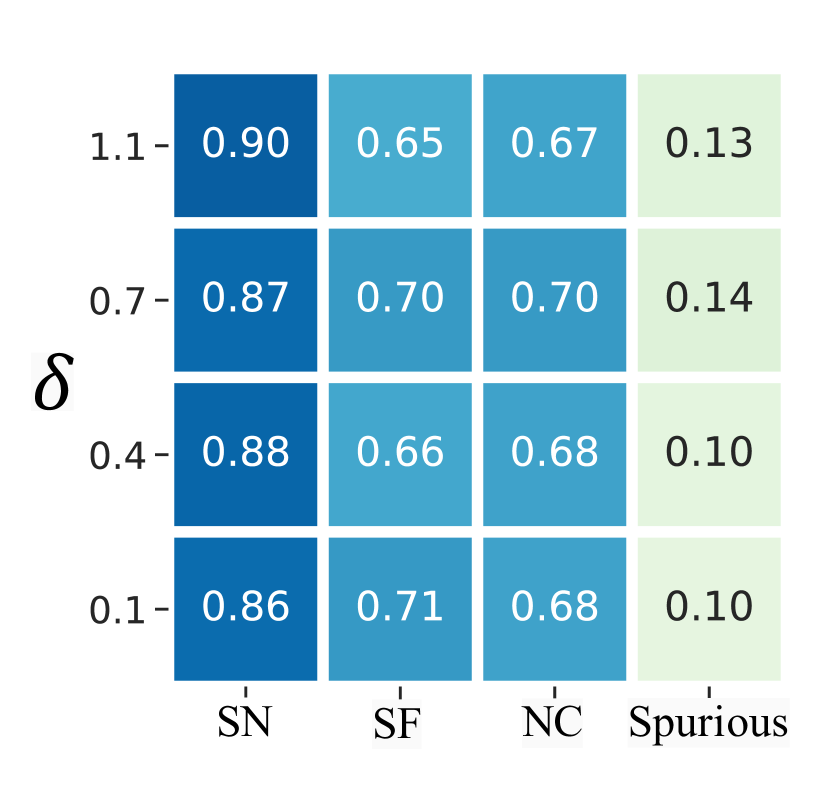
- Experiments confirm that representations with low PNS risk generalize better across domain shifts, especially in worst-case scenarios.
- The method successfully captures both necessary and sufficient causal features, avoiding reliance on spurious correlations.
- The GitHub implementation (https://github.com/ymy4323460/CaSN) enables reproducibility and further research in causal representation learning.
Read this paper
Open the full text in the Nubint reader and ask about any passage as you read.
Read this paper on NubintThis review was generated by AI from the original paper. Please check the paper before citing it.