
[Paper Review] Investigating the Catastrophic Forgetting in Multimodal Large Language Models
The paper introduces EMT, a framework to evaluate catastrophic forgetting in multimodal LLMs by treating them as image classifiers, revealing that most fine-tuned MLLMs lose alignment with their base vision encoders and exhibit hallucinations during fine-tuning. It also analyzes how different fine-tuning regimes on LLaVA impact generalization and hallucinations.
Following the success of GPT4, there has been a surge in interest in multimodal large language model (MLLM) research. This line of research focuses on developing general-purpose LLMs through fine-tuning pre-trained LLMs and vision models. However, catastrophic forgetting, a notorious phenomenon where the fine-tuned model fails to retain similar performance compared to the pre-trained model, still remains an inherent problem in multimodal LLMs (MLLM). In this paper, we introduce EMT: Evaluating MulTimodality for evaluating the catastrophic forgetting in MLLMs, by treating each MLLM as an image classifier. We first apply EMT to evaluate several open-source fine-tuned MLLMs and we discover that almost all evaluated MLLMs fail to retain the same performance levels as their vision encoders on standard image classification tasks. Moreover, we continue fine-tuning LLaVA, an MLLM and utilize EMT to assess performance throughout the fine-tuning. Interestingly, our results suggest that early-stage fine-tuning on an image dataset improves performance across other image datasets, by enhancing the alignment of text and visual features. However, as fine-tuning proceeds, the MLLMs begin to hallucinate, resulting in a significant loss of generalizability, even when the image encoder remains frozen. Our results suggest that MLLMs have yet to demonstrate performance on par with their vision models on standard image classification tasks and the current MLLM fine-tuning procedure still has room for improvement.
Motivation & Objective
- Motivate and quantify catastrophic forgetting in multimodal large language models (MLLMs).
- Develop EMT, an evaluation framework that treats MLLMs as image classifiers to assess memory retention of vision-encoder capabilities.
- Investigate how fine-tuning affects MLLMs through experiments on open-source models and LLaVA.
- Examine failure modes such as hallucinations and identify conditions under which moderate fine-tuning can improve generalization.
Proposed method
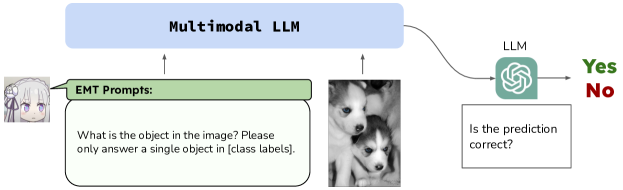
- Introduce EMT: a two-stage evaluation where an MLLM is prompted to classify images and its outputs are post-processed to obtain accuracy.
- Treat each MLLM as an image classifier and compare its zero-shot vision-encoder performance to its fine-tuned performance.
- Use a secondary LLM (GPT-3.5) to assess the correctness of MLLM outputs for each dataset.
- Apply EMT to open-source MLLMs (LLaVA, Otter, InstructBLIP, LENS) to diagnose forgetting and hallucinations.
- Fine-tune LLaVA (7b and 13b) with linear and LoRA adapters and apply EMT to monitor performance across epochs.
- Analyze failure modes including incorrect predictions, intrinsic hallucination, and extrinsic hallucination.
Experimental results
Research questions
- RQ1Do open-source fine-tuned MLLMs retain comparable classification performance to their vision encoders on standard image tasks?
- RQ2How does fine-tuning a multimodal LLM affect its cross-dataset generalization and propensity to hallucinate?
- RQ3What are the main causes of performance degradation in MLLMs during fine-tuning?
- RQ4Can moderate fine-tuning improve feature alignment without substantial forgetting or hallucinations?
Key findings
- Most tested open-source MLLMs fail to retain the same classification accuracy as their vision encoders in EMT evaluations.
- Hallucination is a major contributor to performance degradation, including producing multiple labels or unverifiable descriptions.
- Fine-tuning LLaVA shows that early-stage fine-tuning can improve alignment across datasets, but excessive fine-tuning leads to hallucinations and reduced generalizability.
- Moderate fine-tuning improves non-fine-tuned task performance, indicating improved feature alignment, while overfitting causes forgetting and hallucinations.
- Base language model choice (e.g., LLaMA vs Flan-T5) may influence the extent of forgetting, with some models showing larger deficits.
Read this paper
Open the full text in the Nubint reader and ask about any passage as you read.
Read this paper on NubintThis review was generated by AI from the original paper. Please check the paper before citing it.