
[Paper Review] Investigating the role of model-based learning in exploration and transfer
This paper investigates when and why model-based reinforcement learning enhances transfer learning by pre-training agents via intrinsic exploration in reward-free environments, then fine-tuning on downstream tasks. It demonstrates that model-based agents outperform model-free baselines in transfer, with the dynamics model and policy prior being critical for success, especially under in-distribution conditions.
State of the art reinforcement learning has enabled training agents on tasks of ever increasing complexity. However, the current paradigm tends to favor training agents from scratch on every new task or on collections of tasks with a view towards generalizing to novel task configurations. The former suffers from poor data efficiency while the latter is difficult when test tasks are out-of-distribution. Agents that can effectively transfer their knowledge about the world pose a potential solution to these issues. In this paper, we investigate transfer learning in the context of model-based agents. Specifically, we aim to understand when exactly environment models have an advantage and why. We find that a model-based approach outperforms controlled model-free baselines for transfer learning. Through ablations, we show that both the policy and dynamics model learnt through exploration matter for successful transfer. We demonstrate our results across three domains which vary in their requirements for transfer: in-distribution procedural (Crafter), in-distribution identical (RoboDesk), and out-of-distribution (Meta-World). Our results show that intrinsic exploration combined with environment models present a viable direction towards agents that are self-supervised and able to generalize to novel reward functions.
Motivation & Objective
- To understand when and why model-based learning improves transfer learning in reinforcement learning.
- To isolate the contributions of different components—policy, dynamics model, and representations—during transfer.
- To evaluate transfer performance across environments with varying degrees of distribution shift (in-distribution vs. out-of-distribution).
- To compare model-based and model-free agents under identical architectures and intrinsic exploration mechanisms.
- To assess the impact of pre-training on environment dynamics and exploration quality for downstream task generalization.
Proposed method
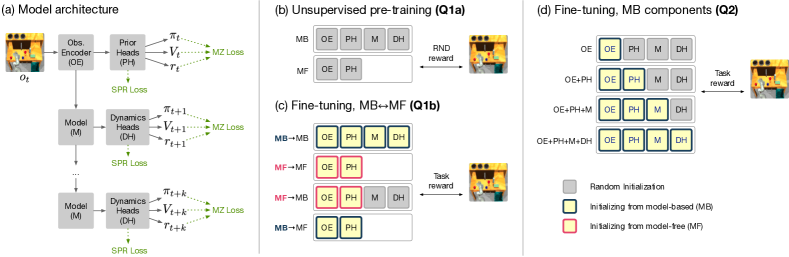
- Pre-train agents using intrinsic exploration via Random Network Distillation (RND) in a reward-free environment.
- Use a self-supervised MuZero variant with self-predictive representations (SPR) to train both policy and dynamics models.
- Fine-tune pre-trained agents on downstream tasks with task-specific rewards, transferring specific components (e.g., dynamics model, policy prior).
- Conduct ablation studies by reinitializing specific components (e.g., policy or dynamics) to isolate their contribution to transfer.
- Evaluate performance across three domains: procedural (Crafter), identical (RoboDesk), and out-of-distribution (Meta-World).
- Use return curves and zero-shot transfer metrics to compare model-based and model-free transfer performance.
Experimental results
Research questions
- RQ1Does model-based exploration lead to better transfer performance than model-free exploration in the absence of task rewards?
- RQ2Which components of a model-based agent—policy, dynamics model, or representations—contribute most to successful transfer?
- RQ3How does environmental shift (e.g., out-of-distribution dynamics) affect the transferability of knowledge from pre-training to fine-tuning?
- RQ4Is the advantage of model-based learning consistent across different types of environment distributions (procedural, identical, out-of-distribution)?
Key findings
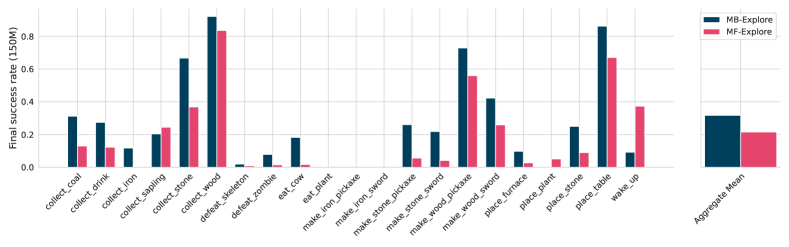
- Model-based agents outperform model-free baselines in both intrinsic exploration and downstream fine-tuning, especially in in-distribution settings.
- Transferring both the dynamics model and the policy prior leads to the strongest transfer performance, indicating that both components are essential.
- The model-based advantage is most pronounced when the dynamics model is trained on the same environment as the downstream task.
- Transfer performance degrades significantly in out-of-distribution settings like Meta-World, where the agent’s knowledge of dynamics is insufficient for positive transfer.
- In Meta-World, model-based transfer only provides a small early training advantage (up to ~20 million frames) over random initialization, suggesting limited generalization under high distribution shift.
- The procedural variation in Crafter enhances transfer, likely due to richer dynamics exposure during pre-training, which supports better generalization to new reward functions.
Read this paper
Open the full text in the Nubint reader and ask about any passage as you read.
Read this paper on NubintThis review was generated by AI from the original paper. Please check the paper before citing it.