
[Paper Review] Iris-SAM: Iris Segmentation Using a Foundation Model
The paper fine-tunes Segment Anything Model (SAM) with Focal Loss for iris segmentation, achieving state-of-the-art IoU on multiple iris datasets and demonstrating strong cross-dataset generalization.
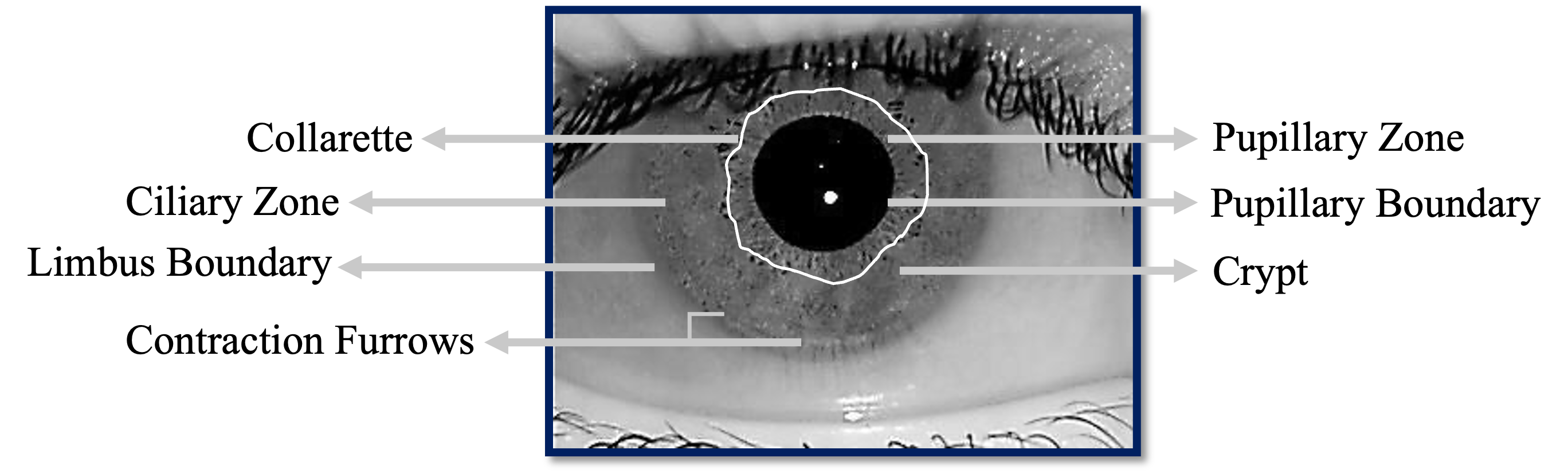
Iris segmentation is a critical component of an iris biometric system and it involves extracting the annular iris region from an ocular image. In this work, we develop a pixel-level iris segmentation model from a foundational model, viz., Segment Anything Model (SAM), that has been successfully used for segmenting arbitrary objects. The primary contribution of this work lies in the integration of different loss functions during the fine-tuning of SAM on ocular images. In particular, the importance of Focal Loss is borne out in the fine-tuning process since it strategically addresses the class imbalance problem (i.e., iris versus non-iris pixels). Experiments on ND-IRIS-0405, CASIA-Iris-Interval-v3, and IIT-Delhi-Iris datasets convey the efficacy of the trained model for the task of iris segmentation. For instance, on the ND-IRIS-0405 dataset, an average segmentation accuracy of 99.58% was achieved, compared to the best baseline performance of 89.75%.
Motivation & Objective
- Motivate iris segmentation as a critical step for reliable iris recognition.
- Leverage a foundation model (SAM) for precise iris segmentation through domain-specific fine-tuning.
- Address class imbalance in iris versus non-iris pixels using Focal Loss.
- Evaluate cross-dataset generalization and robustness to iris-specific challenges like eyelashes.
Proposed method
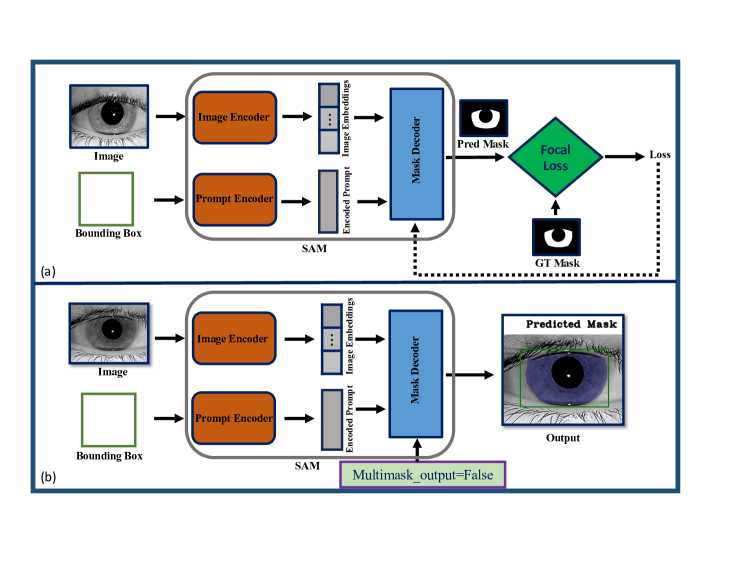
- Fine-tune Segment Anything Model (SAM) on iris images with bounding box prompts.
- Use Focal Loss to address iris/non-iris pixel class imbalance during training.
- Derive bounding boxes from ground-truth masks and apply random perturbations to improve generalization.
- Set multimask_output to False to focus SAM on a single iris mask.
- Train with SGD (learning rate 0.0001) for 100 epochs using standard metrics like IoU.
- Compare against baseline iris segmentation methods and analyze precision-recall across datasets.
Experimental results
Research questions
- RQ1Can a foundational segmentation model (SAM) be effectively adapted to iris segmentation with domain-specific fine-tuning?
- RQ2Does incorporating Focal Loss improve iris segmentation performance under class imbalance?
- RQ3What is the cross-dataset generalization capability of Iris-SAM across ND-Iris-0405, CASIA-Iris-Interval-v3, and IIT-Delhi-Iris?
Key findings
- Iris-SAM achieves average IoU of 96.94% on CASIA-Iris-Interval-v3.
- Iris-SAM achieves average IoU of 99.58% on ND-Iris-0405.
- Iris-SAM achieves average IoU of 94.34% on IIT-Delhi-Iris.
- Focal Loss outperforms Dice and Triplet losses for iris segmentation.
- A gamma value of 2 provides robust performance across datasets.
- Cross-dataset generalization scores include 93.75% (ND-Iris-0405 train → IIT-Delhi-Iris test) and 95.26% (ND-Iris-0405 train → CASIA-Iris-Interval-v3 test).
- Some predictions even exceed ground-truth masks in certain cases, highlighting improved boundary delineation.
Read this paper
Open the full text in the Nubint reader and ask about any passage as you read.
Read this paper on NubintThis review was generated by AI from the original paper. Please check the paper before citing it.