
[Paper Review] IRS-Aided WPCNs: A New Optimization Framework for Dynamic IRS Beamforming
This paper proposes a novel dynamic intelligent reflecting surface (IRS) beamforming framework for wireless powered communication networks (WPCNs), jointly optimizing IRS phase shifts and resource allocation across time to maximize sum throughput. It proves that UL-adaptive and static IRS beamforming achieve identical performance, enabling significant signaling overhead reduction, and introduces a low-complexity algorithm leveraging optimal solution structures for practical deployment.
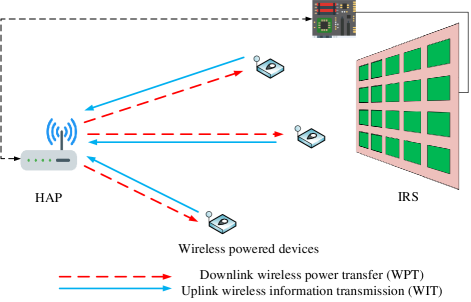
In this paper, we propose a new dynamic IRS beamforming framework to boost the sum throughput of an intelligent reflecting surface (IRS) aided wireless powered communication network (WPCN). Specifically, the IRS phase-shift vectors across time and resource allocation are jointly optimized to enhance the efficiencies of both downlink wireless power transfer (DL WPT) and uplink wireless information transmission (UL WIT) between a hybrid access point (HAP) and multiple wirelessly powered devices. To this end, we first study three special cases of the dynamic IRS beamforming,namely user-adaptive IRS beamforming, UL-adaptive IRS beamforming, and static IRS beamforming,by characterizing their optimal performance relationships and proposing corresponding algorithms. Interestingly, it is rigorously proved that the latter two cases achieve the same throughput, thus helping halve the number of IRS phase shifts to be optimized and signalling overhead practically required for UL-adaptive IRS beamforming. Then, we propose a general optimization framework for dynamic IRS beamforming, which is applicable for any given number of IRS phase-shift vectors available. Despite of the non-convexity of the general problem with highly coupled optimization variables, we propose two algorithms to solve it and particularly, the low-complexity algorithm exploits the intrinsic structure of the optimal solution as well as the solutions to the cases with user-adaptive and static IRS beamforming. Simulation results validate our theoretical findings, illustrate the practical significance of IRS with dynamic beamforming for spectral and energy efficient WPCNs, and demonstrate the effectiveness of our proposed designs over various benchmark schemes.
Motivation & Objective
- To address the challenge of low energy and spectral efficiency in wireless powered IoT networks due to long-distance signal attenuation.
- To design a dynamic IRS beamforming strategy that jointly optimizes phase shifts and resource allocation across time for improved system throughput.
- To reduce signaling overhead in IRS-aided WPCNs by proving equivalence between UL-adaptive and static beamforming strategies.
- To develop a general, scalable optimization framework applicable to any number of IRS phase-shift vectors.
Proposed method
- Proposes a new optimization framework for dynamic IRS beamforming in WPCNs, jointly optimizing IRS phase-shift vectors and time/power allocation across time slots.
- Analyzes three special cases: user-adaptive, UL-adaptive, and static IRS beamforming, deriving their optimal performance relationships.
- Proves mathematically that UL-adaptive and static IRS beamforming achieve identical sum throughput, enabling reduction in the number of phase shifts to be optimized.
- Develops two algorithms to solve the non-convex optimization problem: a high-accuracy method and a low-complexity algorithm exploiting structural insights from special cases.
- Uses Lemma 2 (inequality involving products and square roots) to bound the sum-throughput expression and derive optimality conditions.
- Constructs a contradiction-based proof to show that using multiple IRS phase-shift vectors for the same user degrades performance, justifying single-vector usage per user.
Experimental results
Research questions
- RQ1Can dynamic IRS beamforming significantly improve the sum throughput in IRS-aided WPCNs compared to static or adaptive benchmarks?
- RQ2Is there a theoretical equivalence between UL-adaptive and static IRS beamforming in terms of achievable sum throughput?
- RQ3Can the number of IRS phase-shift vectors be reduced without performance loss, and if so, under what conditions?
- RQ4How can the non-convex, highly coupled optimization problem of dynamic IRS beamforming be efficiently solved in practice?
- RQ5What is the optimal structure of IRS phase-shift vectors across time for maximizing spectral and energy efficiency in WPCNs?
Key findings
- UL-adaptive and static IRS beamforming achieve identical sum throughput, proving that the number of distinct IRS phase-shift vectors can be halved without performance degradation.
- The optimal solution for dynamic IRS beamforming requires that each user employs only one IRS phase-shift vector, as using multiple vectors for the same user leads to suboptimal performance.
- The proposed low-complexity algorithm achieves near-optimal performance by leveraging the structural insights from the static and user-adaptive beamforming cases.
- Simulation results confirm that the proposed framework significantly outperforms benchmark schemes in terms of sum throughput and energy efficiency.
- The theoretical proof of equivalence between UL-adaptive and static beamforming reduces signaling overhead and simplifies practical IRS deployment in WPCNs.

Read this paper
Open the full text in the Nubint reader and ask about any passage as you read.
Read this paper on NubintThis review was generated by AI from the original paper. Please check the paper before citing it.