
[Paper Review] Is ChatGPT a General-Purpose Natural Language Processing Task Solver?
The paper empirically analyzes ChatGPT’s zero-shot NLP capabilities across 20 datasets in 7 task categories, finding strong reasoning/dialogue performance but limits on sequence tagging and overall parity with task-specific fine-tuning.
Spurred by advancements in scale, large language models (LLMs) have demonstrated the ability to perform a variety of natural language processing (NLP) tasks zero-shot -- i.e., without adaptation on downstream data. Recently, the debut of ChatGPT has drawn a great deal of attention from the natural language processing (NLP) community due to the fact that it can generate high-quality responses to human input and self-correct previous mistakes based on subsequent conversations. However, it is not yet known whether ChatGPT can serve as a generalist model that can perform many NLP tasks zero-shot. In this work, we empirically analyze the zero-shot learning ability of ChatGPT by evaluating it on 20 popular NLP datasets covering 7 representative task categories. With extensive empirical studies, we demonstrate both the effectiveness and limitations of the current version of ChatGPT. We find that ChatGPT performs well on many tasks favoring reasoning capabilities (e.g., arithmetic reasoning) while it still faces challenges when solving specific tasks such as sequence tagging. We additionally provide in-depth analysis through qualitative case studies.
Motivation & Objective
- Assess whether ChatGPT can serve as a generalist zero-shot NLP task solver across diverse tasks.
- Characterize tasks where ChatGPT excels, especially those requiring reasoning, and identify tasks where it struggles.
- Compare ChatGPT’s zero-shot performance with GPT-3.5 and with results from fine-tuned or few-shot models.
- Provide insights into the strengths and limitations of ChatGPT through qualitative examples.
Proposed method
- Evaluate ChatGPT (gpt-3.5-turbo) and GPT-3.5 (text-davinci-003) on 20 NLP datasets spanning 7 task categories.
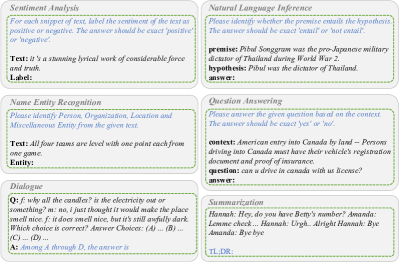
- Use two-stage prompting for zero-shot chain-of-thought on reasoning tasks to elicit rationale and final answers.
- Incorporate task instructions drawn from established prompts in prior work to standardize inputs.
- Compare zero-shot (with and without chain-of-thought) results to few-shot and fine-tuned baselines from the literature.
- Analyze results across arithmetic, commonsense, symbolic, logical reasoning, NLI, QA, dialogue, summarization, NER, and sentiment analysis.
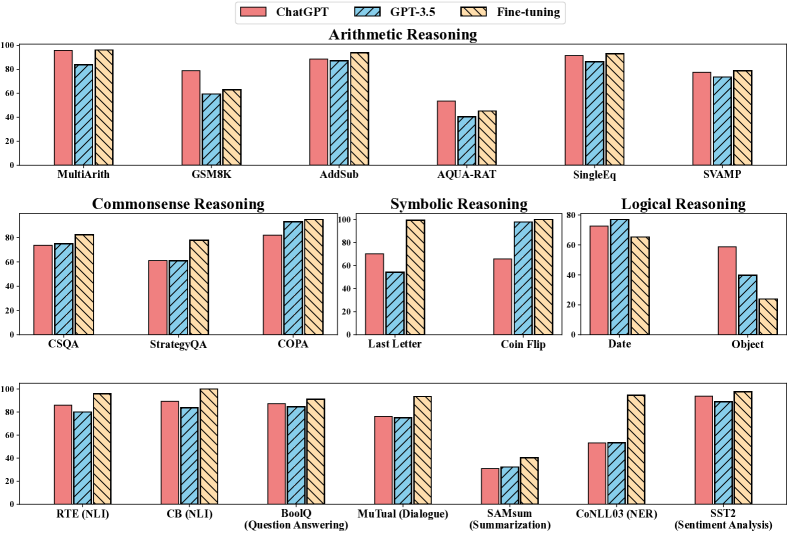
Experimental results
Research questions
- RQ1Is ChatGPT a general-purpose NLP task solver in zero-shot settings?
- RQ2On which task types does ChatGPT perform well or poorly in zero-shot settings?
- RQ3Why does ChatGPT outperform or underperform compared with task-specific or fine-tuned models on certain tasks?
Key findings
- ChatGPT shows strong performance on tasks favoring reasoning and dialogue abilities.
- ChatGPT often underperforms compared with task-specific fine-tuned models on several tasks, especially sequence tagging.
- ChatGPT improves over GPT-3.5 in natural language inference and certain QA tasks that rely on reasoning.
- In arithmetic reasoning, ChatGPT outperforms GPT-3.5, and zero-shot-CoT further enhances performance across datasets.
- ChatGPT yields longer, less controlled summaries than GPT-3.5, reducing ROUGE scores when length is not constrained.
- Both ChatGPT and GPT-3.5 struggle with sequence tagging, including NER, compared to specialized fine-tuned models.
- Sentiment analysis: ChatGPT generally outperforms GPT-3.5, with some class-conditional variation likely due to training data differences.
Read this paper
Open the full text in the Nubint reader and ask about any passage as you read.
Read this paper on NubintThis review was generated by AI from the original paper. Please check the paper before citing it.