
[Paper Review] Is ChatGPT a Highly Fluent Grammatical Error Correction System? A Comprehensive Evaluation
The paper evaluates ChatGPT (gpt-3.5-turbo) for grammatical error correction (GEC) across multiple languages and document-level tasks, using zero-shot and few-shot chain-of-thought prompting, and compares it with SOTA models and Grammarly.
ChatGPT, a large-scale language model based on the advanced GPT-3.5 architecture, has shown remarkable potential in various Natural Language Processing (NLP) tasks. However, there is currently a dearth of comprehensive study exploring its potential in the area of Grammatical Error Correction (GEC). To showcase its capabilities in GEC, we design zero-shot chain-of-thought (CoT) and few-shot CoT settings using in-context learning for ChatGPT. Our evaluation involves assessing ChatGPT's performance on five official test sets in three different languages, along with three document-level GEC test sets in English. Our experimental results and human evaluations demonstrate that ChatGPT has excellent error detection capabilities and can freely correct errors to make the corrected sentences very fluent, possibly due to its over-correction tendencies and not adhering to the principle of minimal edits. Additionally, its performance in non-English and low-resource settings highlights its potential in multilingual GEC tasks. However, further analysis of various types of errors at the document-level has shown that ChatGPT cannot effectively correct agreement, coreference, tense errors across sentences, and cross-sentence boundary errors.
Motivation & Objective
- Assess ChatGPT’s sentence-level GEC capabilities across English, German, and Chinese using multiple official test sets.
- Investigate zero-shot and few-shot in-context learning with chain-of-thought prompting for GEC.
- Evaluate ChatGPT’s performance on document-level GEC in English and analyze error types.
- Conduct automatic and manual human evaluations to understand fluency and edit behavior.
- Examine non-English and low-resource GEC performance and identify strengths and limitations.
Proposed method
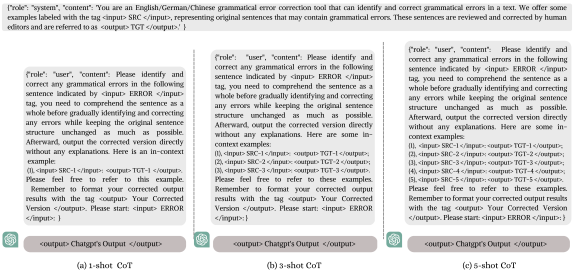
- Design zero-shot and zero-shot CoT prompts for ChatGPT to identify and correct grammatical errors while preserving sentence structure.
- Develop few-shot CoT prompts with randomly selected in-context examples across multiple datasets.
- Evaluate ChatGPT on five sentence-level test sets in English, German, and Chinese, plus three English document-level sets, using automatic metrics and human evaluation.
- Compare ChatGPT against Transformer-base, GECToR, T5-large, and Grammarly using M2 Scorer, ERRANT, and GLUE-based metrics where appropriate.
- Perform a manual error-type analysis for document-level GEC with ERRANT to identify cross-sentence error patterns and limitations.
Experimental results
Research questions
- RQ1How does ChatGPT perform on sentence-level GEC across English, German, and Chinese when using zero-shot and few-shot CoT prompts?
- RQ2Does chain-of-thought prompting improve ChatGPT’s GEC performance over standard prompting?
- RQ3How does ChatGPT compare to SOTA GEC systems and Grammarly on standard benchmarks and fluency-focused metrics?
- RQ4What are ChatGPT’s strengths and limitations for document-level GEC, and which error types does it struggle with?
- RQ5Is ChatGPT effective in non-English and low-resource GEC settings?
Key findings
- ChatGPT achieves high recall and strong fluency but lower precision and F0.5 compared to SOTA models on sentence-level tasks.
- Few-shot CoT prompting generally improves ChatGPT’s performance over zero-shot CoT, with 3-shot often among the best; more than five shots can reduce performance.
- On the JFLEG fluency-focused measure, ChatGPT’s 3-shot CoT nearly matches SOTA and can surpass T5 large, indicating strong fluency corrections.
- In non-English and low-resource languages, ChatGPT can outperform training-from-scratch Transformer baselines in recall, but often lags in precision and F0.5; performance varies by language.
- Document-level GEC reveals ChatGPT’s strong recall and fluency but poor cross-sentence error correction (agreement, coreference, tense) and cross-sentence boundary handling.
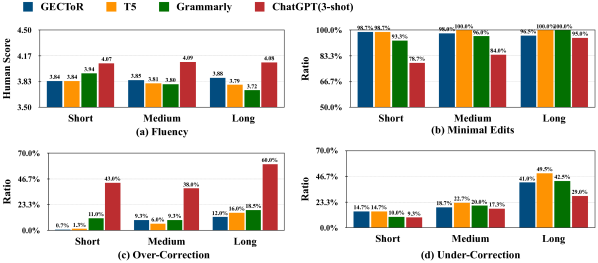
- Automatic human evaluations show ChatGPT can approach or exceed human-level fluency in some settings, but under minimal-edit constraints it may still differ from reference corrections.
Read this paper
Open the full text in the Nubint reader and ask about any passage as you read.
Read this paper on NubintThis review was generated by AI from the original paper. Please check the paper before citing it.