
[Paper Review] ISLES 2022: A multi-center magnetic resonance imaging stroke lesion segmentation dataset
This paper introduces the ISLES 2022 dataset, a large-scale, multi-center MRI collection of 400 acute to subacute ischemic stroke cases with expert-annotated lesion segmentations. It employs a hybrid human-algorithm workflow with hierarchical validation by neuroradiologists to ensure high-quality annotations, enabling benchmarking of robust and generalizable deep learning models for stroke lesion segmentation across diverse scanners and clinical stages.
Magnetic resonance imaging (MRI) is a central modality for stroke imaging. It is used upon patient admission to make treatment decisions such as selecting patients for intravenous thrombolysis or endovascular therapy. MRI is later used in the duration of hospital stay to predict outcome by visualizing infarct core size and location. Furthermore, it may be used to characterize stroke etiology, e.g. differentiation between (cardio)-embolic and non-embolic stroke. Computer based automated medical image processing is increasingly finding its way into clinical routine. Previous iterations of the Ischemic Stroke Lesion Segmentation (ISLES) challenge have aided in the generation of identifying benchmark methods for acute and sub-acute ischemic stroke lesion segmentation. Here we introduce an expert-annotated, multicenter MRI dataset for segmentation of acute to subacute stroke lesions. This dataset comprises 400 multi-vendor MRI cases with high variability in stroke lesion size, quantity and location. It is split into a training dataset of n=250 and a test dataset of n=150. All training data will be made publicly available. The test dataset will be used for model validation only and will not be released to the public. This dataset serves as the foundation of the ISLES 2022 challenge with the goal of finding algorithmic methods to enable the development and benchmarking of robust and accurate segmentation algorithms for ischemic stroke.
Motivation & Objective
- To address the lack of large-scale, multi-center, high-quality MRI datasets for ischemic stroke lesion segmentation in acute and subacute stages.
- To reduce inter-observer variability and manual annotation burden through a hybrid human-algorithm annotation pipeline with expert oversight.
- To enable robust evaluation of segmentation models across diverse scanners, stroke patterns, and clinical timepoints (pre- and post-revascularization).
- To support the development of automated, clinically deployable tools for stroke outcome prediction and treatment guidance.
Proposed method
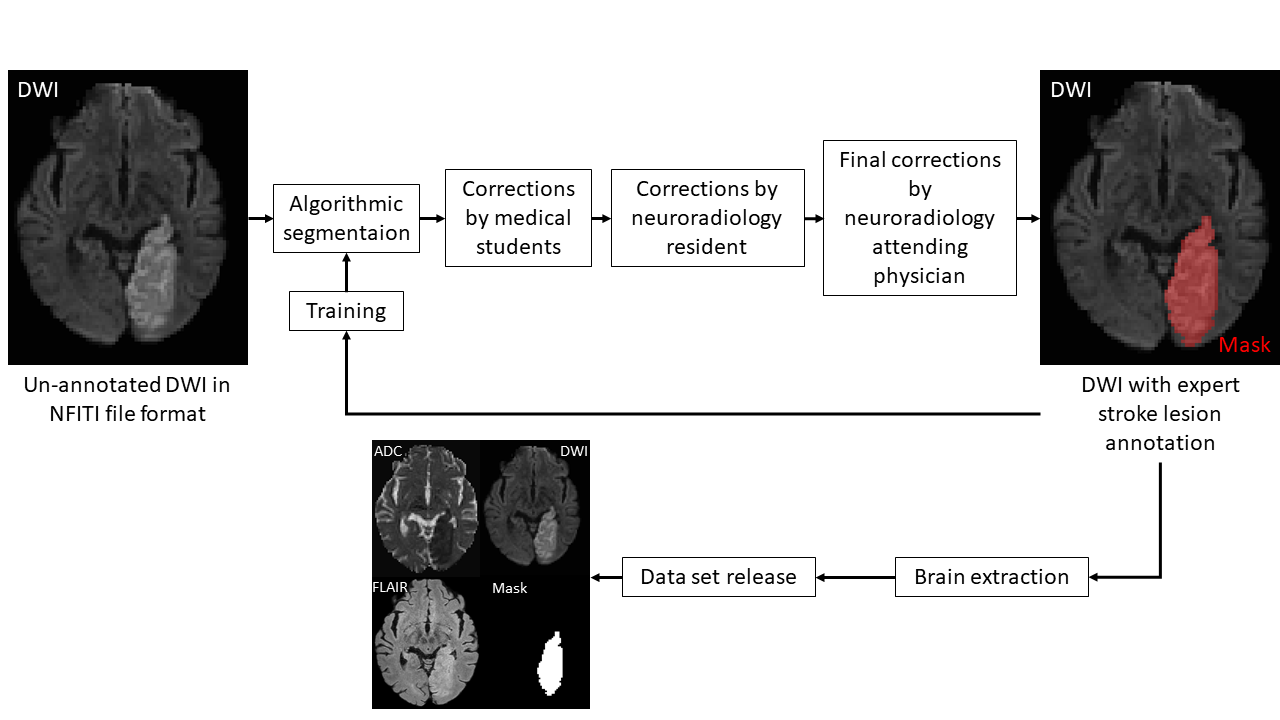
- A hybrid annotation workflow was used: initial automated pre-segmentation using a deep learning model trained on high-quality annotations, followed by manual correction by trained medical students.
- All student-annotated masks were critically reviewed and corrected by a neuroradiology resident, with a substantial portion validated by attending neuroradiologists (>10 years of stroke imaging experience).
- Imaging data was de-identified via brain extraction using HD-BET, followed by rigid registration of FLAIR to DWI and skull-stripping using the registered brain mask.
- All MRI sequences and segmentation masks were stored in NIfTI format, with DICOM metadata preserved in JSON files.
- The dataset was split into a public training set (n=250) and a non-released test set (n=150), with balanced representation across centers and stroke phenotypes.
- Data was released under CC BY-SA 4.0 with accompanying code and visualization scripts on GitHub to support reproducibility and community use.
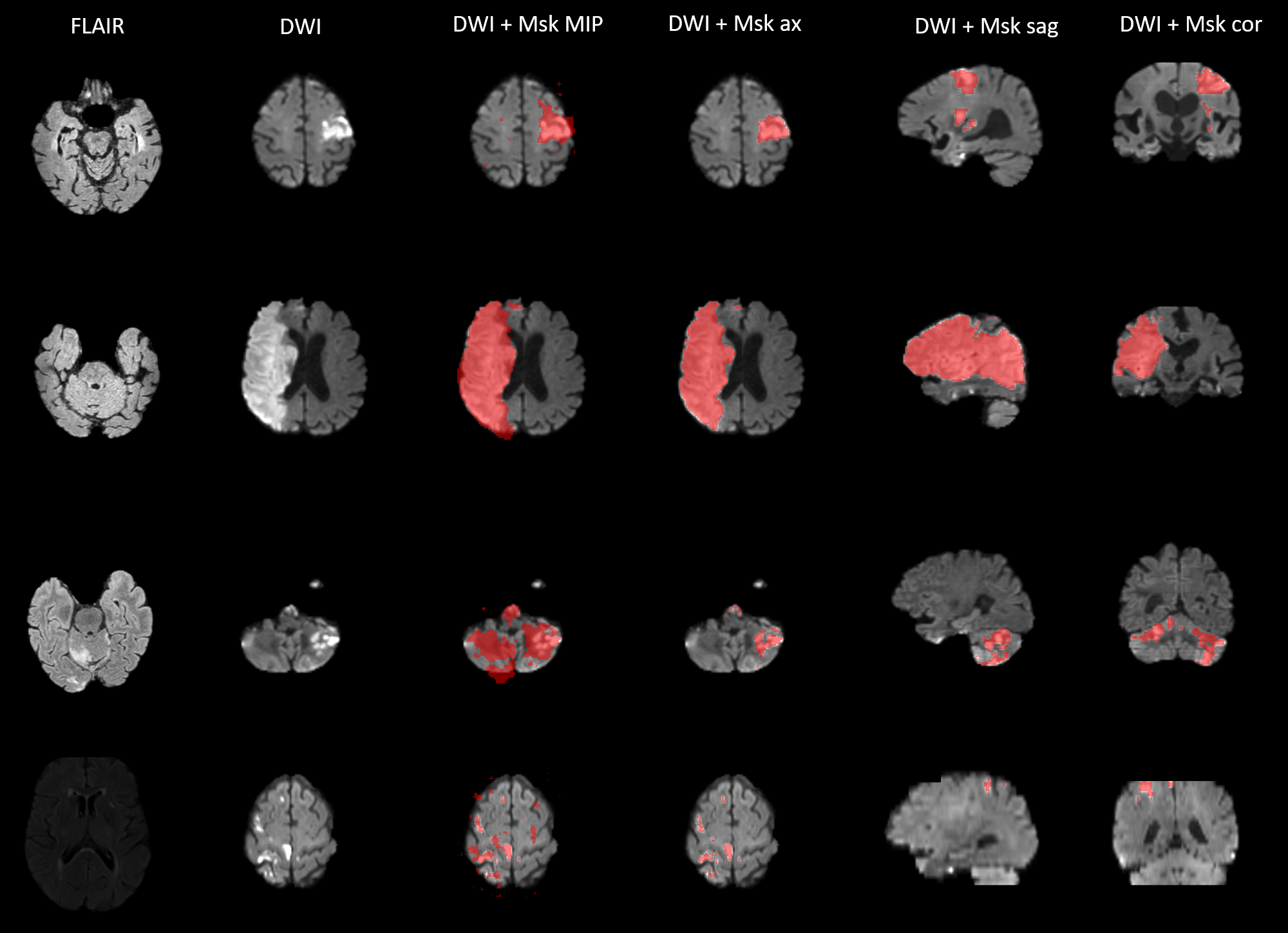
Experimental results
Research questions
- RQ1Can a hybrid human-algorithm approach significantly improve annotation efficiency while maintaining high inter-rater reliability in stroke lesion segmentation?
- RQ2How does model generalization performance vary across different MRI scanners, centers, and clinical timepoints (pre- vs. post-revascularization) in acute and subacute stroke?
- RQ3To what extent does the inclusion of multi-center, multi-vendor data improve the robustness of deep learning models for stroke lesion segmentation?
- RQ4Can automated segmentation tools trained on expert-validated data achieve performance levels suitable for clinical decision support in stroke management?
Key findings
- The ISLES 2022 dataset comprises 400 multi-vendor MRI cases with expert-validated lesion segmentations, including diverse lesion patterns from large territorial infarcts to small punctate infarcts.
- The training set of 250 cases is publicly available under CC BY-SA 4.0, while the test set of 150 cases is reserved for challenge evaluation to ensure fair benchmarking.
- The annotation pipeline reduced manual effort by leveraging a pre-trained segmentation model, with final masks validated by multiple expert levels including attending neuroradiologists.
- The dataset includes pre- and post-interventional scans, enabling evaluation of model robustness to revascularization effects and scan timing.
- The dataset spans three centers, with the test set including data from a new center not seen during training, enhancing generalization evaluation.
- A companion GitHub repository provides code for data loading, visualization, and performance evaluation using challenge-standard metrics.
Read this paper
Open the full text in the Nubint reader and ask about any passage as you read.
Read this paper on NubintThis review was generated by AI from the original paper. Please check the paper before citing it.