
[Paper Review] ISP meets Deep Learning: A Survey on Deep Learning Methods for Image Signal Processing
This survey reviews 27 deep learning-based approaches for replacing or enhancing the traditional Image Signal Processing (ISP) pipeline, focusing on CNNs and end-to-end learning to improve image quality from RAW sensor data. It highlights trends in full-pipeline replacement, dataset limitations, and the need for mobile-optimized, reproducible research.
The entire Image Signal Processor (ISP) of a camera relies on several processes to transform the data from the Color Filter Array (CFA) sensor, such as demosaicing, denoising, and enhancement. These processes can be executed either by some hardware or via software. In recent years, Deep Learning has emerged as one solution for some of them or even to replace the entire ISP using a single neural network for the task. In this work, we investigated several recent pieces of research in this area and provide deeper analysis and comparison among them, including results and possible points of improvement for future researchers.
Motivation & Objective
- To analyze recent deep learning methods replacing or enhancing traditional ISP pipelines in digital cameras.
- To identify key challenges in dataset quality, model reproducibility, and real-world deployment, especially on mobile and edge devices.
- To evaluate the performance and generalization of CNN-based models across different ISP tasks such as demosaicing, denoising, and enhancement.
- To highlight gaps in evaluation protocols, including lack of mobile NPU benchmarking and insufficient ablation studies.
- To advocate for standardized datasets, open-source code, and mobile-optimized model evaluation to advance the field.
Proposed method
- Systematically reviewed 27 recent research papers on deep learning for ISP, focusing on CNN-based architectures and end-to-end learning.
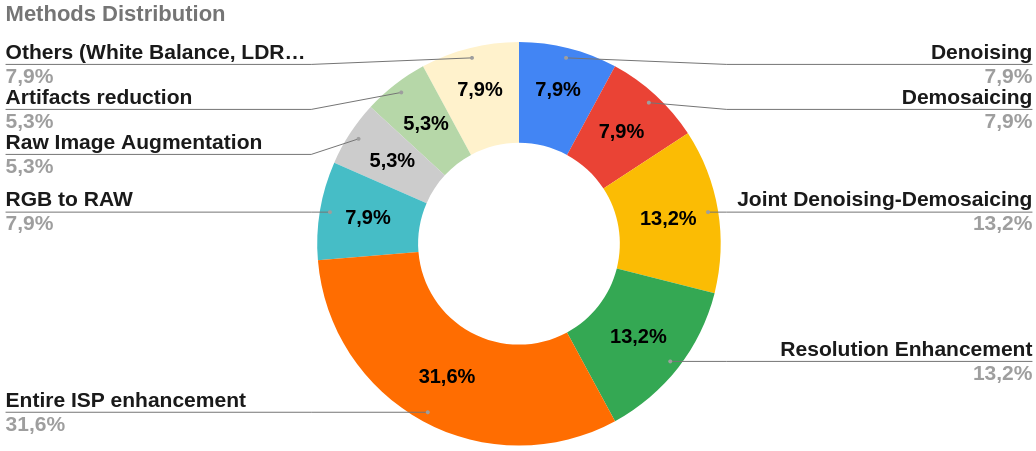
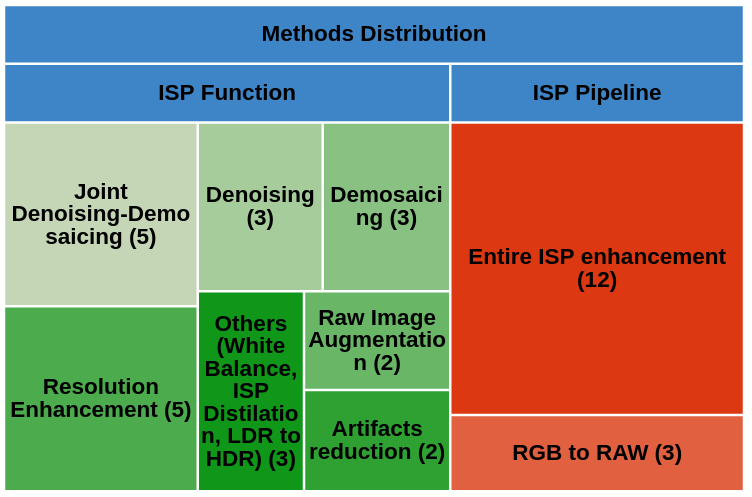
- Classified methods based on whether they replaced individual ISP steps (e.g., demosaicing, denoising) or the entire pipeline.
- Evaluated the use of synthetic and real-world RAW-to-RGB datasets, including Urban100, Kodak, McMaster, ZRR, and others.
- Analyzed model architectures, including U-Net variants, and assessed architectural choices without clear justification in some works.
- Identified common shortcomings such as lack of source code availability, insufficient ablation studies, and absence of edge device testing.
- Proposed future directions, including deployment on Raspberry Pi and exploration of vision transformers for full ISP tasks.
Experimental results
Research questions
- RQ1How effective are deep learning models in replacing or improving individual steps of the traditional ISP pipeline?
- RQ2What are the main limitations in current datasets used for training and evaluating deep learning-based ISP models?
- RQ3Why is the lack of source code and ablation studies a barrier to reproducibility and progress in the field?
- RQ4How do current evaluation protocols fail to reflect real-world performance on mobile and embedded systems?
- RQ5What are the key challenges in deploying end-to-end deep learning ISP models on low-computational-edge devices?
Key findings
- 30% of the reviewed papers proposed deep neural networks (DNNs) to replace the entire ISP pipeline in a single forward pass, indicating a growing trend toward end-to-end learning.
- Many datasets used in ISP research, such as those synthesized from denoising or super-resolution tasks, lack realistic camera noise and hardware artifacts, limiting real-world applicability.
- A significant number of studies (e.g., [22, 24, 23, 3, 25, 28]) did not release source code, hindering reproducibility and fair comparison across methods.
- Only a few works evaluated models on mobile NPUs or embedded systems, despite the primary target application being smartphones and edge devices.
- The use of multiple cameras to create RAW-to-RGB datasets introduces alignment issues, requiring additional preprocessing that increases computational cost and may affect model performance.
- There is a strong need for standardized, high-quality datasets and consistent evaluation protocols to enable reliable benchmarking and progress toward state-of-the-art performance.
Read this paper
Open the full text in the Nubint reader and ask about any passage as you read.
Read this paper on NubintThis review was generated by AI from the original paper. Please check the paper before citing it.