
[Paper Review] Iterative Prompt Learning for Unsupervised Backlit Image Enhancement
This paper proposes CLIP-LIT, a novel unsupervised backlit image enhancement method that leverages Contrastive Language-Image Pre-Training (CLIP) via iterative prompt learning to improve enhancement quality without paired data. By jointly optimizing learnable prompts and an enhancement network in the CLIP latent space, the method achieves state-of-the-art visual quality and generalization on diverse backlit scenes, outperforming existing unsupervised and supervised methods.
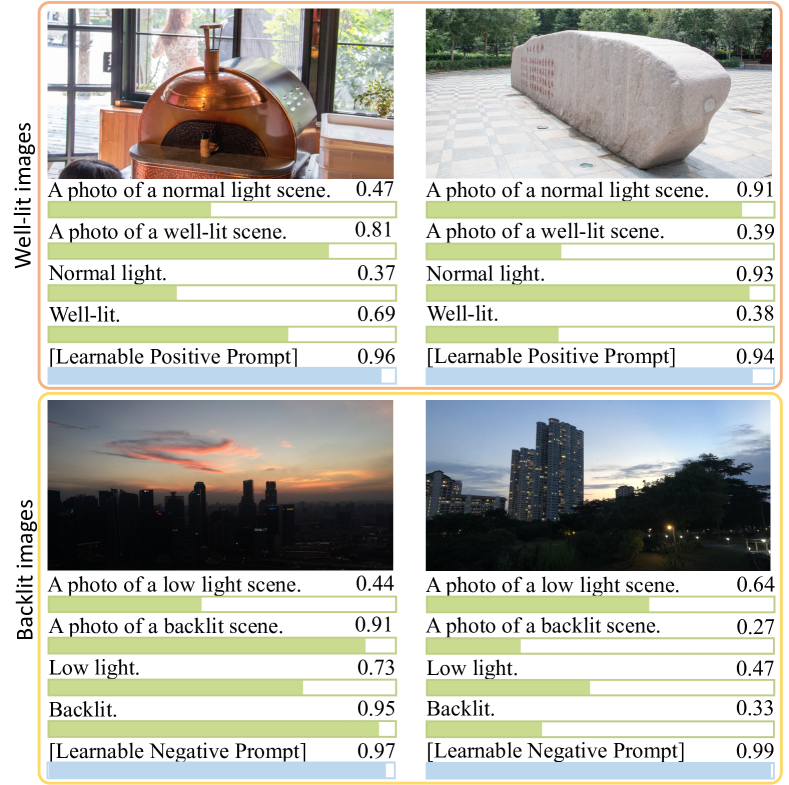
We propose a novel unsupervised backlit image enhancement method, abbreviated as CLIP-LIT, by exploring the potential of Contrastive Language-Image Pre-Training (CLIP) for pixel-level image enhancement. We show that the open-world CLIP prior not only aids in distinguishing between backlit and well-lit images, but also in perceiving heterogeneous regions with different luminance, facilitating the optimization of the enhancement network. Unlike high-level and image manipulation tasks, directly applying CLIP to enhancement tasks is non-trivial, owing to the difficulty in finding accurate prompts. To solve this issue, we devise a prompt learning framework that first learns an initial prompt pair by constraining the text-image similarity between the prompt (negative/positive sample) and the corresponding image (backlit image/well-lit image) in the CLIP latent space. Then, we train the enhancement network based on the text-image similarity between the enhanced result and the initial prompt pair. To further improve the accuracy of the initial prompt pair, we iteratively fine-tune the prompt learning framework to reduce the distribution gaps between the backlit images, enhanced results, and well-lit images via rank learning, boosting the enhancement performance. Our method alternates between updating the prompt learning framework and enhancement network until visually pleasing results are achieved. Extensive experiments demonstrate that our method outperforms state-of-the-art methods in terms of visual quality and generalization ability, without requiring any paired data.
Motivation & Objective
- To address the challenge of unsupervised backlit image enhancement without paired training data, which limits generalization and causes over/under-enhancement.
- To overcome the difficulty of finding accurate fixed prompts for CLIP-based image enhancement, which varies significantly across complex illumination conditions.
- To improve the alignment between CLIP's text-image embeddings and pixel-level enhancement by learning dynamic, data-driven prompts.
- To enhance robustness and visual quality by iteratively refining prompts and the enhancement network using rank learning to reduce distribution gaps.
- To demonstrate that CLIP's visual-language prior can be effectively adapted for low-level image restoration tasks beyond classification or generation.
Proposed method
- The method initializes prompts by minimizing the CLIP embedding distance between backlit images and a negative prompt, and well-lit images and a positive prompt in the latent space.
- It trains an enhancement network using a CLIP-Enhance loss that maximizes similarity between the enhanced image and the positive prompt while minimizing similarity with the negative prompt.
- An iterative refinement loop alternates between fine-tuning the prompt embeddings and updating the enhancement network using rank-based loss functions to reduce distribution gaps between backlit images, enhanced results, and well-lit images.
- The prompt learning framework is updated via rank learning, ensuring that the enhanced results are more similar to the positive prompt than to the negative prompt and to well-lit images.
- The framework alternates between prompt refinement and enhancement network training until visually pleasing results are achieved, with no need for ground-truth supervision.
- The method uses a contrastive learning objective in the CLIP embedding space to guide enhancement, replacing adversarial training with a more interpretable and luminance-sensitive loss.
Experimental results
Research questions
- RQ1Can CLIP’s visual-language prior be effectively leveraged for unsupervised pixel-level image enhancement, particularly for backlit images?
- RQ2How can learnable prompts improve the robustness and accuracy of CLIP-based image classification compared to fixed textual prompts in complex lighting scenarios?
- RQ3Does iterative prompt refinement enhance the generalization and visual quality of backlit image enhancement beyond fixed prompt or adversarial training approaches?
- RQ4To what extent does the choice of reference well-lit images affect the performance of the enhancement network?
- RQ5Can CLIP-based losses outperform adversarial losses in low-level image restoration tasks?
Key findings
- The proposed method achieves a PSNR of 21.579 and SSIM of 0.883 on the BAID test set, significantly outperforming state-of-the-art methods.
- The method improves PSNR by 6.831 and SSIM by 0.060 when compared to using fixed prompts (backlit/well-lit) instead of learned prompts.
- Removing the rank learning losses (Eqs. 7 and 8) reduces PSNR to 20.884 and SSIM to 0.865, demonstrating their critical role in performance.
- The method achieves a MUSIQ score of 55.682, indicating strong perceptual quality, and outperforms adversarial loss-based training (MUSIQ: 52.416).
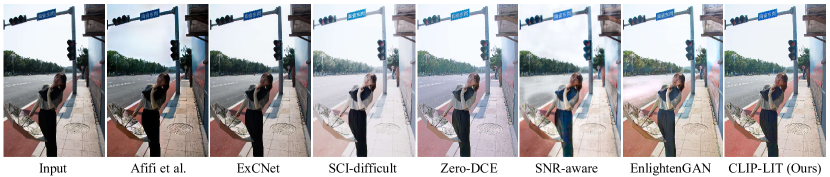
- User studies show that over 60% of participants preferred the results of our method over all baselines, confirming superior visual quality.
- The method generalizes well across diverse scenes—faces, landscapes, animals, architecture, and night scenes—without requiring scene-specific tuning.
Read this paper
Open the full text in the Nubint reader and ask about any passage as you read.
Read this paper on NubintThis review was generated by AI from the original paper. Please check the paper before citing it.