
[Paper Review] JADES + JEMS: A Detailed Look at the Buildup of Central Stellar Cores and Suppression of Star Formation in Galaxies at Redshifts 3 < z < 4.5
This study uses multi-wavelength JWST/NIRCam and HST photometry from the JADES and JEMS surveys to analyze the stellar populations of six massive galaxies at z ≈ 3.7. It finds that their dense central stellar cores, which are more massive than the Toomre mass, likely formed via clump coalescence rather than in-situ fragmentation, and that these cores are already quenching star formation, marking the onset of galaxy-wide quenching at high redshifts.
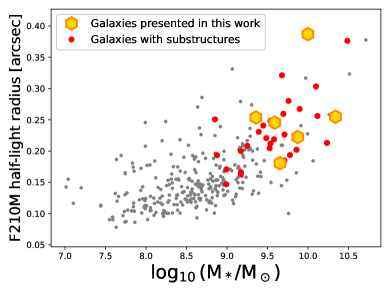
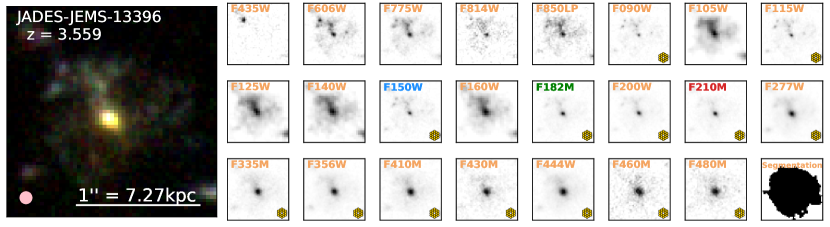
We present a spatially resolved study of stellar populations in 6 galaxies with stellar masses $M_*\sim10^{10}M_\odot$ at $z\sim3.7$ using 14-filter JWST/NIRCam imaging from the JADES and JEMS surveys. The 6 galaxies are visually selected to have clumpy substructures with distinct colors over rest-frame $3600-4100Å$, including a red, dominant stellar core that is close to their stellar-light centroids. With 23-filter photometry from HST to JWST, we measure the stellar-population properties of individual structural components via SED fitting using Prospector. We find that the central stellar cores are $\gtrsim2$ times more massive than the Toomre mass, indicating they may not form via single in-situ fragmentation. The stellar cores have stellar ages of $0.4-0.7$ Gyr that are similar to the timescale of clump inward migration due to dynamical friction, suggesting that they likely instead formed through the coalescence of giant stellar clumps. While they have not yet quenched, the 6 galaxies are below the star-forming main sequence by $0.2-0.7$ dex. Within each galaxy, we find that the specific star formation rate is lower in the central stellar core, and the stellar-mass surface density of the core is already similar to quenched galaxies of the same masses and redshifts. Meanwhile, the stellar ages of the cores are either comparable to or younger than the extended, smooth parts of the galaxies. Our findings are consistent with model predictions of the gas-rich compaction scenario for the buildup of galaxies' central regions at high redshifts. We are likely witnessing the coeval formation of dense central cores, along with the onset of galaxy-wide quenching at $z>3$.
Motivation & Objective
- To understand the formation mechanisms of dense central stellar cores in massive high-redshift galaxies.
- To investigate the suppression of star formation in these galaxies despite their high stellar masses.
- To determine whether the observed cores formed in-situ or through dynamical processes like clump migration and coalescence.
- To assess the star formation histories (SFHs) of distinct structural components (cores, clumps, smooth components) using spatially resolved SED fitting.
- To test whether the observed properties align with the gas-rich compaction scenario for early galaxy evolution.
Proposed method
- Acquired 23-filter photometry from HST to JWST for six galaxies at 3 < z < 4.5, covering rest-frame 3600–4100 Å.
- Performed spatially resolved SED fitting using Prospector to derive stellar population properties (mass, age, SFR, sSFR) for individual components.
- Used three SFH priors: nonparametric Dirichlet, delayed-tau, and parametric models to test robustness of results.
- Defined structural components via visual inspection and aperture photometry, including central cores, clumps (C1–C3), and smooth components.
- Compared stellar mass surface densities and sSFRs across components to assess quenching and structural evolution.
- Evaluated the Toomre mass criterion to assess the likelihood of in-situ fragmentation for the central cores.
Experimental results
Research questions
- RQ1Do the central stellar cores in z ≈ 3.7 galaxies form via in-situ fragmentation or through dynamical processes like clump coalescence?
- RQ2To what extent are the central cores already quenched, and how do their sSFRs compare to the rest of the galaxy?
- RQ3Are the stellar ages of the cores consistent with the timescale of clump inward migration due to dynamical friction?
- RQ4Do the observed stellar population properties align with the predictions of the gas-rich compaction scenario for high-redshift galaxy evolution?
- RQ5How do the star formation histories of the central core, clumps, and smooth components differ, and what does this imply for galaxy-wide quenching?
Key findings
- The central stellar cores have masses exceeding the Toomre mass by a factor of >2, indicating they likely did not form via in-situ fragmentation.
- The cores have stellar ages of 0.4–0.7 Gyr, consistent with the dynamical friction timescale for clump migration, supporting formation via clump coalescence.
- The galaxies are already below the star-forming main sequence by 0.2–0.7 dex, indicating early quenching has begun.
- The specific star formation rate (sSFR) in the central cores is lower than in the extended smooth components, and the cores have stellar-mass surface densities comparable to quenched galaxies of similar mass and redshift.
- The stellar ages of the cores are either comparable to or younger than the extended components, suggesting recent formation and ongoing quenching.
- The observed SFHs of the components remain qualitatively unchanged across different SFH priors, confirming robustness of results.
Read this paper
Open the full text in the Nubint reader and ask about any passage as you read.
Read this paper on NubintThis review was generated by AI from the original paper. Please check the paper before citing it.