
[Paper Review] A massive quiescent galaxy at redshift 4.658
Spectroscopic JWST confirmation of GS-9209 as a massive quiescent galaxy at z=4.658, with a stellar mass of 3.8±0.2×10^10 M⊙ and quenching completed by z≈6.5, implying early, rapid formation and quenching.
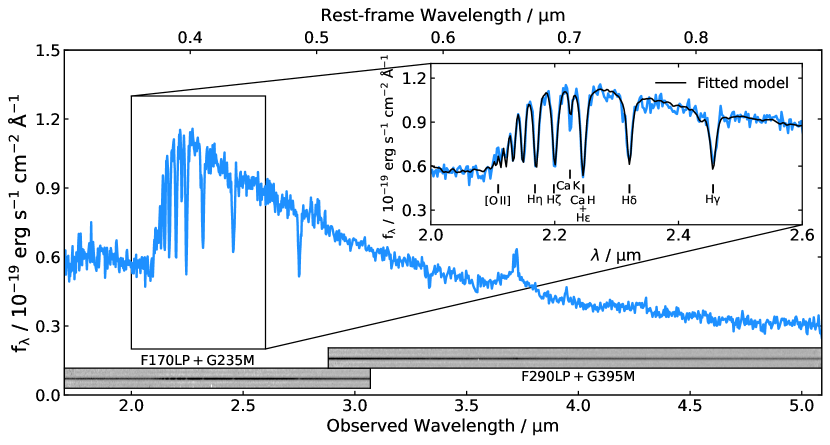
The extremely rapid assembly of the earliest galaxies during the first billion years of cosmic history is a major challenge for our understanding of galaxy formation physics. The advent of JWST has exacerbated this issue by confirming the existence of galaxies in significant numbers as early as the first few hundred million years. Perhaps even more surprisingly, in some galaxies, this initial highly efficient star formation rapidly shuts down, or quenches, giving rise to massive quiescent galaxies as little as 1.5 billion years after the Big Bang. However, due to their faintness and red colour, it has proven extremely challenging to learn about these extreme quiescent galaxies, or to confirm whether any exist at earlier times. Here we report the spectroscopic confirmation of a massive quiescent galaxy, GS-9209, at redshift $z=4.658$, just 1.25 billion years after the Big Bang, using JWST NIRSpec. From these data we infer a stellar mass of $M_* = 3.8\pm0.2 imes10^{10}\ M_\odot$, which formed over a $\simeq200$ Myr period before this galaxy quenched its star formation activity at $z=6.5^{+0.2}_{-0.5}$, when the Universe was $\simeq800$ million years old. Based on the presence of broad H$α$ in the spectrum and a high narrow-line [NII]/H$α$ ratio, we infer the presence of an accreting supermassive black hole, with a mass of $M_\bullet = 5\pm1 imes10^{8}\ M_\odot$. This large black hole mass relative to the stellar mass suggests that active galactic nucleus (AGN) feedback may have been responsible for quenching this galaxy. GS-9209 is also extremely compact, with an effective radius, $r_e=215\pm20$ parsecs. This galaxy is both a likely descendent of the highest-redshift submillimetre galaxies and quasars, and a likely progenitor for the dense, ancient cores of the most massive local galaxies.
Motivation & Objective
- Demonstrate the existence of a massive quiescent galaxy at z>4 using JWST NIRSpec data.
- Infer the stellar population properties, including mass, star formation history, and quenching epoch.
- Assess the presence and influence of an AGN on observed spectra and galaxy evolution.
- Characterize the galaxy size, density, and dynamical mass to place GS-9209 in the context of early massive systems.
Proposed method
- JWST NIRSpec spectroscopy with G235M and G395M gratings (R≈1000) to cover 1.7–5.1 μm and detect Balmer features.
- Full spectrophotometric fitting with the Bagpipes code to combine spectroscopy and multi-wavelength photometry.
- 22-parameter model including stellar, dust, nebular, and AGN components, with priors informed by BC03/MILES libraries and a double-power-law SFH.
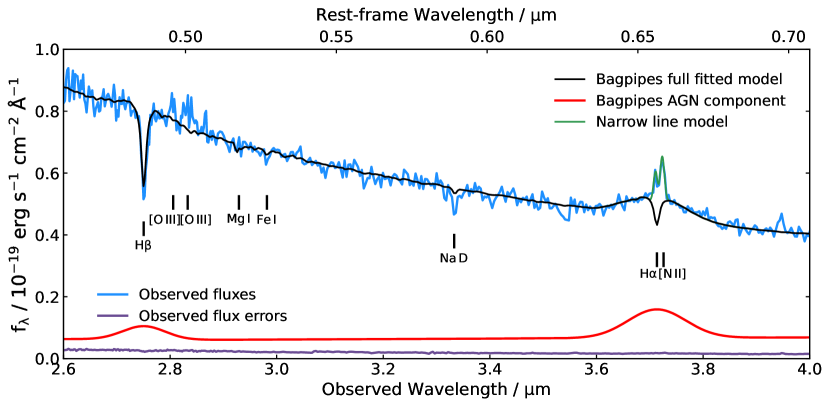
- Masking of narrow emission lines from AGN while fitting a nebular component for potential star formation.
- AGN continuum and broad Hα/Hβ emission modeled to separate stellar and non-stellar contributions.
- Size and structural analysis using JWST NIRCam F210M imaging with PetroFit to decompose stellar and AGN components.
Experimental results
Research questions
- RQ1What is the redshift and spectroscopic confirmation status of GS-9209?
- RQ2What is the stellar mass and star-formation history of GS-9209, and when did it form and quench?
- RQ3Does GS-9209 host an AGN, and how does it affect the observed spectrum and inferred properties?
- RQ4What are the structural and dynamical properties (size, density, velocity dispersion, dynamical mass) of GS-9209, and how do they compare to other high-redshift quiescent systems?
Key findings
- GS-9209 is at z = 4.6582 ± 0.0002 with a Balmer-dominated spectrum indicating a rapid recent decline in SFR.
- Stellar mass is log10(M*/M⊙) = 10.58 ± 0.02, with negligible dust attenuation (AV = 0.02 ± 0.02).
- The formation epoch is zform = 6.9 ± 0.2 and quenching occurs at zquench = 6.5^{+0.2}_{-0.5}, with a ~200 Myr star-formation episode prior to quenching.
- Broad Hα emission and a [N II]/Hα ratio around -0.01 ± 0.04 indicate AGN activity; the AGN contributes about 7.5% of the flux at 5100 Å, and broad Hα has FWHM ≈ 10300 ± 700 km s⁻¹.
- The effective radius of the stellar component is re = 0.033 ± 0.003 arcsec, corresponding to 215 ± 20 pc at z = 4.658, with Sérsic index n = 2.3 ± 0.3, and a stellar-mass surface density log10(Σeff/M⊙ kpc⁻²) = 11.15 ± 0.08.
- Dynamical mass is log10(Mdyn/M⊙) = 10.3 ± 0.1, slightly below the stellar mass; a SMBH mass is inferred to be around (0.5–1)×10^9 M⊙ from Hα and velocity dispersion measurements.
Better researchstarts right now
From reading papers to final review, dramatically reduce your research time.
No credit card · Free plan available
This review was created by AI and reviewed by human editors.