
[Paper Review] Jet Diffusion versus JetGPT -- Modern Networks for the LHC
The paper introduces two diffusion models and an autoregressive transformer for LHC physics simulations, with Bayesian variants for uncertainty control, and compares them to normalizing flows on Z+jets events.
We introduce two diffusion models and an autoregressive transformer for LHC physics simulations. Bayesian versions allow us to control the networks and capture training uncertainties. After illustrating their different density estimation methods for simple toy models, we discuss their advantages for Z plus jets event generation. While diffusion networks excel through their precision, the transformer scales best with the phase space dimensionality. Given the different training and evaluation speed, we expect LHC physics to benefit from dedicated use cases for normalizing flows, diffusion models, and autoregressive transformers.
Motivation & Objective
- Motivate fast, precise, and flexible LHC simulations based on first principles.
- Develop and assess three modern generative network architectures for phase-space density estimation.
- Incorporate Bayesian formulations to quantify training and model uncertainties.
- Benchmark diffusion models and autoregressive transformers against INNs on toy and Z+jets LHC events.
- Highlight scenarios where normalizing flows, diffusion models, and autoregressive transformers excel.
Proposed method
- Introduce two diffusion models (DDPM and Conditional Flow Matching) with discrete and continuous time evolutions.
- Propose an autoregressive transformer (JetGPT) with improved dimensionality scaling.
- Develop Bayesian versions of all three networks to quantify uncertainty in density estimation.
- Derive loss functions for DDPM (Eq. 17/11/13) and CFMs (Eq. 34/37) and outline training/sampling procedures.
- Demonstrate training setups and hyperparameters for toy models and LHC Z+jets events (Table 1).
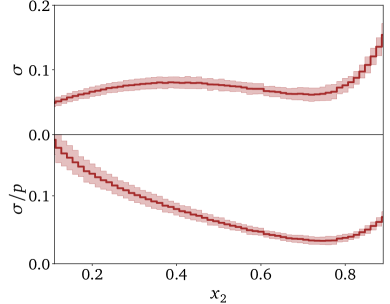
Experimental results
Research questions
- RQ1Can diffusion-based generative models match the precision of invertible neural networks for LHC phase-space density estimation?
- RQ2How do discrete DDPM, continuous-time CFMs, and autoregressive transformers scale with phase-space dimensionality?
- RQ3What are the training and sampling speed trade-offs among normalizing flows, diffusion models, and autoregressive transformers for LHC simulations?
- RQ4How does Bayesian uncertainty quantification affect the reliability of density estimates in these networks?
- RQ5Which dedicated use cases emerge for each architecture in LHC-like tasks such as Z+jets generation?
Key findings
- Diffusion networks offer high precision in density estimation for LHC-like phase spaces.
- Autoregressive transformers scale more favorably with higher phase-space dimensionality.
- Bayesian versions of all three networks provide uncertainty quantification for learned densities.
- Diffusion models require longer sampling times compared to INNs and VAEs/GANs, but offer strong likelihood-based training.
- CFM provides a bijective-style mapping via solving an ODE for sample generation.
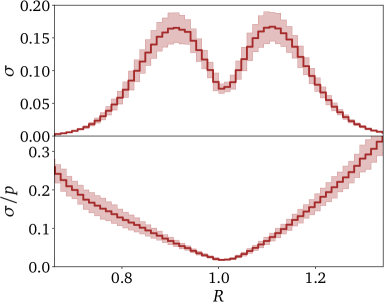
- The paper benchmarks the three models on toy problems and Z+jets events to compare strengths and use-case-fit.
Read this paper
Open the full text in the Nubint reader and ask about any passage as you read.
Read this paper on NubintThis review was generated by AI from the original paper. Please check the paper before citing it.