
[Paper Review] Joint Delay-Phase Precoding Under True-Time Delay Constraints in Wideband Sub-THz Hybrid Massive MIMO Systems
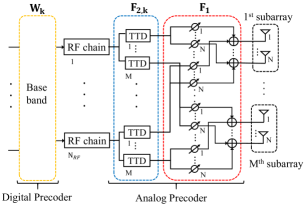
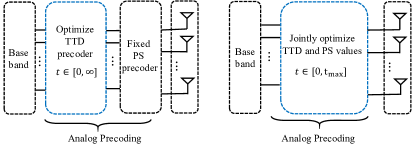
This paper proposes a joint hybrid true-time delay (TTD) and phase shifter (PS) precoding scheme for wideband sub-THz massive MIMO systems to mitigate the beam squint effect under practical TTD hardware constraints. By jointly optimizing TTD and PS precoders instead of assuming unbounded time delays, the method achieves near-ideal array gain performance and quantifies the minimum number of TTDs required for a target performance level, significantly improving spectral efficiency over prior approaches.
In wideband sub-Terahertz (sub-THz) massive multiple-input multiple-output (MIMO) communication systems, the beam squint effect manifests as a substantial degradation in array gain. To mitigate the aforementioned beam squint effect, a hybrid precoding approach leveraging both true-time delay (TTD) and phase shifters (PS) has been proposed. However, existing methods operate under the assumption that the TTD device can generate any desired time delay value. These methods subsequently design the TTD precoder while fixing the PS precoder. This work presents a novel optimization framework for the joint TTD and PS precoder design, incorporating realistic time delay constraints for each TTD device. Unlike previous methods, our framework does not rely on the unbounded time delay assumption and optimizes the TTD and PS values jointly to cope with the practical limitations. Furthermore, within the context of our proposed framework, we mathematically determine the minimum number of TTD devices necessitated to achieve a predetermined target array gain. Simulations confirm the proposed approach exhibits performance improvement, guarantees array gain, and achieves computational efficiency.
Motivation & Objective
- Address the beam squint effect in wideband sub-THz massive MIMO systems, which causes severe array gain loss across subcarriers.
- Overcome the limitation of prior TTD-based precoding methods that assume unbounded time delay values, which are impractical in real hardware.
- Develop a joint optimization framework for TTD and PS precoders under per-device time delay constraints to improve spectral efficiency and hardware feasibility.
- Quantify the minimum number of TTDs required to achieve a predefined array gain performance in wideband THz systems.
- Provide a closed-form solution for the optimal precoder design that maximizes the achievable rate lower bound in the large-system limit.
Proposed method
- Derive a lower bound on the achievable rate for the hybrid precoding system under TTD and PS constraints.
- Formulate a joint optimization problem for TTD and PS precoders that maximizes the achievable rate lower bound under per-TTD time delay constraints.
- Use Lagrangian duality and Karush-Kuhn-Tucker (KKT) conditions to derive a closed-form solution for the optimal TTD and PS precoder coefficients.
- Establish equivalence between the ideal analog precoder (that fully compensates beam squint) and the one maximizing the achievable rate lower bound in the large-system regime.
- Incorporate hardware constraints by modeling the finite range of time delays per TTD device, avoiding the unbounded delay assumption of prior works.
- Utilize the structure of the optimization problem to simplify the solution into two cases: one with unconstrained delay and one with saturated delay, based on the threshold $\vartheta_{\text{max}}$.
Experimental results
Research questions
- RQ1Can joint optimization of TTD and PS precoders outperform conventional TTD-only designs under practical time delay constraints?
- RQ2What is the minimum number of TTDs required to achieve a target array gain performance in wideband THz massive MIMO systems?
- RQ3How does the achievable rate lower bound relate to the beam squint compensation capability in the large-system limit?
- RQ4Does the proposed method eliminate the need for unbounded time delay assumptions while still achieving near-ideal array gain?
- RQ5How does the joint TTD-PS precoding scheme compare to prior hybrid precoding methods in terms of spectral efficiency and hardware efficiency?
Key findings
- The proposed joint TTD-PS precoding scheme achieves near-ideal array gain performance even under strict time delay constraints, outperforming prior methods that assume unbounded TTDs.
- The optimal precoder derived via joint optimization is equivalent to the ideal analog precoder that fully compensates for beam squint in the large-system limit.
- The method quantifies the minimum number of TTDs required to achieve a predefined array gain, with the required number decreasing as the number of PSs increases.
- Simulation results confirm a substantial performance gain in array gain and spectral efficiency, with the proposed method maintaining high performance even with limited TTDs.
- The closed-form solution for the precoder coefficients is derived using KKT conditions and matrix inversion, enabling efficient implementation without iterative optimization.
- The method reduces hardware cost and power consumption compared to full TTD architectures by minimizing the number of required TTDs while maintaining performance.
Read this paper
Open the full text in the Nubint reader and ask about any passage as you read.
Read this paper on NubintThis review was generated by AI from the original paper. Please check the paper before citing it.