
[Paper Review] Jointly Modeling and Clustering Tensors in High Dimensions
This paper proposes a high-dimensional tensor mixture model with heterogeneous covariances for jointly modeling and clustering tensor data, leveraging low-rank mean and separable, conditionally sparse covariance structures. It introduces the HECM algorithm—efficient, convex, and closed-form—achieving geometric convergence to statistical precision, outperforming benchmarks in clustering accuracy on synthetic and fMRI data.
We consider the problem of jointly modeling and clustering populations of tensors by introducing a high-dimensional tensor mixture model with heterogeneous covariances. To effectively tackle the high dimensionality of tensor objects, we employ plausible dimension reduction assumptions that exploit the intrinsic structures of tensors such as low-rankness in the mean and separability in the covariance. In estimation, we develop an efficient high-dimensional expectation-conditional-maximization (HECM) algorithm that breaks the intractable optimization in the M-step into a sequence of much simpler conditional optimization problems, each of which is convex, admits regularization and has closed-form updating formulas. Our theoretical analysis is challenged by both the non-convexity in the EM-type estimation and having access to only the solutions of conditional maximizations in the M-step, leading to the notion of dual non-convexity. We demonstrate that the proposed HECM algorithm, with an appropriate initialization, converges geometrically to a neighborhood that is within statistical precision of the true parameter. The efficacy of our proposed method is demonstrated through comparative numerical experiments and an application to a medical study, where our proposal achieves an improved clustering accuracy over existing benchmarking methods.
Motivation & Objective
- To address the challenge of clustering high-dimensional tensor data while preserving intrinsic tensor structures.
- To jointly model and cluster tensor populations with heterogeneous covariance structures, relaxing restrictive assumptions of homogeneity.
- To develop a computationally efficient and statistically sound estimation method for high-dimensional tensor mixtures.
- To ensure model interpretability through structured dimension reduction assumptions on mean and covariance.
- To demonstrate superior clustering performance on both synthetic data and real fMRI data from autism spectrum disorder studies.
Proposed method
- Introduces a high-dimensional tensor mixture model with heterogeneous covariances to capture population heterogeneity in tensor data.
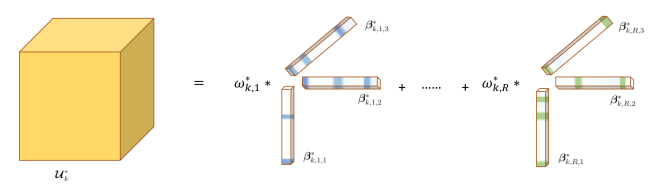
- Imposes low-rank and internally sparse structure on tensor means to reduce dimensionality and improve interpretability.
- Assumes separable and conditionally sparse covariance structures to model complex dependence while maintaining tractability.
- Develops the HECM algorithm, which reformulates the intractable M-step of EM into a sequence of convex, regularized, closed-form optimization problems.
- Employs dual non-convexity analysis to establish geometric convergence under appropriate initialization.
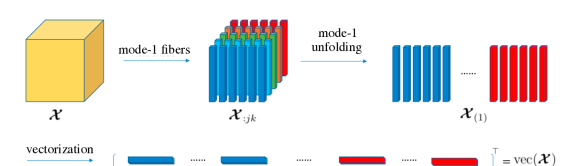
- Uses tensor decomposition and conditional maximization to enable scalable and stable inference in high-dimensional settings.
Experimental results
Research questions
- RQ1Can a tensor mixture model with heterogeneous covariances effectively capture population heterogeneity in high-dimensional tensor data?
- RQ2How can low-rank and structured covariance assumptions improve estimation efficiency and interpretability in tensor clustering?
- RQ3What algorithmic framework enables stable and efficient estimation when the M-step is intractable in high-dimensional tensor models?
- RQ4To what extent does the proposed HECM algorithm achieve geometric convergence despite non-convexity in the EM-type procedure?
- RQ5How does the method compare in clustering accuracy to existing benchmarks on real-world fMRI data?
Key findings
- The HECM algorithm converges geometrically to a neighborhood within statistical precision of the true parameter under appropriate initialization.
- The method achieves significantly improved clustering accuracy compared to benchmark methods, including DEEM and vector-based clustering, on both synthetic and real fMRI data.
- On fMRI data with 57 subjects and tensors of size 116×116×30, the proposed method successfully identified distinct brain connectivity patterns between ASD and normal control groups.
- The model revealed that ASD subjects exhibit less dynamic and less connected brain networks over time, particularly in the frontal lobe, consistent with existing neuroimaging findings.
- The method demonstrated numerical stability and robustness, outperforming DEEM, which showed sensitivity to model misspecification and instability in simulations.
- The estimated brain connectivity patterns showed clear differences: normal controls exhibited increasing then decreasing connectivity, while ASD subjects showed relatively stable, low connectivity across time windows.
Read this paper
Open the full text in the Nubint reader and ask about any passage as you read.
Read this paper on NubintThis review was generated by AI from the original paper. Please check the paper before citing it.