
[Paper Review] Joule-Thomson Expansion of Born-Infeld AdS Black Holes
This paper investigates Joule-Thomson expansion in Born-Infeld AdS black holes within the extended phase space, treating the cosmological constant as pressure. It derives the Joule-Thomson coefficient, inversion curves, and isenthalpic curves in 4D and higher dimensions, showing that the inversion curve always has a positive slope and the ratio of critical temperature to minimum inversion temperature asymptotically approaches 1/2 as charge increases or β → ∞.
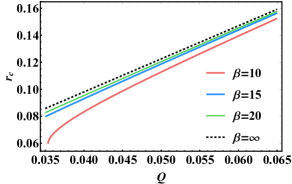
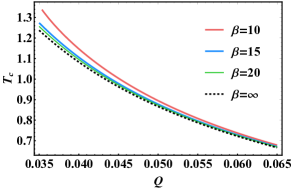
In this paper, the Joule-Thomson expansion of Born-Infeld AdS black holes is studied in the extended phase space, where the cosmological constant is identified with the pressure. The Joule-Thomson coefficient, the inversion curves and the isenthalpic curves are discussed in detail by 4-dimensional black hole. The critical point of Born-Infeld black hole is depicted with varying parameter $β$ and the charge $Q$. In $T-P$ plane, the inversion temperature curves and isenthalpic curves are obtained with different parameter $β$ and the charge $Q$. We find that the missing negative slope is still conserved in Born-Infeld black holes. We also extend our discussion to arbitrary dimension higher than 4. The critical temperature and the minimum of inversion temperature are compared, and the ratio is asymptotically $1/2$ as $Q$ increases or $β o\infty$ in $D=4$, and reproduce the previous results in higher dimension.
Motivation & Objective
- To extend the study of Joule-Thomson expansion to Born-Infeld AdS black holes in the extended phase space.
- To analyze the Joule-Thomson coefficient, inversion curves, and isenthalpic processes in D-dimensional spacetime.
- To investigate the influence of nonlinear electrodynamics parameter β and black hole charge Q on thermodynamic behavior.
- To compare critical temperature and minimum inversion temperature, particularly in the limit β → ∞ and Q → ∞.
- To generalize results from 4D to higher dimensions and confirm consistency with known RN-AdS black hole behavior.
Proposed method
- Formulates the Einstein-Hilbert-Born-Infeld action with a cosmological constant related to AdS radius l.
- Uses the Born-Infeld Lagrangian L(F) = 4β²(1 - √(1 + F²/(2β²))) to model nonlinear electrodynamics.
- Derives the equation of state for D-dimensional Born-Infeld AdS black holes in terms of pressure P, temperature T, and horizon radius r₊.
- Computes the Joule-Thomson coefficient μ as a function of r₊ and β, identifying divergence and zero points.
- Constructs inversion curves T(P) and isenthalpic curves in the T-P plane for varying β and Q.
- Performs asymptotic analysis in the high-temperature, low-pressure limit to show μ remains positive, implying no maximum inversion temperature.
Experimental results
Research questions
- RQ1How does the Joule-Thomson coefficient behave in Born-Infeld AdS black holes, and what is its relation to extremal black holes?
- RQ2What are the shapes and properties of inversion curves in the T-P plane for different values of β and Q?
- RQ3How do the critical temperature and the minimum inversion temperature compare in 4D and higher dimensions?
- RQ4Does the absence of a maximum inversion temperature persist in Born-Infeld AdS black holes, and why?
- RQ5To what extent do the results reproduce known RN-AdS black hole behavior in the β → ∞ limit?
Key findings
- The Joule-Thomson coefficient μ exhibits a divergence at the same point where the Hawking temperature vanishes, corresponding to extremal black holes.
- Inversion curves in the T-P plane always have a positive slope, indicating that Born-Infeld AdS black holes cool during expansion above the curve.
- The ratio of critical temperature to the minimum inversion temperature asymptotically approaches 1/2 as Q increases or β → ∞ in 4D spacetime.
- In higher dimensions, the same asymptotic ratio of 1/2 is reproduced, consistent with previous results for RN-AdS black holes.
- The absence of a maximum inversion temperature is analytically confirmed via Virial expansion, as the second Virial coefficient remains negative, keeping μ positive at high T.
- The results reduce to the RN-AdS case in the limit β → ∞, validating consistency with established thermodynamic behavior.
Read this paper
Open the full text in the Nubint reader and ask about any passage as you read.
Read this paper on NubintThis review was generated by AI from the original paper. Please check the paper before citing it.