
[Paper Review] Jupiter Mass Binary Objects in the Trapezium Cluster
The study uses JWST NIRCam imaging to identify 540 planetary-mass candidates down to 0.6 Jupiter masses in the Trapezium Cluster, finds 9% in wide binaries (JuMBOs), and discusses implications for the planetary-mass end of the IMF and formation mechanisms.
A key outstanding question in star and planet formation is how far the initial mass function of stars and sub-stellar objects extends, and whether or not there is a cut-off at the very lowest masses. Isolated objects in the planetary-mass domain below 13 Jupiter masses, where not even deuterium can fuse, are very challenging to observe as these objects are inherently faint. Nearby star-forming regions provide the best opportunity to search for them though: while they are young, they are still relatively warm and luminous at infrared wavelengths. Previous surveys have discovered a handful of such sources down to 3--5 Jupiter masses, around the minimum mass limit established for formation via the fragmentation of molecular clouds, but does the mass function extend further? In a new James Webb Space Telescope near-infrared survey of the inner Orion Nebula and Trapezium Cluster, we have discovered and characterised a sample of 540 planetary-mass candidates with masses down to 0.6 Jupiter masses, demonstrating that there is indeed no sharp cut-off in the mass function. Furthermore, we find that 9\% of the planetary-mass objects are in wide binaries, a result that is highly unexpected and which challenges current theories of both star and planet formation.
Motivation & Objective
- Assess how far the initial mass function extends into the planetary-mass regime in a young cluster.
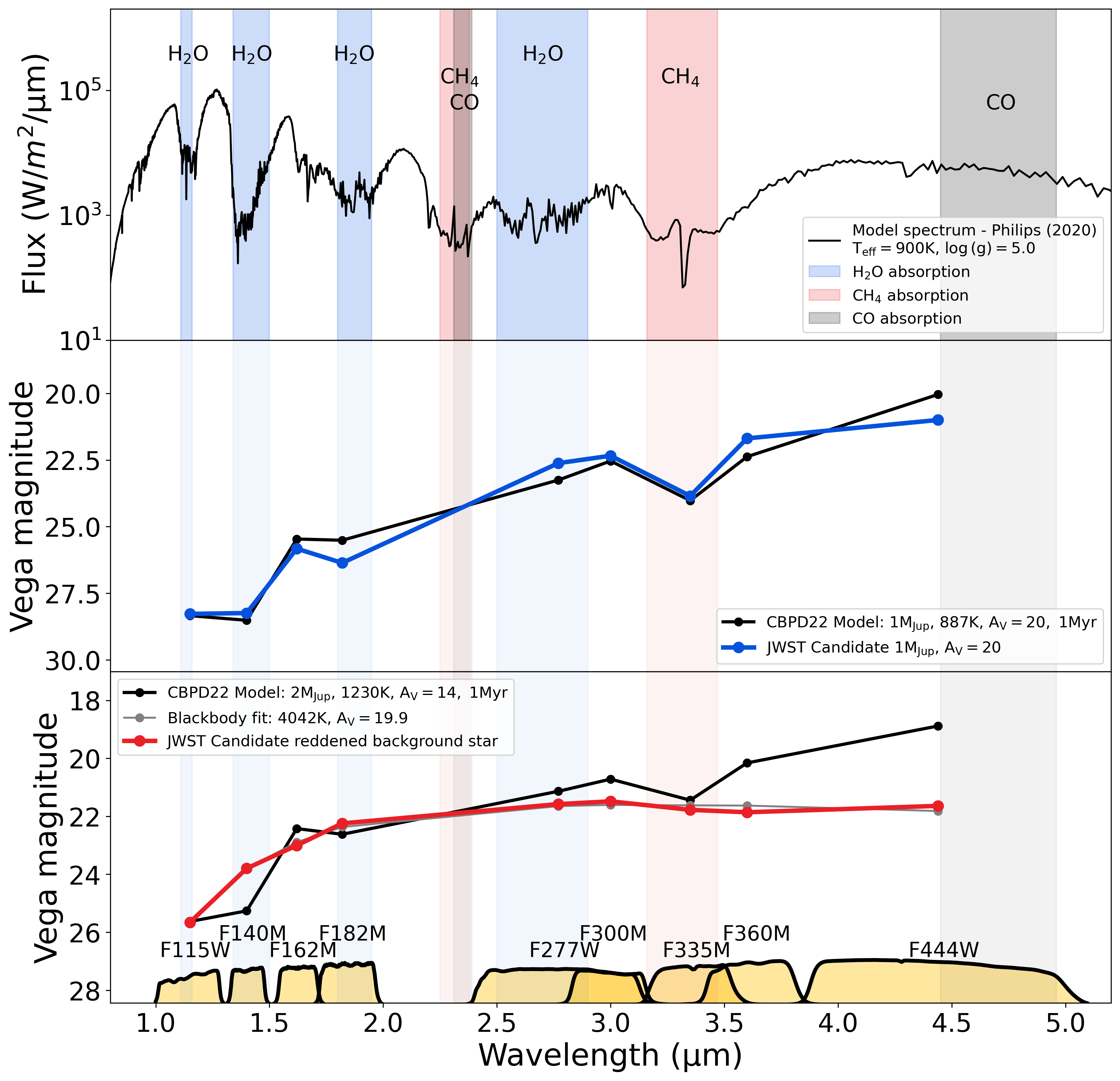
- Identify PMO candidates using JWST NIRCam medium- and wide-band photometry targeting molecular absorption features (H2O and CH4).
- Characterize multiplicity among planetary-mass objects and quantify the wide binary fraction.
- Compare observed PMO demographics with formation scenarios (star-like vs planet-like mechanisms).
- Provide a catalog and methodology to distinguish PMOs from background/foreground sources in a dense star-forming region.
Proposed method
- JWST NIRCam imaging of an 11' × 7.5' region in the inner Orion Nebula and Trapezium Cluster (34.9 hours, 12 filters).
- Photometric classification of PMOs using H2O (1.4 and 1.9 μm) and CH4 (3.35 μm) absorption features via specific filter combinations and defined indices (Equations 1–3).
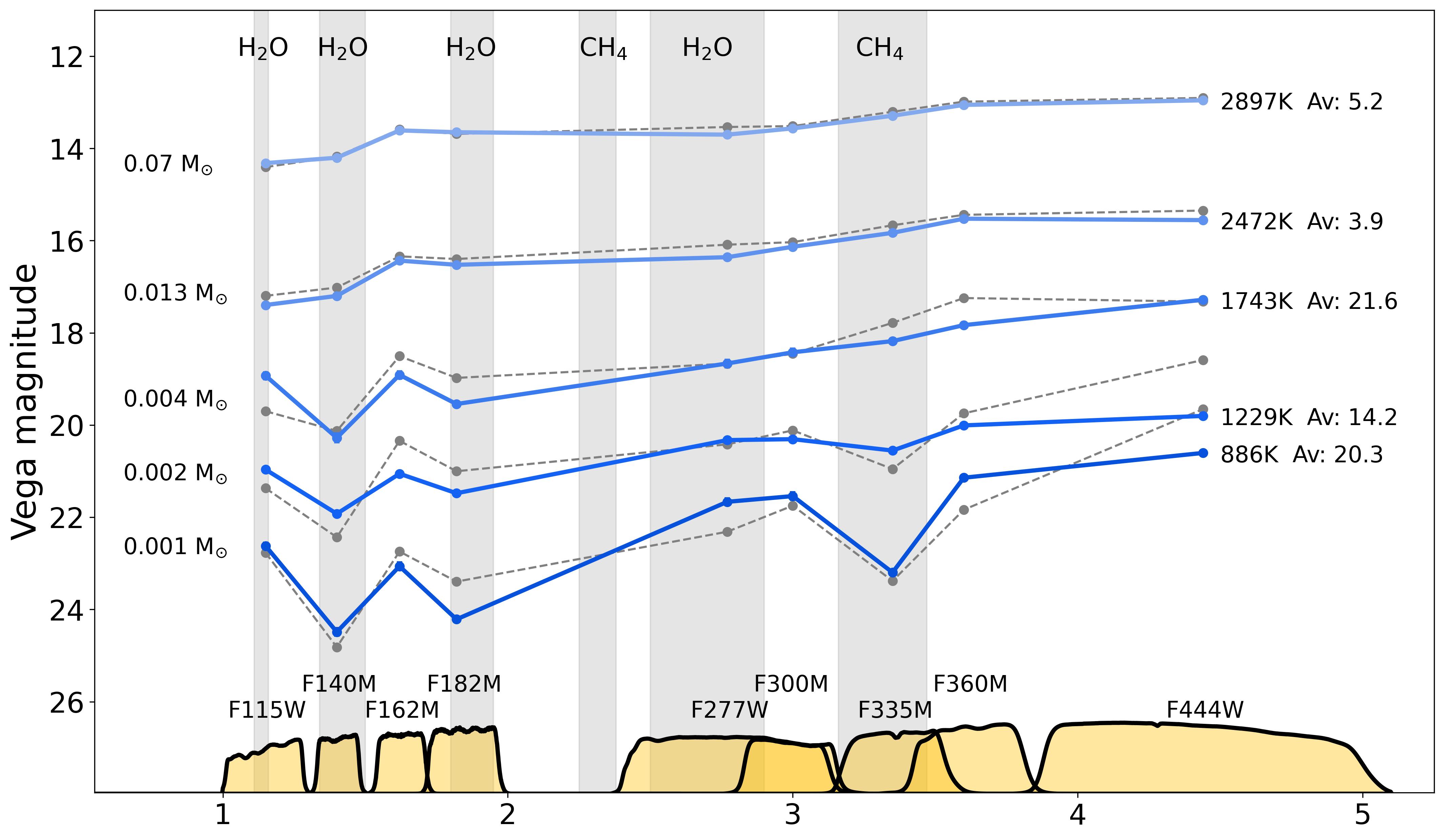
- Model fitting of nine-filter SEDs with grids of evolutionary models (CEQ and NEQ from ATMO 2020) plus BHAC15 for higher masses, across extinction AV 1–100 and age 1 Myr at 390 pc.
- Dereddened photometry compared against 1 Myr evolutionary model grids to estimate masses (0.0004–0.015 M⊙) and identify PMOs down to ≈0.6 Mjup.
- Visual inspection and aperture photometry (2.5 and 4.5 pixel apertures) to build a candidate PMO catalog of 540 objects.
- Supplementary materials detail data reduction, source detection, and contamination assessment (galaxies, background stars).
Experimental results
Research questions
- RQ1What is the lower-mass extent of the PMO population in the Trapezium Cluster as traced by JWST photometry?
- RQ2Do planetary-mass objects in this environment exist as wide binaries (JuMBOs), and what is their frequency and properties?
- RQ3How does the PMO mass function extend below 1 Mjup, and is there evidence for a sharp cut-off?
- RQ4What formation mechanisms (star-like fragmentation vs planet-like ejection) can explain the JuMBO population and their separations/mass ratios?
Key findings
- A sample of 540 PMO candidates with masses down to 0.6 Mjup is identified, showing a smooth continuation of the IMF without a sharp cut-off.
- 9% of PMOs are in wide binary systems (JuMBOs) with separations ≈25–390 au, a surprising result at planetary masses.
- JuMBOs span 0.7–7 Mjup with evenly distributed separations; average mass ratio is q = 0.66, with only ~40% having q ≥ 0.8.
- The wide-binary fraction as a function of primary mass rises at PMO masses, contrasting with the decreasing trend from higher masses, suggesting new formation channels at planetary masses.
- CEQ atmospheric/chemistry models fit PMOs down to 2 Mjup best; NEQ weak models favored below 2 Mjup, indicating potential vertical mixing effects.
- Follow-up NIRSpec spectroscopy (JWST Cycle 2) is planned to refine temperatures, spectral types, and chemistry of PMOs and JuMBOs.
Read this paper
Open the full text in the Nubint reader and ask about any passage as you read.
Read this paper on NubintThis review was generated by AI from the original paper. Please check the paper before citing it.