
[Paper Review] Just Another Day on Twitter: A Complete 24 Hours of Twitter Data
The paper presents the first complete 24-hour Twitter dataset (375M tweets from Sep 21, 2022) collected with an all-encompassing query to study activity, bot prevalence, language, topics, and user characteristics, establishing baselines before the platform’s ownership change.
At the end of October 2022, Elon Musk concluded his acquisition of Twitter. In the weeks and months before that, several questions were publicly discussed that were not only of interest to the platform's future buyers, but also of high relevance to the Computational Social Science research community. For example, how many active users does the platform have? What percentage of accounts on the site are bots? And, what are the dominating topics and sub-topical spheres on the platform? In a globally coordinated effort of 80 scholars to shed light on these questions, and to offer a dataset that will equip other researchers to do the same, we have collected all 375 million tweets published within a 24-hour time period starting on September 21, 2022. To the best of our knowledge, this is the first complete 24-hour Twitter dataset that is available for the research community. With it, the present work aims to accomplish two goals. First, we seek to answer the aforementioned questions and provide descriptive metrics about Twitter that can serve as references for other researchers. Second, we create a baseline dataset for future research that can be used to study the potential impact of the platform's ownership change.
Motivation & Objective
- Provide a complete 24-hour Twitter dataset to address sampling bias and data quality concerns in prior studies.
- Describe the data collection pipeline and methods to minimize temporal bias and maximize representativeness.
- Offer descriptive metrics to serve as reference for researchers and a baseline before the Twitter ownership change.
- Enable future research on platform dynamics, bot prevalence, language distribution, and content topics.
Proposed method
- Collect 24 hours of Twitter data (Sept 20 15:00 UTC – Sept 21 14:59 UTC) using the Academic API with a time-sliced, 1-second task design to reduce temporal bias.
- Use a negative-language-inclusive query strategy to capture all tweets within the window, leveraging Twitter language tagging (lang: codes) and a long OR-language construction.
- Split the day into 86,400 tasks, each representing one second of activity, started 10 minutes after creation time to stabilize samples.
- Implement multiple parallel API tokens (80 processes) to avoid backlog and ensure high temporal coverage.
- Provide dataset via tweet IDs under FAIR principles to support privacy and reproducibility (CC BY 4.0).
Experimental results
Research questions
- RQ1What is the scale and composition of Twitter activity over a complete 24-hour period on a representative day?
- RQ2What are the distributions of active accounts, languages, and content types (texts, media, geo-tags) during a full day?
- RQ3What is the prevalence and characteristics of bot-like behavior on the collected day?
- RQ4What topics and communities dominate the 24-hour discourse as reflected by hashtags and content categories?
- RQ5How do these baseline metrics inform future research, especially in light of platform ownership changes?
Key findings
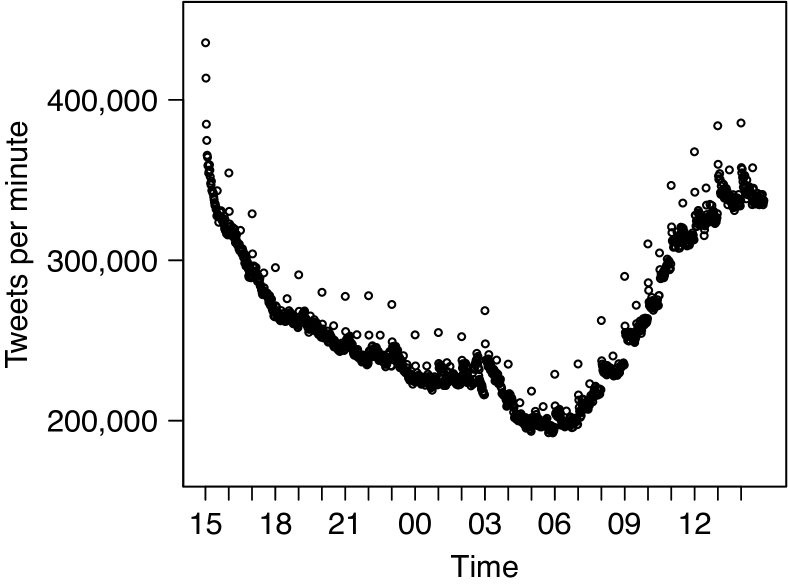
- The dataset contains 374,937,971 tweets from 40,199,195 accounts, with about 1% of users generating around 3.5 million tweets and 50% of tweets coming from 175,000 accounts.
- On average about 4,340 tweets per second (range 2,989–8,955) were collected; tweet activity shows a 15.5% higher tweet rate in the first minute of each hour.
- 79.2% of tweets are retweets or quotes or replies, while 20.8% are original tweets; total retweets across the day amount to 401 billion performances.
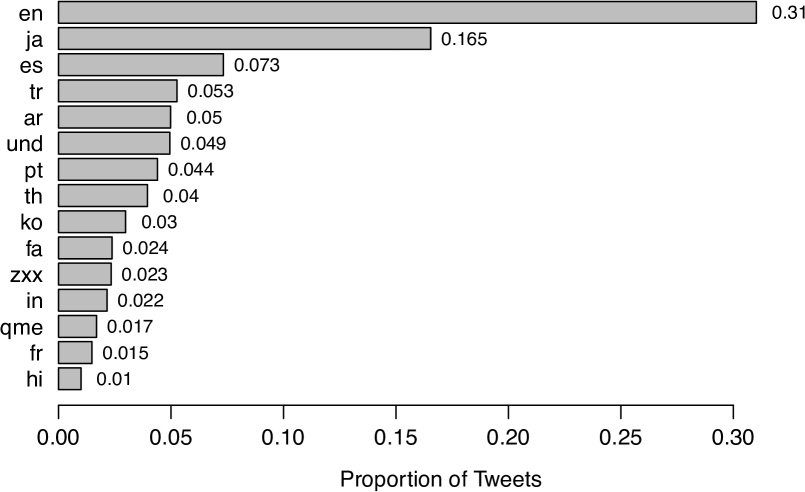
- Languages: 15 languages account for 92.5% of tweets; 0.5% of tweets are geo-tagged globally, with the US, Brazil, Japan, Saudi Arabia, and India as top geo-tagged countries.
- Media: 112,779,266 media attachments (76.9% photos, 20.7% videos, 2.4% GIFs); 0.5% geo-tagged tweets.
- Bot prevalence (via BotometerLite): about 20% of active accounts have bot-like scores above 0.5; bot-like behavior appears higher among older accounts and those with more tweets.
Read this paper
Open the full text in the Nubint reader and ask about any passage as you read.
Read this paper on NubintThis review was generated by AI from the original paper. Please check the paper before citing it.