
[Paper Review] Kernelized Back-Projection Networks for Blind Super Resolution
This paper proposes Kernelized Back-Projection Networks (KBPN and KCBPN) for blind super-resolution by iteratively integrating blur kernel estimation and super-resolution feature enhancement. By modeling the degradation process via a raw blur kernel and using residual learning through back-projection, KBPN achieves state-of-the-art PSNR (29.52) on blind SR benchmarks, outperforming prior methods by leveraging iterative refinement of both HR image and blur kernel estimates.
Since non-blind Super Resolution (SR) fails to super-resolve Low-Resolution (LR) images degraded by arbitrary degradations, SR with the degradation model is required. However, this paper reveals that non-blind SR that is trained simply with various blur kernels exhibits comparable performance as those with the degradation model for blind SR. This result motivates us to revisit high-performance non-blind SR and extend it to blind SR with blur kernels. This paper proposes two SR networks by integrating kernel estimation and SR branches in an iterative end-to-end manner. In the first model, which is called the Kernel Conditioned Back-Projection Network (KCBPN), the low-dimensional kernel representations are estimated for conditioning the SR branch. In our second model, the Kernelized BackProjection Network (KBPN), a raw kernel is estimated and directly employed for modeling the image degradation. The estimated kernel is employed not only for back-propagating its residual but also for forward-propagating the residual to iterative stages. This forward-propagation encourages these stages to learn a variety of different features in different stages by focusing on pixels with large residuals in each stage. Experimental results validate the effectiveness of our proposed networks for kernel estimation and SR. We will release the code for this work.
Motivation & Objective
- To address the limitation of non-blind super-resolution in handling arbitrary degradations, especially blur kernels not seen during training.
- To investigate whether non-blind SR models trained on diverse blur kernels can achieve blind SR performance comparable to dedicated blind methods.
- To develop end-to-end trainable networks that jointly optimize super-resolution and blur kernel estimation through iterative refinement.
- To improve feature learning in deep SR networks by focusing on high-residual pixels via a residual-based back-projection mechanism.
- To enhance robustness and accuracy in both image reconstruction and blur kernel estimation using explicit degradation modeling.
Proposed method
- Proposes two models: KCBPN, which conditions the SR branch on low-dimensional kernel representations, and KBPN, which estimates a raw blur kernel for explicit degradation modeling.
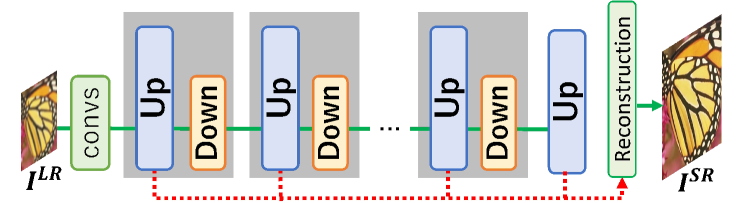
- Integrates iterative up-projection and down-projection in a back-projection framework, where the estimated LR image is reconstructed using the current HR estimate and blur kernel at each stage.
- Employs a residual loss between the input LR image and the reconstructed LR image at each stage, enabling progressive refinement of both SR and blur kernel estimates.
- Uses a combined loss function: kernel loss for blur kernel estimation and LR loss for aligning reconstructed LR images with the input, promoting accurate degradation modeling.
- Applies back-projection not only for error feedback but also for forward-propagating residuals, encouraging stage-specific feature learning on pixels with high error.
- Utilizes a dense skip connection structure to preserve and enhance features across iterative stages, improving representation diversity.

Experimental results
Research questions
- RQ1Can non-blind super-resolution models trained on diverse blur kernels achieve performance comparable to dedicated blind super-resolution methods?
- RQ2How can iterative back-projection be extended to jointly optimize blur kernel estimation and super-resolution in blind settings?
- RQ3To what extent does residual learning based on reconstructed LR images improve feature representation and reconstruction quality in blind SR?
- RQ4Does explicit modeling of the degradation process (via raw blur kernel) enhance both SR and kernel estimation performance?
- RQ5How do iterative stages in the proposed network learn diverse features, and does this contribute to improved reconstruction fidelity?
Key findings
- KBPN achieves a PSNR of 29.52 on the DIV2K blind SR benchmark, surpassing state-of-the-art methods such as IKC (27.64) and KOALAnet (25.46).
- The proposed method demonstrates superior visual quality, particularly in reconstructing sharp edges and fine textures, as shown in qualitative comparisons.
- Feature map visualization confirms that earlier stages learn low-frequency features, while later stages focus on high-frequency details, indicating progressive refinement.
- Residual maps (R^LR_t) show decreasing pixel-wise values across stages, indicating improved alignment between reconstructed and ground-truth LR images.
- The method is robust to various blur types, including anisotropic Gaussian blurs, though kernel variance estimation remains imperfect for complex blurs.
- Empirical results confirm that non-blind SR models trained on diverse blur kernels can achieve performance close to blind SR, validating the core design principle of the proposed framework.
Read this paper
Open the full text in the Nubint reader and ask about any passage as you read.
Read this paper on NubintThis review was generated by AI from the original paper. Please check the paper before citing it.