
[Paper Review] Keyframer: Empowering Animation Design using Large Language Models
Keyframer is an LLM-powered animation tool that enables users to generate and iteratively refine CSS animations from static SVGs using natural language prompts and direct code editing. The system supports creative iteration through decomposed prompting, variant generation, and hybrid prompting/editing workflows, demonstrating how LLMs can empower both novices and experts in animation design while maintaining user control.
Creating 2D animations is a complex, iterative process requiring continuous adjustments to movement, timing, and coordination of multiple elements within a scene. To support designers of varying levels of experience with animation design and implementation, we developed Keyframer, a design tool that generates animation code in response to natural language prompts, enabling users to preview rendered animations inline and edit them directly through provided editors. Through a user study with 13 novices and experts in animation design and programming, we contribute 1) a categorization of semantic prompt types for describing motion and identification of a 'decomposed' prompting style where users continually adapt their goals in response to generated output; and 2) design insights on supporting iterative refinement of animations through the combination of direct editing and natural language interfaces.
Motivation & Objective
- To address the underexplored application of LLMs in animation design, where motion description poses unique challenges beyond static image generation.
- To understand professional motion designers’ pain points and AI-assist needs through formative interviews with 9 practitioners.
- To develop and evaluate an interactive animation prototyping tool that combines LLM prompting with direct code editing for iterative refinement.
- To characterize user prompting strategies in animation generation, especially for describing motion semantics and timing.
- To explore how LLMs can support ideation and creative exploration through design variant generation and responsive feedback.
Proposed method
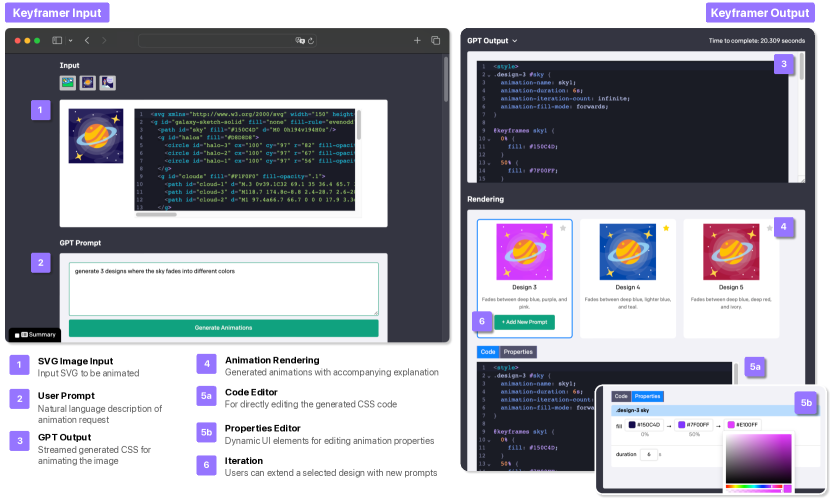
- Keyframer integrates GPT-4 to generate semantic, human-readable CSS animation code from natural language prompts applied to input SVGs.
- The system provides multiple editor interfaces: a prompt input field for text-based instructions and a code editor for direct modification of generated animation properties and keyframes.
- Users can request design variants via LLM prompting, enabling exploration of alternative interpretations of the same prompt.
- The interface supports a 'decomposed' prompting workflow, where users iteratively animate individual scene elements rather than specifying full animations in one prompt.
- Inline animation previews and descriptive code (e.g., 'flameFlicker', 'opacity') help users interpret and debug LLM-generated output.
- User study data was collected from 13 participants across varying experience levels to analyze prompting behaviors and iterative design workflows.
Experimental results
Research questions
- RQ1What painpoints exist for motion designers, and what ideas do they have for how AI might assist with these processes?
- RQ2What design strategies do users take to prompt LLMs for animations using natural language?
- RQ3How does Keyframer support iteration in animation design through combined prompting and direct editing?
- RQ4How do users interpret and respond to unexpected or serendipitous LLM-generated animation outputs?
- RQ5What role do design variants play in supporting ideation and creative exploration during animation prototyping?
Key findings
- Users predominantly employed a 'decomposed' prompting strategy, iteratively animating individual elements in a scene rather than specifying full animations in a single prompt.
- A taxonomy of semantic prompting styles emerged, including descriptions of timing, coordination, and open-ended creative prompts such as 'make it look cool'.
- The combination of prompting and direct code editing enabled users to maintain creative control and refine animations beyond the limitations of one-shot prompting interfaces.
- Design variant generation was valued as a tool for ideation, helping users explore alternative interpretations of their prompts and discover unexpected creative directions.
- Users expressed strong interest in improved interpretability, such as syntax highlighting for SVG identifiers and pre-generation confirmation questions from the LLM.
- Despite limitations, users found serendipitous LLM outputs to be creatively stimulating, particularly when exploring variants or debugging through iterative refinement.
Read this paper
Open the full text in the Nubint reader and ask about any passage as you read.
Read this paper on NubintThis review was generated by AI from the original paper. Please check the paper before citing it.