
[Paper Review] Keyword Search on RDF Graphs - A Query Graph Assembly Approach
This paper proposes a query graph assembly (QGA) approach for keyword search on RDF graphs, modeling user intent as a structured query graph assembled from disambiguated entities, classes, and predicates. By formulating QGA as an NP-complete problem and using a bipartite graph matching-based best-first search with heuristic lower bounds, the method achieves high efficiency and scalability independent of RDF graph size, outperforming prior systems in both effectiveness and response time on DBpedia and Freebase.
Keyword search provides ordinary users an easy-to-use interface for querying RDF data. Given the input keywords, in this paper, we study how to assemble a query graph that is to represent user's query intention accurately and efficiently. Based on the input keywords, we first obtain the elementary query graph building blocks, such as entity/class vertices and predicate edges. Then, we formally define the query graph assembly (QGA) problem. Unfortunately, we prove theoretically that QGA is a NP-complete problem. In order to solve that, we design some heuristic lower bounds and propose a bipartite graph matching-based best-first search algorithm. The algorithm's time complexity is $O(k^{2l} \cdot l^{3l})$, where $l$ is the number of the keywords and $k$ is a tunable parameter, i.e., the maximum number of candidate entity/class vertices and predicate edges allowed to match each keyword. Although QGA is intractable, both $l$ and $k$ are small in practice. Furthermore, the algorithm's time complexity does not depend on the RDF graph size, which guarantees the good scalability of our system in large RDF graphs. Experiments on DBpedia and Freebase confirm the superiority of our system on both effectiveness and efficiency.
Motivation & Objective
- To address the challenge of accurately interpreting user keyword queries on RDF graphs by modeling query intent as a structured query graph.
- To integrate keyword disambiguation and query structure generation into a unified optimization model, avoiding error propagation from sequential processing.
- To design an efficient, scalable algorithm for query graph assembly that is independent of RDF graph size, ensuring fast response times in large-scale deployments.
- To improve retrieval effectiveness by leveraging TransE-based graph embedding to evaluate the semantic quality of candidate query graphs.
Proposed method
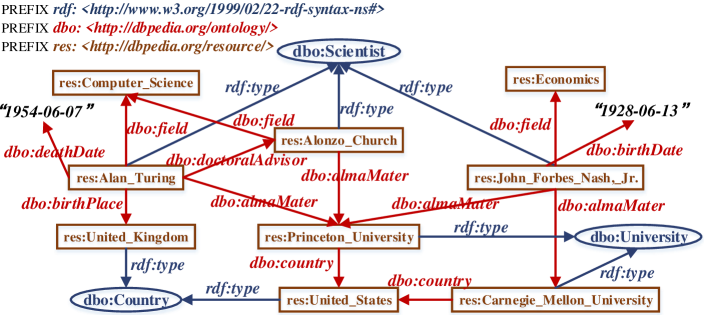
- The approach formulates keyword search as a query graph assembly (QGA) problem, where each keyword is matched to candidate entities, classes, and predicates.
- A bipartite graph model is constructed to represent matches between keywords and query graph elements, enabling joint optimization of disambiguation and structure formation.
- Heuristic lower bounds—Naive-LB, Greedy-LB, and KM-LB—are introduced to prune the search space in a best-first search strategy.
- The QGA algorithm uses a best-first search guided by these bounds, with time complexity O(k²ˡ·l³ˡ), where l is the number of keywords and k is the maximum number of candidates per keyword.
- TransE embedding is used to evaluate the semantic coherence of candidate query graphs, serving as the objective function for optimization.
- The system employs a two-phase framework: Phase I maps keywords to RDF items and builds candidate query graphs; Phase II assembles the optimal query graph using the QGA algorithm.
Experimental results
Research questions
- RQ1How can keyword search on RDF graphs be modeled as a unified query graph assembly problem that jointly handles disambiguation and structural formation?
- RQ2What are effective heuristic lower bounds that can significantly reduce the search space in the NP-complete QGA problem without sacrificing solution quality?
- RQ3How can the query graph assembly process be made efficient and scalable, especially in large RDF graphs with billions of triples?
- RQ4To what extent does integrating disambiguation and structure formation into a single optimization model improve retrieval accuracy compared to sequential approaches?
- RQ5What is the trade-off between response time and accuracy when tuning parameters k (candidate limit) and N (number of top query graphs to consider)?
Key findings
- The proposed QGA algorithm achieves an average response time of 734.9ms on DBpedia and 1103.2ms on Freebase, with the QGA phase itself taking less than 80ms per query.
- Using k=10 and N=5 provides the best trade-off between precision and performance, as F1 scores plateau beyond these values.
- The Greedy-LB heuristic provides the best balance between pruning power and efficiency, reducing search states by over 70% compared to Naive-LB while being faster than KM-LB.
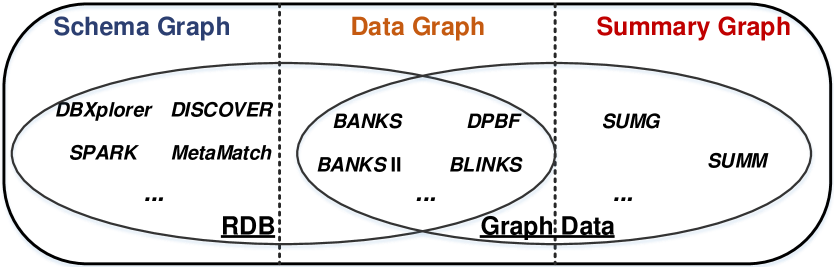
- The system outperforms state-of-the-art methods DPBF and SUMG by 1–3 times on average across 180 benchmark queries from QALD-6 and Free917.
- TransE-based scoring significantly improves accuracy over baseline methods that do not capture structural information, as shown by F1 score comparisons.
- The time complexity of the QGA algorithm is independent of RDF graph size, making it highly scalable to large-scale knowledge graphs like DBpedia and Freebase.
Read this paper
Open the full text in the Nubint reader and ask about any passage as you read.
Read this paper on NubintThis review was generated by AI from the original paper. Please check the paper before citing it.