
[Paper Review] KG-FIT: Knowledge Graph Fine-Tuning Upon Open-World Knowledge
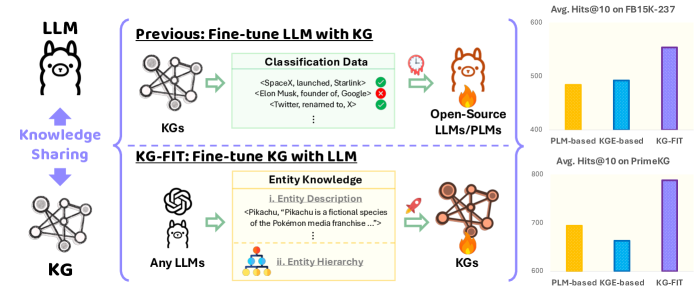
KG-FIT is a novel framework that enhances knowledge graph embeddings by integrating open-world knowledge from large language models (LLMs) through LLM-guided hierarchical clustering and fine-tuning. It achieves state-of-the-art performance, improving Hits@10 by 14.4%, 13.5%, and 11.9% on FB15K-237, YAGO3-10, and PrimeKG, respectively, by fusing global semantics from LLMs with local KG structure.
Knowledge Graph Embedding (KGE) techniques are crucial in learning compact representations of entities and relations within a knowledge graph, facilitating efficient reasoning and knowledge discovery. While existing methods typically focus either on training KGE models solely based on graph structure or fine-tuning pre-trained language models with classification data in KG, KG-FIT leverages LLM-guided refinement to construct a semantically coherent hierarchical structure of entity clusters. By incorporating this hierarchical knowledge along with textual information during the fine-tuning process, KG-FIT effectively captures both global semantics from the LLM and local semantics from the KG. Extensive experiments on the benchmark datasets FB15K-237, YAGO3-10, and PrimeKG demonstrate the superiority of KG-FIT over state-of-the-art pre-trained language model-based methods, achieving improvements of 14.4%, 13.5%, and 11.9% in the Hits@10 metric for the link prediction task, respectively. Furthermore, KG-FIT yields substantial performance gains of 12.6%, 6.7%, and 17.7% compared to the structure-based base models upon which it is built. These results highlight the effectiveness of KG-FIT in incorporating open-world knowledge from LLMs to significantly enhance the expressiveness and informativeness of KG embeddings.
Motivation & Objective
- To address the limitation of existing knowledge graph embedding (KGE) methods that rely solely on graph structure and ignore rich open-world knowledge from LLMs.
- To overcome the inefficiency and knowledge stagnation of fine-tuning large language models (LLMs) directly for KGE tasks.
- To develop a method that leverages pre-trained LLMs to enrich KG embeddings without fine-tuning the LLMs themselves.
- To construct a semantically coherent, hierarchical structure of entities using LLM-generated descriptions and agglomerative clustering.
- To improve link prediction performance by jointly optimizing for both KG structural constraints and LLM-derived semantic knowledge.
Proposed method
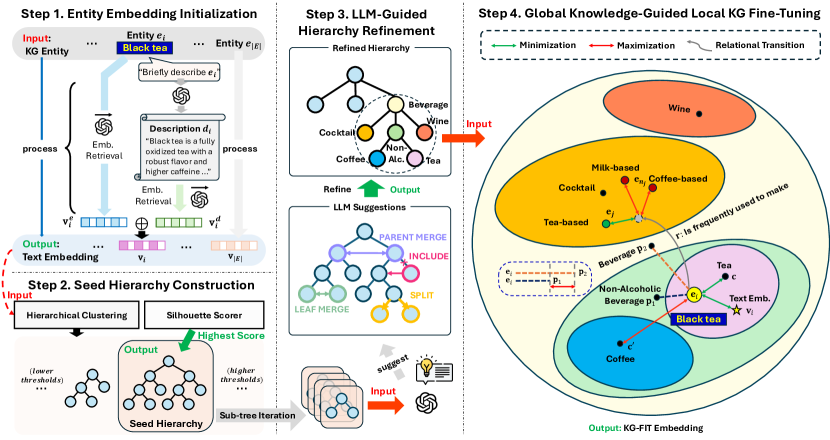
- KG-FIT first generates descriptive text for entities using a pre-trained language model (PLM), then applies LLM-guided agglomerative clustering to build a hierarchical structure of entity clusters.
- It constructs a seed hierarchy via agglomerative clustering on PLM-generated text embeddings, followed by iterative splitting of clusters based on semantic coherence and LLM feedback.
- The framework refines the initial hierarchy using LLM-guided cluster splitting, ensuring parent-child relationships reflect semantic similarity and hierarchical relationships.
- KG-FIT fine-tunes KG embeddings by jointly optimizing for structural link prediction loss, hierarchical clustering constraints, and LLM-based text embedding alignment.
- It uses a hybrid scoring function based on HAKE, where the modulus of entity embeddings is derived from PLM text embeddings and the phase from entity name embeddings.
- The final entity embedding combines information from both the PLM-generated description and name embeddings, with a learnable fusion mechanism controlled by hyperparameters.
Experimental results
Research questions
- RQ1Can LLM-generated entity descriptions be effectively used to construct a semantically coherent hierarchical structure of entities in a knowledge graph?
- RQ2How can open-world knowledge from LLMs be systematically integrated into KG embeddings without fine-tuning the LLMs?
- RQ3Does the integration of hierarchical and textual knowledge from LLMs significantly improve the expressiveness and performance of KG embeddings in link prediction?
- RQ4How does KG-FIT compare to state-of-the-art KGE methods that rely solely on graph structure or PLM fine-tuning?
- RQ5What is the relative contribution of hierarchical structure versus raw text embeddings in enhancing KG representation learning?
Key findings
- KG-FIT achieves a 14.4% improvement in Hits@10 on FB15K-237 compared to state-of-the-art PLM-based methods, demonstrating superior link prediction performance.
- On YAGO3-10, KG-FIT improves Hits@10 by 13.5% over existing PLM-based baselines, highlighting its effectiveness in complex relational reasoning.
- On PrimeKG, KG-FIT achieves an 11.9% gain in Hits@10, indicating strong generalization across diverse knowledge graph distributions.
- KG-FIT outperforms its base structure-based model by 12.6%, 6.7%, and 17.7% on FB15K-237, YAGO3-10, and PrimeKG, respectively, proving the value of open-world knowledge integration.
- The ablation study confirms that both the hierarchical structure and LLM-generated text embeddings contribute significantly to performance gains, with the combination yielding the strongest results.
Read this paper
Open the full text in the Nubint reader and ask about any passage as you read.
Read this paper on NubintThis review was generated by AI from the original paper. Please check the paper before citing it.