
[Paper Review] Kicking it Off(-shell) with Direct Diffusion
This paper proposes Direct Diffusion (DiDi), a generative machine learning method that efficiently transforms on-shell LHC events into precise off-shell configurations by learning the phase space extension beyond on-shell peaks. The approach achieves sub-10% relative error in off-shell kinematic distributions and sub-5% precision on on-shell features, with classifier reweighting improving accuracy to the few percent level, enabling fast, high-precision simulation of complex off-shell backgrounds for HL-LHC physics.
Off-shell effects in large LHC backgrounds are crucial for precision predictions and, at the same time, challenging to simulate. We present a novel method to transform high-dimensional distributions based on a diffusion neural network and use it to generate a process with off-shell kinematics from the much simpler on-shell one. Applied to a toy example of top pair production at LO we show how our method generates off-shell configurations fast and precisely, while reproducing even challenging on-shell features.
Motivation & Objective
- Address the challenge of generating precise off-shell kinematic configurations in high-energy physics simulations, especially for large LHC backgrounds.
- Overcome limitations of on-shell approximations in precision predictions for top quark pair production and decay.
- Develop a fast, modular, and composable generative surrogate that maps on-shell events to off-shell phase space without degrading on-shell feature accuracy.
- Enable efficient integration into standard event generators like MadGraph via LHE format, supporting future HL-LHC analyses.
- Provide a conservative uncertainty estimate via Bayesian deep learning to track statistical limitations of training data.
Proposed method
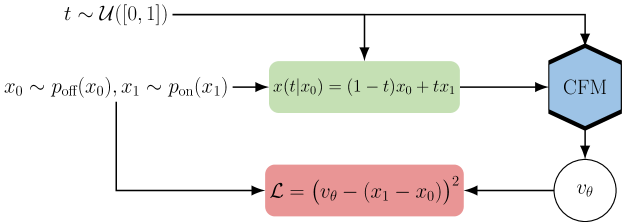
- Train a conditional diffusion generative model (DiDi) to map on-shell events to off-shell configurations, learning the phase space extension from a simple unit transformation.
- Use a Bayesian-CFM diffusion architecture to model complex off-shell phase space while maintaining invertibility and sampling efficiency.
- Apply classifier reweighting to correct distributional biases and improve precision in challenging kinematic regions, especially in tails and resonance structures.
- Leverage a small, high-quality on-shell training dataset to generate a much larger off-shell dataset with controlled extrapolation.
- Use Bayesian uncertainty quantification to estimate predictive uncertainty, tracking statistical limitations of the training data.
- Integrate the trained model into a modular pipeline compatible with standard LHE event format for use in event generators.
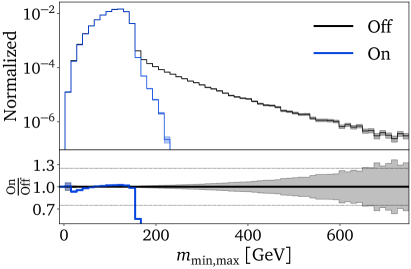
Experimental results
Research questions
- RQ1Can a generative model learn to produce accurate off-shell event configurations from on-shell events without degrading on-shell feature precision?
- RQ2How can classifier reweighting improve the accuracy of off-shell kinematic distributions, especially in high-sensitivity regions like resonance tails?
- RQ3To what extent can a small, low-complexity diffusion network achieve sub-10% relative error in off-shell phase space while preserving on-shell peak accuracy?
- RQ4Can Bayesian uncertainty estimation in the diffusion model provide reliable, conservative error bounds for extrapolated regions?
- RQ5Is the proposed method scalable and composable for inclusion in standard event generators for future HL-LHC analyses?
Key findings
- The DiDi model reproduces on-shell features with relative error below 5%, confirming high fidelity to the original on-shell phase space.
- Off-shell kinematic distributions, including $m_{\bar{l}b}$ and $p_{T,\bar{b}}$, are reproduced within 10% relative error across the full phase space, with uncertainties consistent with training data.
- Classifier reweighting reduces precision errors to the few percent level, particularly improving performance in the tails and resonance regions.
- The Bayesian extension of DiDi provides conservative uncertainty estimates that track statistical limitations of the training data, enabling reliable uncertainty quantification.
- The method achieves high performance with limited training data and a small network, demonstrating feasibility for real-world LHC simulation pipelines.
- The model is compatible with LHE format and can be directly integrated into event generators like MadGraph, enabling plug-and-play use in future analyses.
Read this paper
Open the full text in the Nubint reader and ask about any passage as you read.
Read this paper on NubintThis review was generated by AI from the original paper. Please check the paper before citing it.