
[Paper Review] KITE: Keypoint-Conditioned Policies for Semantic Manipulation
KITE is a two-stage framework for semantic manipulation that grounds natural language instructions in 2D image keypoints to enable precise, 6-DoF manipulation. By combining keypoint-based grounding with learned, keypoint-conditioned skills, KITE achieves 75%, 70%, and 71% success rates in real-world long-horizon manipulation, semantic grasping, and coffee-making tasks, outperforming end-to-end and VLM-based baselines with significantly less demonstration data.
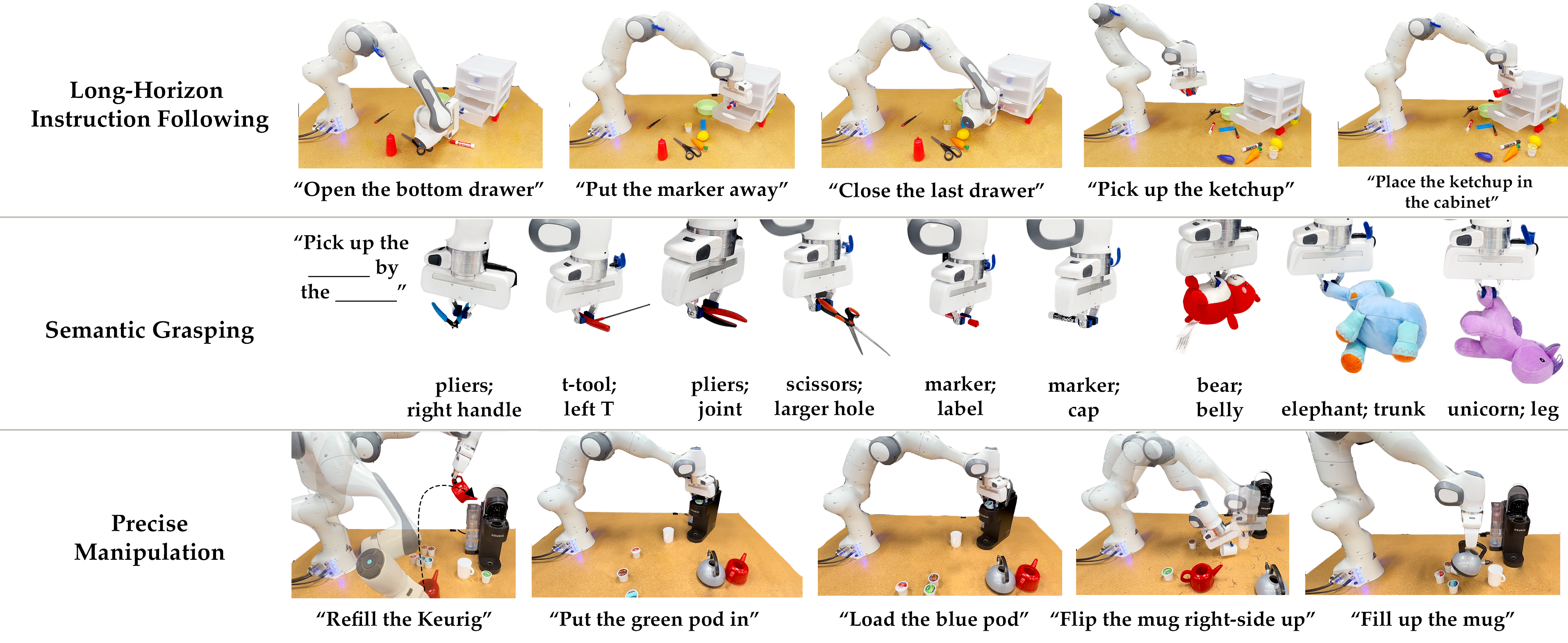
While natural language offers a convenient shared interface for humans and robots, enabling robots to interpret and follow language commands remains a longstanding challenge in manipulation. A crucial step to realizing a performant instruction-following robot is achieving semantic manipulation, where a robot interprets language at different specificities, from high-level instructions like "Pick up the stuffed animal" to more detailed inputs like "Grab the left ear of the elephant." To tackle this, we propose Keypoints + Instructions to Execution (KITE), a two-step framework for semantic manipulation which attends to both scene semantics (distinguishing between different objects in a visual scene) and object semantics (precisely localizing different parts within an object instance). KITE first grounds an input instruction in a visual scene through 2D image keypoints, providing a highly accurate object-centric bias for downstream action inference. Provided an RGB-D scene observation, KITE then executes a learned keypoint-conditioned skill to carry out the instruction. The combined precision of keypoints and parameterized skills enables fine-grained manipulation with generalization to scene and object variations. Empirically, we demonstrate KITE in 3 real-world environments: long-horizon 6-DoF tabletop manipulation, semantic grasping, and a high-precision coffee-making task. In these settings, KITE achieves a 75%, 70%, and 71% overall success rate for instruction-following, respectively. KITE outperforms frameworks that opt for pre-trained visual language models over keypoint-based grounding, or omit skills in favor of end-to-end visuomotor control, all while being trained from fewer or comparable amounts of demonstrations. Supplementary material, datasets, code, and videos can be found on our website: http://tinyurl.com/kite-site.
Motivation & Objective
- To enable robots to interpret and execute natural language instructions with fine-grained semantic awareness at both scene and object levels.
- To address the challenge of semantic manipulation—interpreting instructions ranging from high-level commands to part-specific actions—using a structured, object-centric representation.
- To reduce data requirements for training while maintaining high performance in complex, long-horizon manipulation tasks.
- To bridge the gap between coarse visual-language grounding and fine-grained 6-DoF action execution through a decoupled keypoint-conditioned policy framework.
Proposed method
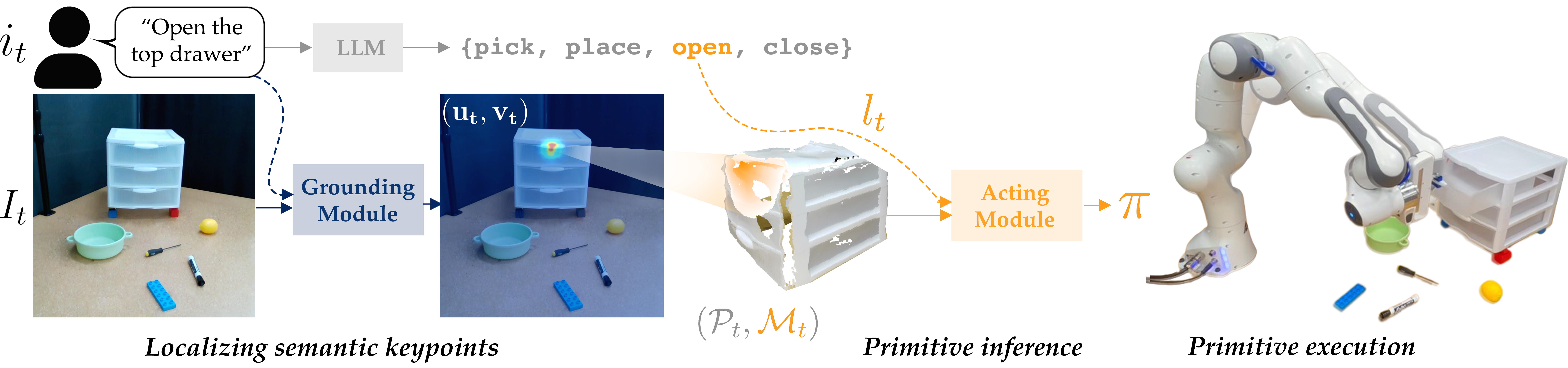
- KITE uses a grounding policy that maps RGB-D observations and language instructions to 2D task-relevant keypoints on objects, providing precise spatial supervision.
- The framework employs a library of parameterized, keypoint-conditioned skills that generate 6-DoF actions based on the predicted keypoints.
- Keypoints serve as a shared, interpretable representation that links language semantics to both scene-level (object identity) and object-level (part-specific) semantics.
- The system is trained from fewer than 50 demonstrations per skill and a few hundred annotated examples for the grounding model, enabling data-efficient learning.
- Keypoint predictions are used to condition low-level control policies, enabling precise manipulation such as reorienting mugs or inserting coffee pods.
- The framework operates in an open-loop manner using waypoint-based skills, with potential for future extension to closed-loop feedback.
Experimental results
Research questions
- RQ1Can a keypoint-based grounding mechanism improve the accuracy and generalization of language-based manipulation in complex, real-world environments?
- RQ2How does combining keypoint-conditioned skills with language grounding affect performance in long-horizon and fine-grained manipulation tasks?
- RQ3To what extent can KITE reduce data requirements compared to end-to-end visuomotor policies while maintaining high success rates?
- RQ4How do keypoint-based representations compare to bounding boxes or segmentation masks in enabling object-part-level semantic manipulation?
Key findings
- KITE achieved a 75% success rate in long-horizon 6-DoF tabletop manipulation, outperforming baselines that rely on pre-trained visual language models or end-to-end control.
- In semantic grasping, KITE achieved a 70% success rate across seen and unseen instances, with only 4 out of 13 failures due to grounding errors, indicating high robustness.
- For high-precision coffee-making, KITE achieved 67–75% success across four fine-grained skills, with failures primarily due to low-level control errors rather than misgrounding.
- KITE’s grounding module generalizes well to unseen object instances and variations in language phrasing, with the majority of failures stemming from symmetry errors rather than incorrect keypoint detection.
- The framework requires significantly fewer demonstrations—less than 50 per skill—compared to end-to-end methods, demonstrating strong data efficiency.
- KITE’s performance is robust across diverse object categories, including rigid tools, deformable objects, and articulated items, with consistent success across all categories.
Read this paper
Open the full text in the Nubint reader and ask about any passage as you read.
Read this paper on NubintThis review was generated by AI from the original paper. Please check the paper before citing it.