
[Paper Review] Knowledge AI: Fine-tuning NLP Models for Facilitating Scientific Knowledge Extraction and Understanding
This paper introduces Knowledge AI, a fine-tuned LLM framework that enhances scientific knowledge extraction and understanding across four NLP tasks—summarization, text generation, question answering, and named entity recognition. By fine-tuning models like BART, BERT, SciBERT, and distilGPT-2 on domain-specific scientific datasets, the framework significantly improves performance, especially in low-data regimes and for non-expert users, demonstrating that domain-adapted LLMs can effectively bridge the accessibility gap in scientific communication.
This project investigates the efficacy of Large Language Models (LLMs) in understanding and extracting scientific knowledge across specific domains and to create a deep learning framework: Knowledge AI. As a part of this framework, we employ pre-trained models and fine-tune them on datasets in the scientific domain. The models are adapted for four key Natural Language Processing (NLP) tasks: summarization, text generation, question answering, and named entity recognition. Our results indicate that domain-specific fine-tuning significantly enhances model performance in each of these tasks, thereby improving their applicability for scientific contexts. This adaptation enables non-experts to efficiently query and extract information within targeted scientific fields, demonstrating the potential of fine-tuned LLMs as a tool for knowledge discovery in the sciences.
Motivation & Objective
- Address the gap in accessible scientific knowledge dissemination by creating a unified AI framework for non-experts.
- Improve the performance of LLMs in scientific NLP tasks through domain-specific fine-tuning.
- Evaluate the effectiveness of parameter-efficient fine-tuning (LoRA) versus full fine-tuning in scientific text generation.
- Investigate the impact of data size and class imbalance on named entity recognition in scientific texts.
- Demonstrate that fine-tuned LLMs can enable accurate, interpretable, and accessible scientific knowledge extraction for general audiences.
Proposed method
- Fine-tune sequence-to-sequence models (BART, LED) for scientific text summarization using adaptive tokenization and dynamic sampling.
- Apply Low-Rank Adaptation (LoRA) to distilGPT-2 for efficient text generation, comparing full fine-tuning and PEFT approaches.
- Fine-tune BERT and SciBERT for extractive and abstractive question answering on SQuAD and PubMedQA datasets using prompt-based and encoder-decoder architectures.
- Train BERT, SciBERT, and SciDeBERTa on progressively complex scientific NER datasets (CoNLL2003, SciERC, GENIA) with post-processing for result interpretability.
- Use Hugging Face libraries for model training, evaluation, and deployment, with code publicly available on the Georgia Tech GitHub.
- Optimize training efficiency through multi-core processing, strategic data sampling, and hardware-aware computation to mitigate transformer model complexity.
Experimental results
Research questions
- RQ1How does domain-specific fine-tuning affect the performance of LLMs in summarizing scientific papers?
- RQ2To what extent does LoRA-based parameter-efficient fine-tuning match the performance of full fine-tuning in scientific text generation?
- RQ3How do pre-trained models like SciBERT and BERT perform in extractive and abstractive question-answering tasks on scientific datasets?
- RQ4What is the impact of dataset size and class imbalance on named entity recognition performance in scientific texts?
- RQ5Can fine-tuned LLMs effectively extract and present scientific knowledge in a way that is accessible to non-experts?
Key findings
- Fine-tuned BART and LED models significantly outperform baseline models in summarizing scientific papers, with BART producing concise summaries and LED handling longer, more comprehensive content.
- Full fine-tuning achieved higher ROUGE scores than LoRA-based PEFT in text generation, though LoRA offered substantial computational savings and remained effective for resource-constrained settings.
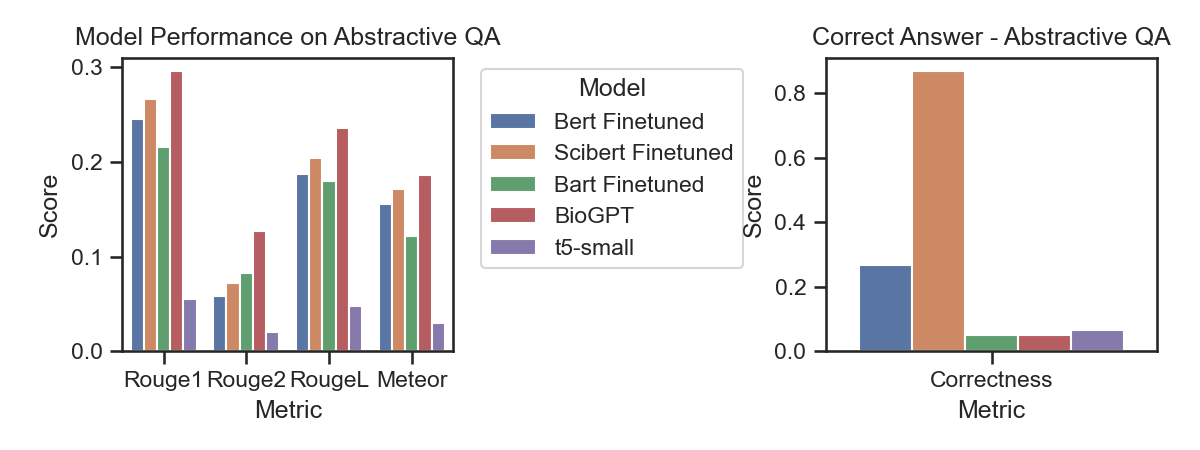
- Domain-pretrained models like SciBERT showed superior performance in few-shot extractive QA, while FLAN-T5 demonstrated strong generative QA capabilities.
- In abstractive QA, SciBERT's full transformer architecture enabled direct, coherent answer generation, indicating strong internal reasoning and generation capacity.
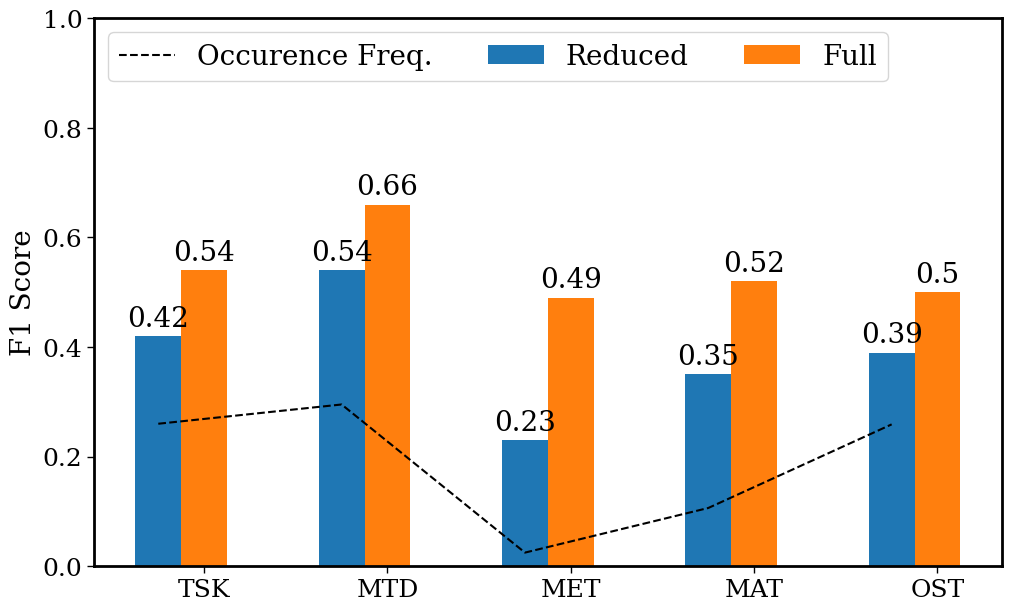
- For NER, domain-specific pre-training provided a significant advantage in low-data regimes, but general BERT models approached similar performance as dataset size increased, reducing the impact of class imbalance.
- The framework successfully enables non-experts to query and extract scientific knowledge effectively, validating the potential of fine-tuned LLMs as tools for scientific knowledge discovery and dissemination.
Read this paper
Open the full text in the Nubint reader and ask about any passage as you read.
Read this paper on NubintThis review was generated by AI from the original paper. Please check the paper before citing it.