
[Paper Review] Knowledge Card: Filling LLMs' Knowledge Gaps with Plug-in Specialized Language Models
Knowledge Card proposes a modular framework to dynamically inject up-to-date, domain-specific knowledge into black-box large language models (LLMs) via plug-in specialized language models called 'knowledge cards.' By using three content selectors for relevance, brevity, and factuality, and two integration strategies—bottom-up and top-down—it achieves state-of-the-art performance, improving Codex by 6.6% on MMLU and outperforming larger models like Flan-PaLM.
By design, large language models (LLMs) are static general-purpose models, expensive to retrain or update frequently. As they are increasingly adopted for knowledge-intensive tasks, it becomes evident that these design choices lead to failures to generate factual, relevant, and up-to-date knowledge. To this end, we propose Knowledge Card, a modular framework to plug in new factual and relevant knowledge into general-purpose LLMs. We first introduce knowledge cards -- specialized language models trained on corpora from specific domains and sources. Knowledge cards serve as parametric repositories that are selected at inference time to generate background knowledge for the base LLM. We then propose three content selectors to dynamically select and retain information in documents generated by knowledge cards, specifically controlling for relevance, brevity, and factuality of outputs. Finally, we propose two complementary integration approaches to augment the base LLM with the (relevant, factual) knowledge curated from the specialized LMs. Through extensive experiments, we demonstrate that Knowledge Card achieves state-of-the-art performance on six benchmark datasets. Ultimately, Knowledge Card framework enables dynamic synthesis and updates of knowledge from diverse domains. Its modularity will ensure that relevant knowledge can be continuously updated through the collective efforts of the research community.
Motivation & Objective
- To address the limitations of static, general-purpose LLMs in generating factual, up-to-date, and domain-specific knowledge.
- To enable modular and collaborative knowledge integration from diverse, specialized sources without retraining the base LLM.
- To support continuous knowledge updates through community-driven contributions of domain-specific language models.
- To overcome the static nature of LLMs and reduce hallucinations in knowledge-intensive tasks.
Proposed method
- Knowledge cards are specialized language models fine-tuned on domain-specific corpora to serve as parametric, modular knowledge repositories.
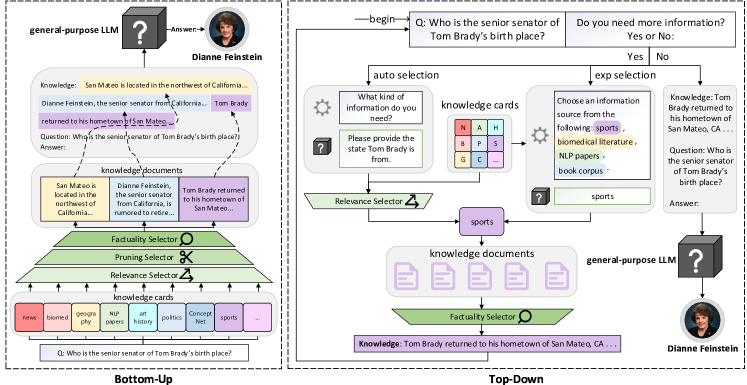
- Three content selectors—relevance, pruning (brevity), and factuality—are applied to filter and refine knowledge outputs from knowledge cards.
- The bottom-up approach prompts all knowledge cards to generate documents, which are then filtered and concatenated with the query before LLM inference.
- The top-down approach uses the base LLM to decide whether external knowledge is needed, then dynamically selects and activates relevant knowledge cards based on query context.
- Two integration modes are supported: automatic selection via LLM reasoning or explicit user-specified source selection.
- The framework supports plug-and-play updates and enables collaborative knowledge contributions from domain experts and researchers.
Experimental results
Research questions
- RQ1Can specialized, domain-specific language models effectively fill factual knowledge gaps in general-purpose LLMs without retraining?
- RQ2How can relevance, brevity, and factuality of external knowledge be dynamically controlled during inference?
- RQ3Can modular knowledge injection outperform retrieval-augmented and generated prompting baselines in knowledge-intensive tasks?
- RQ4How does the framework support continuous, community-driven updates to LLM knowledge?
- RQ5What is the impact of dynamic, selective knowledge retrieval on hallucination and factual consistency?
Key findings
- Knowledge Card improves performance by 6.6% on the MMLU benchmark compared to the base Codex model, outperforming even larger models like Flan-PaLM.
- On misinformation classification, Knowledge Card achieves at least 15.8% higher balanced accuracy than baselines in two-way classification and 10.0% in four-way classification.
- The top-down approach with automatic selection achieves high precision in knowledge source selection, with YAGO and Wikipedia being the most frequently selected knowledge cards across 57 MMLU sub-tasks.
- Factuality scores vary across knowledge cards, with distributions indicating that some domains (e.g., biomedical) yield more reliable outputs than others.
- The bottom-up approach enables multi-domain knowledge synthesis but carries a risk of injecting irrelevant information when external knowledge is unnecessary.
- Extensive ablation shows that all three content selectors (relevance, pruning, factuality) contribute significantly to output quality, with factuality being the most impactful.
Read this paper
Open the full text in the Nubint reader and ask about any passage as you read.
Read this paper on NubintThis review was generated by AI from the original paper. Please check the paper before citing it.