
[Paper Review] Knowledge Editing for Large Language Models: A Survey
This survey provides a comprehensive overview of Knowledge Editing for Large Language Models (KME), proposing a unified formulation of KME as a constrained optimization problem to enable precise, efficient, and knowledge-preserving updates. It introduces a novel taxonomy of KME techniques based on knowledge injection mechanisms, analyzes key methods, evaluates metrics and datasets, and identifies critical challenges and future directions for robust, continual, and fair editing in LLMs.
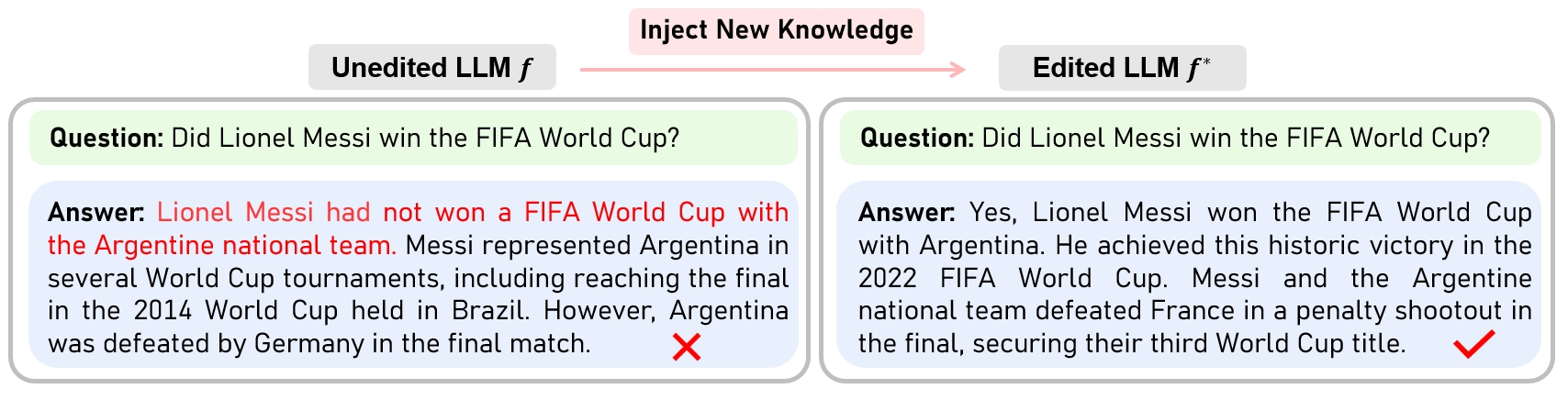
Large language models (LLMs) have recently transformed both the academic and industrial landscapes due to their remarkable capacity to understand, analyze, and generate texts based on their vast knowledge and reasoning ability. Nevertheless, one major drawback of LLMs is their substantial computational cost for pre-training due to their unprecedented amounts of parameters. The disadvantage is exacerbated when new knowledge frequently needs to be introduced into the pre-trained model. Therefore, it is imperative to develop effective and efficient techniques to update pre-trained LLMs. Traditional methods encode new knowledge in pre-trained LLMs through direct fine-tuning. However, naively re-training LLMs can be computationally intensive and risks degenerating valuable pre-trained knowledge irrelevant to the update in the model. Recently, Knowledge-based Model Editing (KME) has attracted increasing attention, which aims to precisely modify the LLMs to incorporate specific knowledge, without negatively influencing other irrelevant knowledge. In this survey, we aim to provide a comprehensive and in-depth overview of recent advances in the field of KME. We first introduce a general formulation of KME to encompass different KME strategies. Afterward, we provide an innovative taxonomy of KME techniques based on how the new knowledge is introduced into pre-trained LLMs, and investigate existing KME strategies while analyzing key insights, advantages, and limitations of methods from each category. Moreover, representative metrics, datasets, and applications of KME are introduced accordingly. Finally, we provide an in-depth analysis regarding the practicality and remaining challenges of KME and suggest promising research directions for further advancement in this field.
Motivation & Objective
- To address the high computational cost and knowledge degradation risks of fine-tuning LLMs when updating with new knowledge.
- To identify the limitations of traditional fine-tuning, including parameter overwriting, catastrophic forgetting, and high resource demands.
- To provide a systematic taxonomy of KME techniques based on how new knowledge is injected into pre-trained models.
- To evaluate existing KME methods using standardized metrics, datasets, and real-world applications.
- To identify open challenges in continual editing, adversarial robustness, and fairness, and to suggest future research directions.
Proposed method
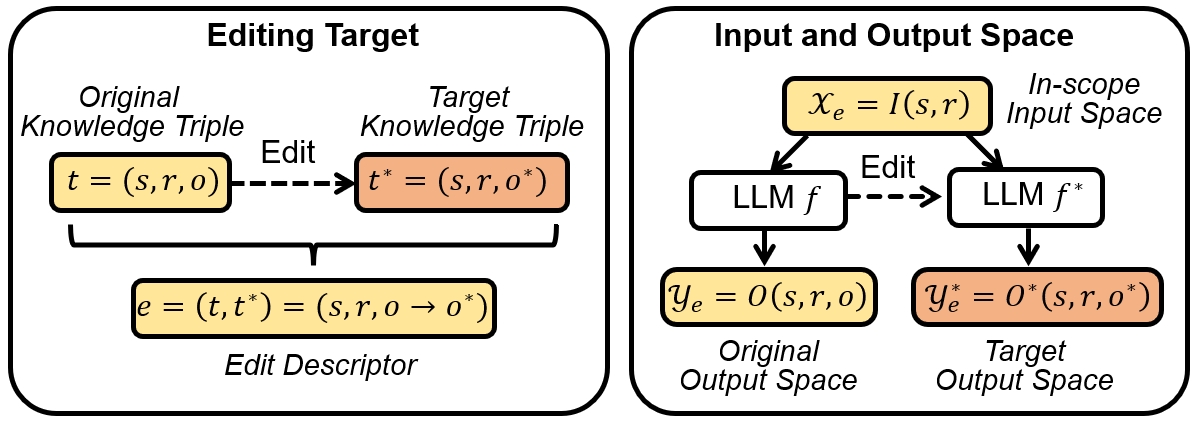
- Formulate KME as a constrained optimization problem that balances accuracy on new knowledge and retention of pre-existing knowledge.
- Categorize KME methods into two main types: (1) parameter update-based editing (e.g., updating attention heads or MLP layers), and (2) auxiliary network-based editing (e.g., using retrieval-augmented or adapter modules).
- Introduce a structured taxonomy based on knowledge injection mechanisms: parameter-based editing, retrieval-augmented editing, and adapter-based editing.
- Propose evaluation metrics such as edit success rate, knowledge retention, and edit specificity to assess KME performance.
- Highlight the use of specialized datasets like HELM, MMLU, and custom knowledge injection benchmarks for training and evaluation.
- Integrate loss functions that penalize deviations from original model behavior on unmodified facts to ensure knowledge preservation.
Experimental results
Research questions
- RQ1How can KME techniques be systematically categorized based on their knowledge injection mechanisms?
- RQ2What are the key trade-offs between edit accuracy, knowledge retention, and computational efficiency across different KME methods?
- RQ3How do existing KME techniques perform under continual editing scenarios where multiple edits are applied sequentially?
- RQ4To what extent can KME techniques enhance model robustness against adversarial edits and misinformation?
- RQ5Can KME be effectively leveraged to mitigate bias and improve fairness in pre-trained LLMs?
Key findings
- KME techniques significantly reduce computational cost compared to full fine-tuning by modifying only a subset of model parameters or injecting lightweight modules.
- Parameter-based editing methods like those modifying attention heads or MLP layers show high edit success rates but risk knowledge forgetting if not carefully regularized.
- Auxiliary network-based approaches, such as retrieval-augmented or adapter-based editing, achieve better knowledge retention and are more modular, but may introduce inference latency.
- Evaluation metrics such as edit success rate and retention accuracy are essential for quantifying KME performance, with state-of-the-art methods achieving over 90% success on standard benchmarks.
- Continual editing remains a major challenge, as successive edits can lead to interference and forgetting of prior edits, especially in non-orthogonal edit spaces.
- Robustness and fairness are emerging as critical concerns, with KME showing promise in mitigating bias and resisting adversarial edits when combined with constrained optimization and verification mechanisms.
Read this paper
Open the full text in the Nubint reader and ask about any passage as you read.
Read this paper on NubintThis review was generated by AI from the original paper. Please check the paper before citing it.