
[Paper Review] Knowledge-guided Machine Learning: Current Trends and Future Prospects
A survey of KGML, outlining how scientific knowledge and data can be integrated in ML to improve generalizability, consistency, and explainability, with a three-dimensional categorization and exploration of methods and use-cases.
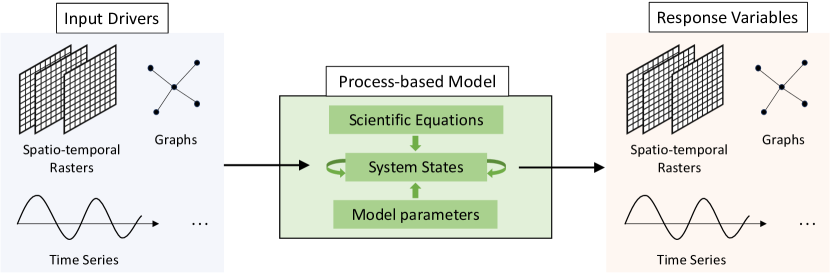
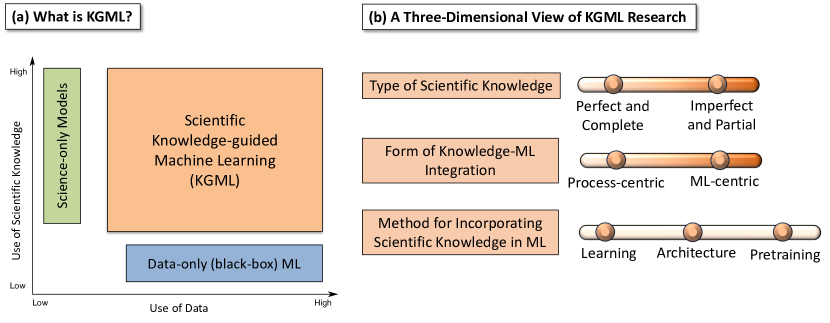
This paper presents an overview of scientific modeling and discusses the complementary strengths and weaknesses of ML methods for scientific modeling in comparison to process-based models. It also provides an introduction to the current state of research in the emerging field of scientific knowledge-guided machine learning (KGML) that aims to use both scientific knowledge and data in ML frameworks to achieve better generalizability, scientific consistency, and explainability of results. We discuss different facets of KGML research in terms of the type of scientific knowledge used, the form of knowledge-ML integration explored, and the method for incorporating scientific knowledge in ML. We also discuss some of the common categories of use cases in environmental sciences where KGML methods are being developed, using illustrative examples in each category.
Motivation & Objective
- Introduce the field of scientific modeling and KGML.
- Compare process-based models with ML approaches and discuss their complementarities.
- Present a three-dimensional KGML framework (knowledge type, integration form, incorporation method).
- Describe major KGML methods and use-cases in environmental sciences.
- Highlight future directions and opportunities, including foundation models in environmental science.
Proposed method
- Describe the strengths and weaknesses of process-based vs. ML models for scientific modeling.
- Propose a three-dimensional KGML taxonomy: type of knowledge, form of integration, and method of incorporation.
- Summarize three primary KGML integration methods: knowledge-guided learning, architecture, and pretraining/initialization.
- Provide illustrative examples and reference key KGML works (e.g., PGNN, PINNs, PGRNN, PGA-LSTM).
- Discuss use-cases in forward modeling, inverse modeling, generative modeling, and downscaling.
- Highlight opportunities such as foundation models and future research directions.
Experimental results
Research questions
- RQ1What are the types of scientific knowledge used in KGML and how do partial vs. complete knowledge affect modeling?
- RQ2What forms of knowledge-ML integration exist and how do they differ (ML-centric vs. process-centric)?
- RQ3What methods are used to incorporate scientific knowledge into ML models (learning, architecture, pretraining)?
- RQ4What are the major KGML use-cases in environmental sciences and what opportunities exist for future research?
- RQ5How can KGML contribute to foundation models in environmental science?
Key findings
- KGML combines scientific knowledge with data to improve generalizability and scientific consistency compared to black-box ML.
- KGML can be categorized along three dimensions: type of knowledge, form of knowledge-ML integration, and method of incorporation.
- There are three primary incorporation methods: knowledge-guided learning (loss functions), knowledge-guided architectures, and knowledge-guided pretraining/initialization.
- Examples of KGML methods include PINNs, PGNNs, PGRNN, PGA-LSTM, and subgrid parameterization, illustrating ML-centric and process-centric approaches.
- KGML use-cases span forward modeling, inverse modeling, generative modeling, and downscaling in environmental sciences.
- The field is progressing toward foundation models in environmental science, signaling opportunities for broad, transferable knowledge.
Read this paper
Open the full text in the Nubint reader and ask about any passage as you read.
Read this paper on NubintThis review was generated by AI from the original paper. Please check the paper before citing it.